


Ripple's Largest DAT Goes Public: Can XRPN Become the Next MSTR?

Original | Odaily (@OdailyChina)
Author | Wenser (@wenser 2010)

In October, the Ripple ecosystem reached another milestone—Evernorth, the largest DAT treasury company, completed its merger and listing, officially debuting on Nasdaq.
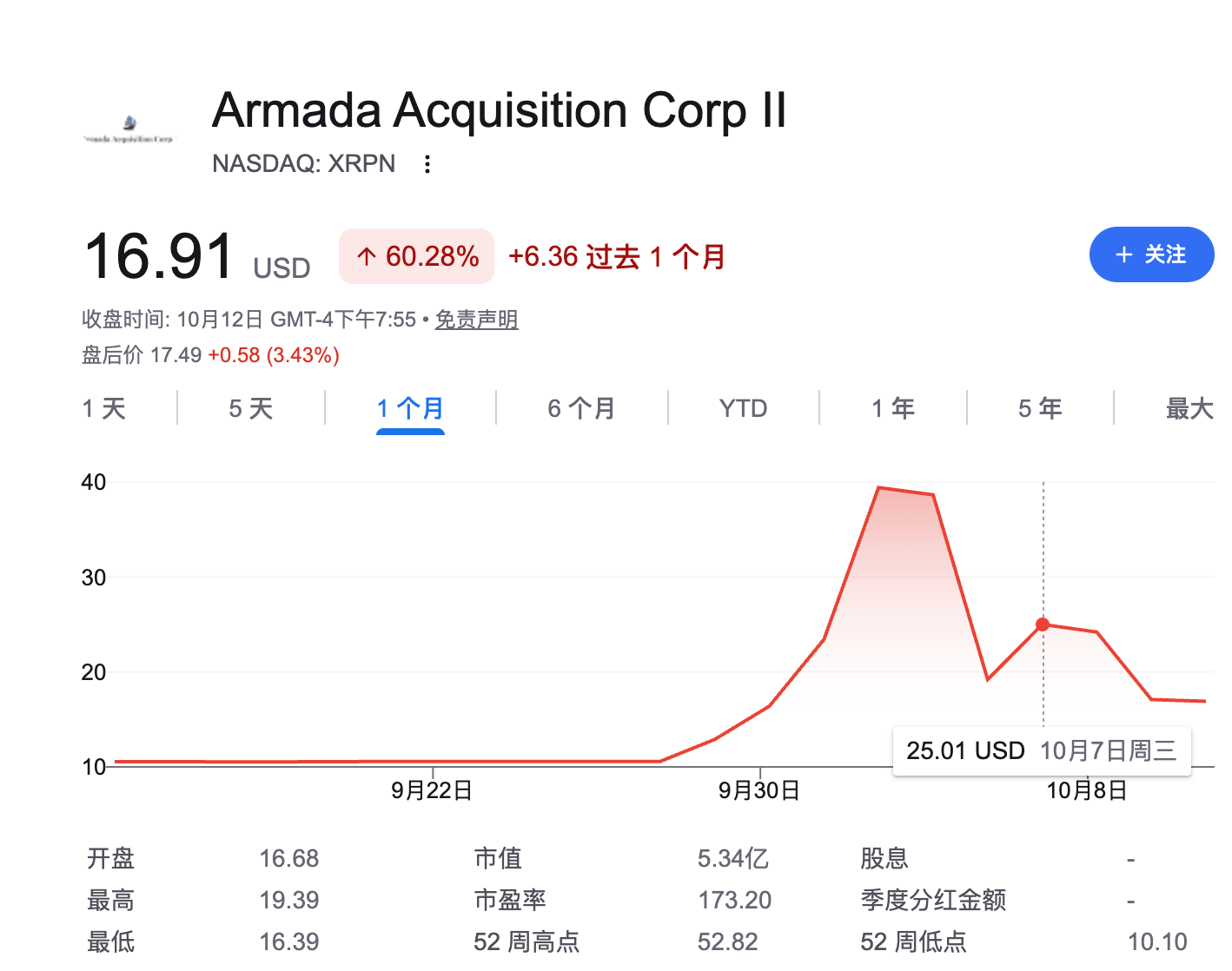
On October 9, Evernorth completed its business combination with SPAC company Armada Acquisition Corp. II, bringing approximately 473 million XRP and $300 million in cash proceeds into the public market. On October 12, Evernorth began trading on Nasdaq under the ticker XRPN, rising over 15% at the open before pulling back to close at $16.9. Over the past month, Evernorth's stock price climbed as high as $53, a peak gain of nearly 4x.
As a key channel connecting to traditional capital markets, can XRPN transform the XRP treasury narrative into a long-term gateway for institutional capital? The real test has only just begun.
XRPN Targets Wall Street Liquidity, Aiming to Become the Next "MSTR"
As the primary driver behind this nearly $1 billion merger, Evernorth is founded and led by former Ripple executive Asheesh Birla as Founder and CEO, with investors including Ripple, SBI Group, Arrington Capital, Pantera, Kraken, GSR, and others.
Among them, SBI Group and Arrington Capital hold significant voting power, particularly the former, which as a long-time supporter of the XRP ecosystem has consistently been active in the crypto market. Additionally, Japan's crypto market support for XRP is well-documented, with XRP's trading volume and ecosystem activity in the region once trailing only BTC and ETH. With that background established, let's discuss XRPN's year-long "long road to birth."
Formative Period: $1 Billion Fundraise, Backdoor Listing
Last October, Ripple-backed crypto company Evernorth announced it would list on Nasdaq through a merger with Armada Acquisition Corp II (AACI.O), expecting to raise over $1 billion, including a $200 million investment from SBI, along with joint contributions from Ripple, Rippleworks, Pantera Capital, Kraken, GSR, and other leading digital asset and fintech institutions and investors. Ripple co-founder Chris Larsen also participated in the investment.
The company plans to become the largest XRP treasury and the U.S.-listed company holding the most XRP. The transaction was expected to close in Q1 2026.
Following the "DAT boom" in the crypto market since last June, Evernorth—an XRP treasury company with official backing—had mapped out its "route" and channels into traditional financial markets from the start. But after the crypto market experienced the "October 11 epic crash," the DAT model faced intense scrutiny, and the merger originally planned for Q1 2026 was repeatedly delayed.
It's worth noting that at the time, Evernorth's XRP holdings had already grown to 389 million tokens, valued at over $1 billion at a price of $2.6 per token, with unrealized gains exceeding $50 million.
Period of Strain: Holdings Grow to Over 470 Million Tokens, Asset Impairment Reaches $233 Million
The good times didn't last. As the broader crypto market declined, XRP couldn't escape unscathed, and the treasury company became part of the domino effect.
In March of this year, Evernorth Holdings disclosed in its S-4 filing related to the SPAC listing that its digital assets suffered approximately $233.7 million in impairment in 2025, primarily due to the difference between acquisition cost and market price during the reporting period.
The filing showed that as of the end of 2025, Evernorth and Pathfinder Digital Assets (a wholly-owned subsidiary of Ripple Labs, Inc. and Evernorth's core operator) collectively held approximately 473.1 million XRP, of which the company purchased 84.4 million XRP for approximately $214.1 million at an average cost of about $2.54 per token, while XRP's price at the time had dropped to approximately $1.45, a decline of about 35% from cost.
Evernorth stated it plans to introduce the RLUSD stablecoin into XRP ecosystem DeFi transactions, including building RLUSD/XRP liquidity pools, while enhancing asset yields through lending XRP, providing AMM liquidity, and options strategies (such as covered calls and cash-secured puts). It's evident that the XRP treasury company's operational approach differs from passive yield-oriented DAT companies like Strategy and Bitmine from the very beginning.
Final Chapter: 470 Million XRP and $300 Million in Cash in Hand
By September of this year, according to an 8-K filing with the U.S. SEC, XRP treasury company Evernorth Holdings signed a bond purchase agreement with NH Investment & Securities to issue convertible senior notes to an investment trust it represents, raising $30 million. The notes bear interest paid in kind (PIK), which can be added to the bond principal. The proceeds are intended for general corporate purposes, including purchasing XRP and conducting XRP ecosystem-related business. The bond issuance is contingent upon Evernorth completing its business combination with SPAC Armada Acquisition Corp. II, and was expected to close alongside the merger in Q4 2026.
After nearly a year of lengthy waiting, with relatively ample liquidity and a sizable XRP position, Evernorth's merger with Armada Acquisition Corp II finally reached its conclusion. After officially completing the merger on October 9, XRPN officially launched and began trading on Nasdaq on October 12 Eastern Time.
The combined company remains named Evernorth Holdings Inc, positioned as an "actively managed treasury," planning to enhance "XRP per share" value through lending, liquidity provision, DeFi strategies, and XRPL infrastructure investments, benchmarking against BTC DAT company Strategy.
As of press time, XRPN's after-hours price stood at $16.9, with a decline of 56.65% over the past 5 days. To some extent, the DAT treasury origins determine that XRPN still cannot escape the market pattern of boom and bust.
Opening the Door to Traditional Financial Markets with a Capital Story, Rebuilding RWA Assets and Ecosystem Channels
Like a trail of clues leading far into the distance, XRPN's birth cannot be viewed merely as an independent DAT company. What it carries may be the ambition of the XRP ecosystem, Ripple, and many others to create the next "Strategy-style miracle."
XRP Trends from ETF Data: Ripple Not Satisfied with a Single Capital Channel
According to SoSoValue data, during last week's trading days (October 5 to October 9, Eastern Time), XRP spot ETFs saw net inflows of $11.3068 million. Among them: the XRP spot ETF with the largest weekly net inflow was Bitwise ETF XRP, with weekly net inflows of $10.5514 million, bringing its total historical net inflow to $688 million; followed by Franklin Templeton's ETF XRPZ, with weekly net inflows of $4.0962 million, bringing its total historical net inflow to $509 million.
The XRP spot ETF with the largest weekly net outflow was Canary ETF XRPC, with weekly net outflows of $3.3407 million, bringing its total historical net inflow to $487 million.
As of press time, XRP spot ETFs have total net asset value of $1.57 billion, with an ETF net asset ratio (market cap as a percentage of XRP's total market cap) of 1.80%, and cumulative historical net inflows of $1.80 billion.
While the data appears impressive, a weekly inflow of just over $10 million and total assets under $2 billion are merely a drop in the ocean for traditional financial markets that routinely handle hundreds of billions or trillions of dollars. To achieve broader liquidity participation and attract traditional financial industry attention, XRPN's continued development is indispensable.
XRPN's Long-tail Value: New Exposure, New Integration, New Model
After the company's merger and listing, XRPN's main value will be reflected in the following aspects:
First, it provides stock-form XRP asset exposure for institutions such as pension funds, RIAs, and corporate treasuries that cannot directly hold crypto assets;
Second, the company will further promote deep integration between crypto assets and TradFi markets. XRPN can serve as a capital bridge, supporting tokenized securities, on-chain credit, and complementing stablecoin and RWA trends. This is also the potential benefit of XRPN choosing an "actively managed model" to create ecosystem value;
Finally, as XRPN officials have mentioned, the company is committed to enhancing "XRP per share" value, just as Strategy is committed to enhancing "BTC per share" value. This will subsequently help XRP evolve from a payment tool and单一 cryptocurrency into broader institutional financial infrastructure. Just as Strategy has widely evangelized and continuously promoted BTC, XRPN will further expand XRP's global influence and capital reach.
Of course, XRPN's birth was primarily driven by Ripple executives and related institutions, and the actively managed DAT company operating model cannot guarantee that increased XRP holdings will necessarily drive up XRP token prices or trigger explosions in various markets and applications within the XRP ecosystem. Moreover, XRPN's related holdings mainly come from "contributions" by Ripple officials and related partners—bluntly put, it's just moving from one pocket to another. It appears to create a new asset class, increasing asset liquidity and transparency, but it also amplifies stock market volatility and risk. In the short term, it may be worth speculating on, but in the medium to long term, it still heavily depends on XRPN's actual operational efficiency and yield performance.
The stock market is sometimes like a magic mirror—whether it's a god or a demon, time will give the answer.