


BiyaPay Market Watch | U.S. Stocks Rise, Chip Stocks Pull Back — How Will This Week's CPI and TSMC Earnings Affect the Market?

Major U.S. stock indices closed higher last week, but AI chip stocks did not rally alongside them. Entering this week, pressure on tech stocks is persisting, and bank earnings, TSMC's results, and U.S. inflation data will all face market scrutiny in turn.
This is what makes the current market worth discussing. The index remains near its highs, yet the market has already begun re-evaluating the growth quality of different companies. Capital has not exited wholesale, but the demands placed on AI investment, profit realization, and financing costs have become noticeably more specific.
Last Week in Review: Indices Rise, Sector Divergence Widens
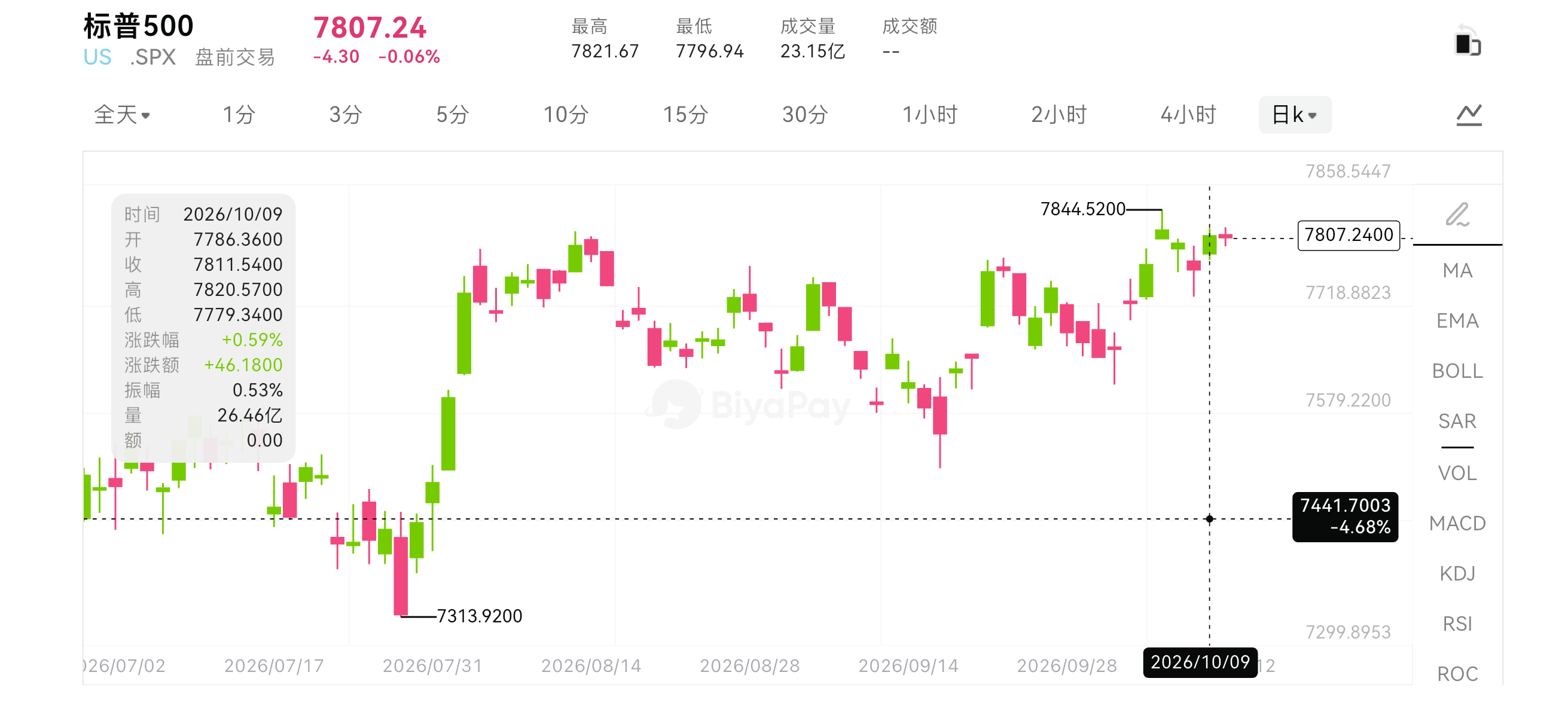
According to BiyaPay data, as of the close on October 9, the S&P 500 stood at 7,811.54, up about 1.2% for the week; the Dow Jones Industrial Average was at 51,654.95, up about 0.9%; and the Nasdaq was at 27,366.17, up about 0.6%. The Russell 2000, meanwhile, fell about 0.9%. Large-cap and small-cap stocks performed differently, indicating that gains in the indices cannot yet be equated with a synchronized recovery across the broader market.
Hong Kong stocks also saw a recovery. On October 9, the Hang Seng Index rose about 1.8%, closing near 24,211 points, up about 1% for the week; the Hang Seng Tech Index gained about 3.1% that day. The rebound in internet stocks provided support for Friday's market performance, but whether a single-day recovery can translate into a sustained rally still depends on subsequent sector performance and earnings expectations.
With indices rising but sectors clearly diverging, observing the market requires comparing different assets together. Take BiyaPay, a global one-stop asset allocation platform, which uses USDT as its core funding entry point and connects U.S. and Hong Kong stocks, cryptocurrencies, commodity futures, cross-border remittances, and other scenarios through a single account system. It also supports exchange among more than 30 fiat currencies and over 200 digital currencies, allowing users to participate in real stock trading for U.S. and Hong Kong equities with zero commission via USDT. For those who frequently follow multiple markets, the convenience of such a centralized entry point lies in the more seamless connection between market observation, currency exchange, trading, and subsequent use of funds.
AI Chips Under Pressure, Market Begins to Ask How Revenue Will Be Realized
Nvidia closed last week at $229.28, down about 2.00% for the week based on adjacent Friday closing prices; AMD closed at $608.10, down about 4.07%. On October 8, the two companies fell about 2.94% and 3.90% respectively, showing that AI-related stocks faced relatively concentrated pressure midweek.
An important backdrop to this pullback is the market re-examining the revenue scale of AI companies and how it is measured. According to reports, OpenAI disclosed to investors that its September annualized revenue was close to $50 billion, which differs from the widely circulated figure of about $70 billion. However, the report also noted that the discrepancy between the two figures involves how comparisons with other AI companies are calibrated. Therefore, it cannot simply be written as "OpenAI's revenue suddenly dropped by $20 billion"; annualized revenue is also not revenue already realized for the full year.
The impact of this on the market lies more in the need to recalculate growth expectations. Chip orders, cloud service contracts, and data center construction all ultimately require end-user demand to support them. If AI application revenue can continue to grow, infrastructure investment will have a clearer source of returns; if revenue is realized slower than expected, the market will further question customers' funding sources, compute utilization rates, and future purchasing capacity.
Therefore, the pullback in chip stocks is not enough to prove that AI demand has reversed, but it does show that capital markets are raising their standards for growth numbers. Order scale, contract value, and annualized revenue all need to correspond with actual deliveries, profits, and cash flow. This is especially true for highly valued companies, because their stock prices often already embed fairly optimistic growth expectations.
Energy and Utilities Strengthen, High Interest Rate Impact Has Not Disappeared
Last week's relative strength was not confined to the tech sector. Using sector ETFs as observation samples, the Energy Select Sector SPDR Fund (XLE) rose about 3.60% based on closing prices, while the Utilities Select Sector SPDR Fund (XLU) rose about 3.97%. This reflects the performance of the two ETFs and cannot directly substitute for the moves of all related companies.
Energy companies and utility companies also operate on different business logic. Rising oil prices may improve revenue for some upstream oil and gas companies, but they also increase costs for transportation, manufacturing, and consumer companies. The performance of utility companies needs to be analyzed in conjunction with demand, financing costs, and capital expenditure. The simultaneous strength of both asset classes suggests the market is seeking different sources of earnings support, and it cannot be concluded from this that capital has completed a unified "defensive rotation."
As of October 9, the U.S. 10-year Treasury yield was about 5.24%, and WTI crude oil futures settled at about $91.85 per barrel. These two variables still deserve attention: the former affects valuations and financing costs, while the latter affects corporate costs and inflation expectations. Even if stock indices rise, the constraints of high funding costs on operations and valuations will not disappear as a result.
Whether Hong Kong Stocks' Recovery Can Continue Depends on Sectors, Not Just the Hang Seng Index
The rebound in Hong Kong stocks last Friday continued to show divergence entering this week. On October 13, the Hang Seng Index closed up about 0.3%, while the Hang Seng Tech Index fell about 0.79%. Banking, real estate, and optical communications sectors rose, while semiconductor and memory-related stocks came under pressure, indicating that index performance and tech sector performance are not entirely consistent.
For Hong Kong tech companies, changes in the U.S. AI supply chain affect sentiment, but a company's revenue structure still determines its medium-term operating performance. For internet companies, it is necessary to watch advertising, e-commerce, cloud business, and returns on AI investment; for consumer electronics companies, end demand and orders matter; for semiconductor companies, it is also necessary to distinguish product types, capacity utilization, and price changes. The impact on different companies is difficult to explain uniformly with the phrase "tech stocks."

This Week's Focus: Inflation and Earnings Both Test Market Expectations
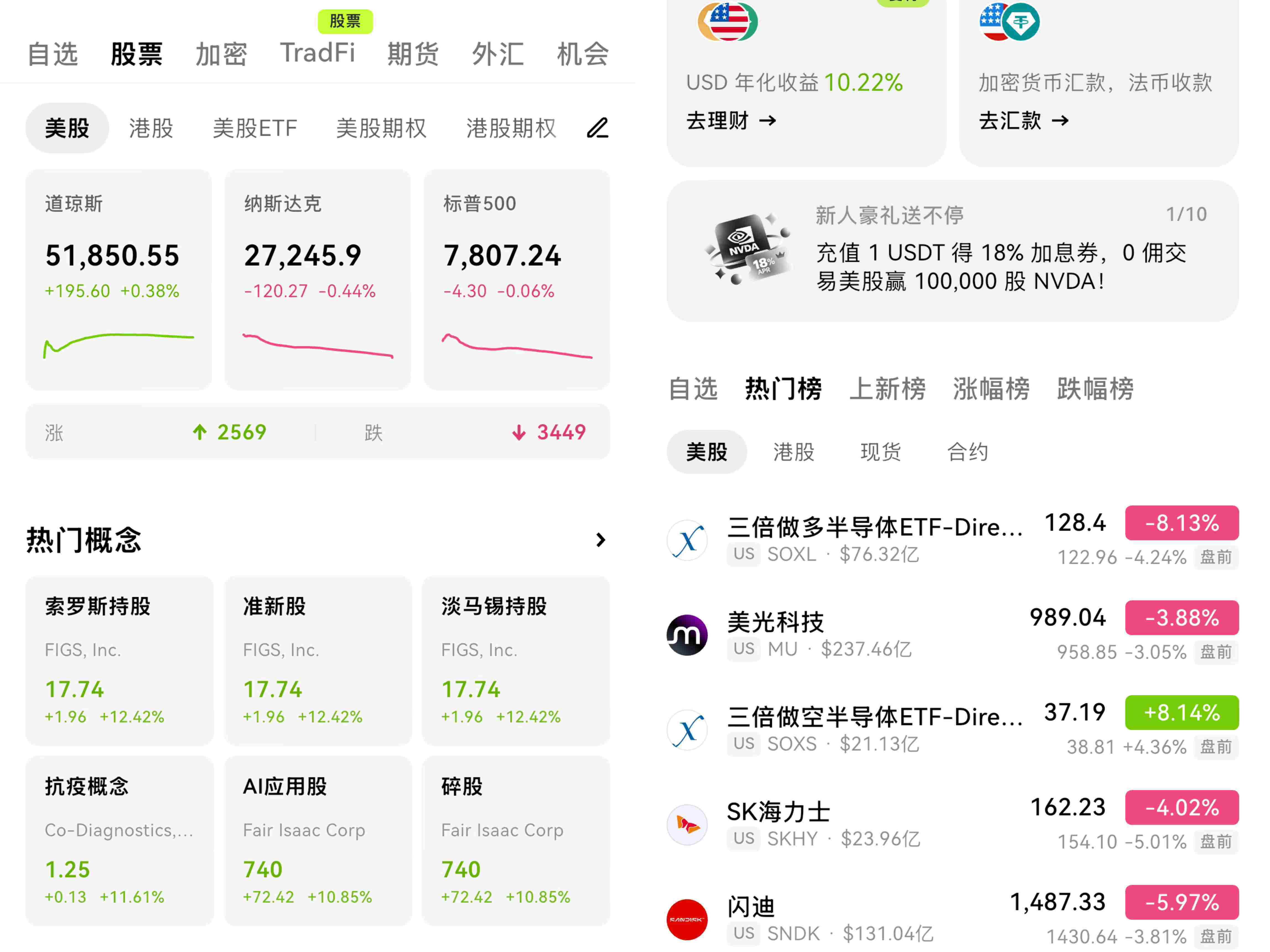
Monday's U.S. stock performance already reflected this divergence. On October 12, the Dow rose about 0.4%, the Nasdaq fell about 0.4%, and the S&P 500 closed slightly lower. Meta rose about 3.4%, while Nvidia, AMD, and Micron fell about 1.3%, 2.3%, and 3.9% respectively. There is no unified direction within tech stocks either, as chip pressure and strength in some platform companies can occur simultaneously.
CPI and Retail Sales Should Be Viewed Together
According to the official schedule, September CPI will be released on October 14, September PPI will be released on October 15, and September retail sales is also scheduled for release on October 15. All of the above data will be published at 8:30 a.m. Eastern Time, corresponding to 8:30 p.m. Beijing time on the same day.
CPI affects the market's judgment of consumer-side price pressure, PPI provides clues on producer-side costs, and retail sales helps observe the resilience of demand. The three sets of data need to be analyzed together. If prices rise while demand remains strong, the market may continue to raise expectations for how long high interest rates will persist; if consumption weakens while price pressure does not ease in tandem, companies could face the dual constraints of slower revenue growth and persistently high costs.
Retail sales especially requires attention to its measurement basis. It tracks nominal sales, and an increase in amount may come from volume or may be affected by price increases. To judge whether consumption is improving, it is necessary to further examine product categories and price changes. Stronger data does not necessarily bring only good news, and weaker data does not necessarily make stocks rise immediately; the key lies in how it changes interest rate and earnings expectations.
Bank Earnings: Look at Profitability, and Also Credit Quality
JPMorgan Chase and Goldman Sachs are both scheduled to release third-quarter results on October 13. As of the information cutoff for this article, the relevant results are still pending and cannot be written in advance as having exceeded or fallen short of expectations.
In bank earnings, besides earnings per share, the key points of observation also include net interest income, deposit costs, loan demand, and credit loss provisions. High interest rates may boost asset yields, but deposit competition and financing costs can also erode part of the returns. Trading, underwriting, and M&A businesses provide another set of clues about the level of capital market activity. Only by putting these indicators together can one judge whether profit growth comes from operational improvement or from a few businesses and one-off factors.
Banks are also a window for observing economic pressure. If consumer credit, delinquency, and bad debt data remain stable, the market will have more basis for judging demand resilience; if credit quality begins to deteriorate, then even if current-quarter profits are decent, the future impact on provisions and loan growth still needs to be considered.
TSMC and ASML Verify How AI Investment Is Transmitted
ASML plans to announce third-quarter results on October 14, and TSMC's third-quarter earnings call is scheduled for 2 p.m. Beijing time on October 15. The two companies operate in semiconductor equipment and wafer manufacturing respectively, and can provide supply chain information at different levels.
TSMC's already announced September revenue was about NT$511.857 billion, up 54.6% year over year and down 0.6% month over month; cumulative revenue for the first three quarters rose 41.1% year over year. This shows revenue is still growing rapidly, but the monthly revenue announcement does not include complete profit and cash flow information, so operating quality cannot be judged solely by revenue growth.
What deserves more attention in this week's earnings is gross margin, advanced process demand, capital expenditure, and next-quarter guidance. For ASML, it is necessary to judge in conjunction with new orders, order structure, and customer expansion plans. There is a time lag between equipment orders and current deliveries, and there is also a transmission distance between wafer manufacturing revenue and end-application revenue. What the two companies provide is supply chain evidence, not a unified answer for the entire AI market.
Last week's rise in the indices shows the market is still willing to pay a price for the growth of some companies; the pullback in chip stocks shows that this willingness increasingly depends on concrete evidence. This week's inflation data determines expectations for funding costs, bank earnings test economic and credit conditions, and TSMC and ASML's results test supply chain demand. The key to the next market move is whether the earnings and cash flow companies deliver can continue to support the growth expectations already embedded in prices.