

RWA Enters the "Big Infrastructure" Era: The Real Competition Begins After Assets Go On-Chain

On November 19, 2026, Anthropic officially listed on Nasdaq at an offering price of $83 per share. This high-profile IPO of an AI giant was not only a focal point for traditional capital markets, but also served as a real-world stress test for the Crypto market.
Even before the listing, the price of Anthropic Pre-IPO contracts on OKX had briefly surged to around 103 USDC, representing a premium of approximately 24% over the offering price. After the official listing, multiple crypto trading platforms quickly followed suit, launching corresponding tokenized stock products, allowing on-chain users to directly access the most sought-after targets in traditional capital markets.
This is also a fascinating microcosm. Since 2025, from traditional U.S. exchanges to crypto trading platforms, and to financial regulators around the world, a competition centered on RWA infrastructure has been unfolding.
1. Does RWA Bring Incremental Capital or Divert Existing Funds?
In the past, RWA was primarily viewed as a bridge connecting traditional finance and Crypto.
From U.S. Treasuries and money market funds, to gold and private credit, and now to listed stocks and pre-IPO equity, an increasing number of traditional assets are entering the on-chain world in tokenized form (Further reading: Crypto Moves Toward an "External Circulation," Why Is RWA Web3's "Historic Bandwagon"?).
The Anthropic case is quite representative. In the traditional system, investors participating in a company's IPO typically need to go through multiple thresholds such as brokerage accounts, investor qualification reviews, and subscription allocation. Crypto platforms' Pre-IPO and tokenized stocks allow users to directly participate in trading with stablecoins, eliminating the need for fund preparation in traditional securities accounts, and some products even support round-the-clock trading.
It can be said that over the past year, tokenized stocks have visibly grown into a considerable market.
A CoinGecko report from November 2026 shows that as of October 21, the total market capitalization of tokenized stocks had grown from $1.25 billion in July to $2.71 billion, with average daily trading volume reaching approximately $402 million—and this does not include the derived perpetual contract trading volume.
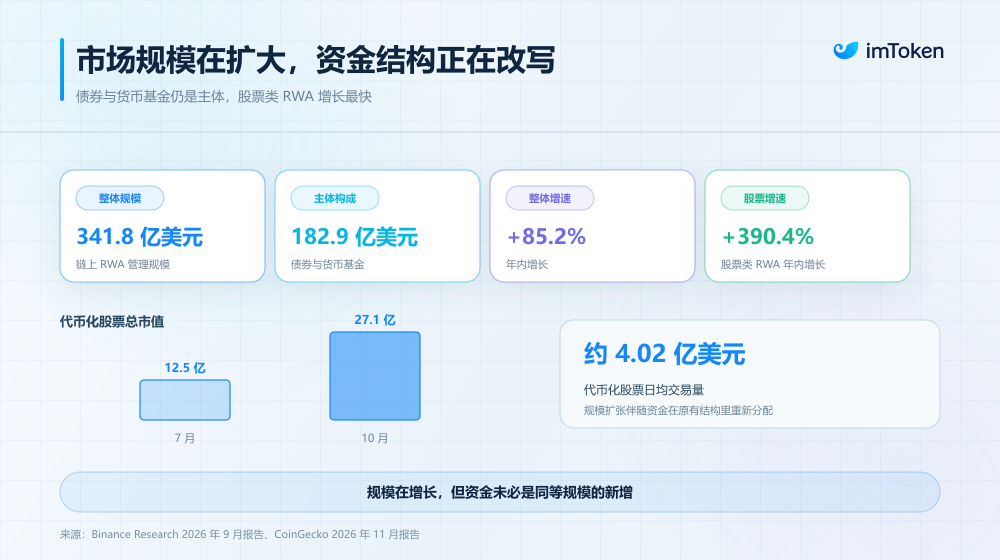
However, market expansion does not necessarily mean that Crypto has received a comparable scale of new capital.
These types of assets do provide new allocation outlets for idle on-chain capital and have the potential to bring some investors accustomed to the traditional brokerage system into crypto platforms. On the other hand, capital could equally flow out of existing DeFi lending, liquidity mining, and native crypto asset trading, redirecting toward tokenized Treasuries, money market funds, and stock products.
In other words, RWA brings not only incremental expansion but also a re-division of the existing capital structure.
According to Binance Research statistics, the capital activation rate of on-chain RWA remains limited. After a large number of assets are tokenized, they still primarily remain in the holding and trading stages, and have not yet fully entered more complex financial applications such as lending, collateralization, and portfolio investment.
This also means that the real challenge RWA needs to address in the next stage is how to keep these assets continuously flowing on-chain and generate more financial activity.
If RWA demand primarily comes from existing crypto market participants, its growth may be more reflective of reallocation of existing capital. Whether it can continuously attract external capital and expand on-chain financial applications will be an important dimension for measuring RWA's long-term value.
2. Infrastructure Competition from Asset Issuance to Trade Settlement
If early RWA projects were solving "how to bring assets on-chain," the current competitive focus has shifted to who can control the core hubs of issuance, ownership verification, trading, clearing, and fund settlement.
For this reason, traditional financial giants, crypto exchanges, and retail brokerages have all entered the fray, rapidly diverging into three clear paths.
1. NYSE and ICE: Bringing Traditional Securities Markets "Natively" On-Chain
In January 2026, Intercontinental Exchange (ICE), the parent company of the New York Stock Exchange, announced the development of a tokenized securities trading platform, planning to support 24-hour trading, fractional share trading, and instant settlement of U.S.-listed stocks and ETFs, while allowing stablecoins for fund settlement.
The core approach is to combine NYSE's existing Pillar matching engine with blockchain-based post-trade processing, settlement, and custody systems, while supporting both "tokenized stocks interchangeable with traditional shares" and "natively issued digital securities." This is fundamentally different from the commonly seen price-tracking Tokens on the market—holders will continue to enjoy the dividends and corporate governance rights corresponding to real shares.
On November 2, NYSE further announced its list of transfer agent partners, including Securitize, tZERO, Superstate, as well as traditional giants such as Broadridge, Computershare, and Equiniti. This indicates that TradFi institutions are connecting their existing issuer relationships, shareholder registration, and securities service systems with blockchain infrastructure.
2. OKX and ICE: The "Dual-Track" Extension of a Crypto Trading Platform
In contrast to NYSE's extension from traditional to on-chain, OKX represents a two-way exploration by a crypto platform into the traditional securities entrance.
One track is the compliant infrastructure route. In June 2026, OKX and ICE established a joint venture called OKXICE, and in October submitted a trading venue plan to the U.S. SEC. Meanwhile, OKXICE officially launched its tokenized securities trading venue on November 23, 2026.
The other track is a product distribution route targeting existing crypto users. The Unified Tokenized Stocks launched in November integrates similar stocks from different issuers under the xStocks framework into a unified order book and corporate actions processing rules, supports 24-hour USDT trading, and allows withdrawal to Solana and X Layer networks. However, these products currently do not grant actual equity or voting rights in the underlying companies, and essentially focus on providing price exposure.
3. Robinhood: Brokerage Entrance, Integrating On-Chain Finance Downward
As a securities brokerage with a massive retail base, Robinhood has chosen an approach that emphasizes the front-end entrance.
In July 2026, it launched a new generation of Stock Tokens through its Jersey subsidiary—essentially tokenized debt securities backed by the corresponding underlying securities purchased and held by the issuer as collateral. Holders similarly do not obtain legal ownership or shareholder rights of the underlying stocks.
Combined with the ongoing development of Robinhood Wallet and on-chain infrastructure, Robinhood's advantage lies not in building from scratch, but in packaging its existing securities business, user distribution capabilities, and on-chain financial services into a unified entrance. After all, it already has a massive stock investor base and a mature financial services system.
Overall, the three paths each have their own objectives: traditional exchanges are targeting control over issuance, registration, and clearing; crypto platforms are attempting to bring stablecoins, global traffic, and 24/7 trading into traditional assets; and fintech brokerages aim to integrate brokerage, wallets, and on-chain entrances.
However, more participants does not mean the market will automatically develop unified liquidity. On the contrary, the same company's stock may now simultaneously exist across multiple issuance platforms, multiple public chains, and different trading venues, with their respective issuance entities, legal structures, custody arrangements, and redemption mechanisms being mutually incompatible—this is also a problem that needs to be addressed over the long term.
3. Regulatory Boundaries: RWA Development Cannot Bypass the Basic Rules of Financial Markets
The development of RWA involves not only technology and business models, but also securities issuance, asset ownership verification, investor protection, and cross-border capital flows.
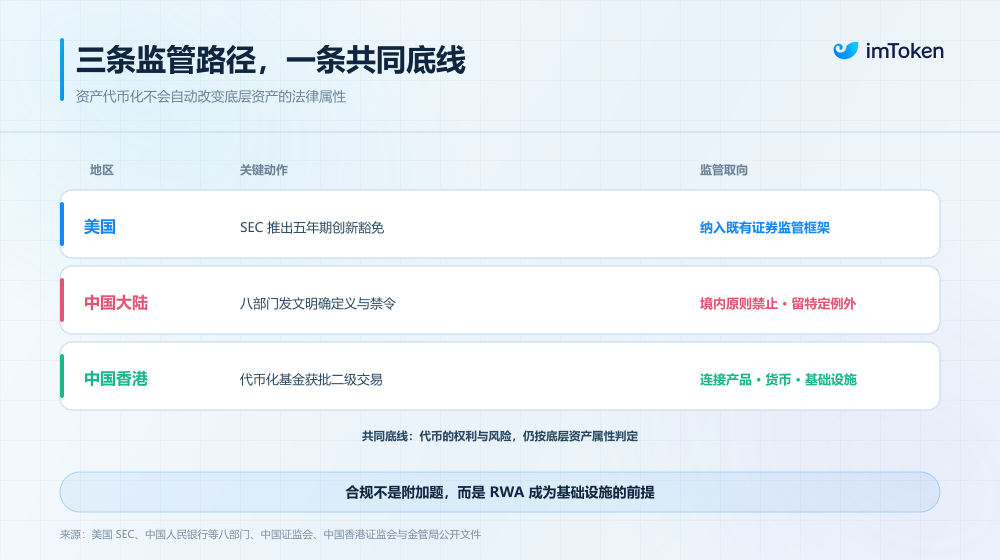
Judging from current regulatory developments, different regions are exploring different institutional paths, but one basic principle is becoming increasingly clear—asset tokenization does not automatically change the legal attributes of the underlying asset. As long as a Token substantively corresponds to securities rights, it must be subject to the constraints of the corresponding financial rules.
U.S. regulatory changes are worth noting.
On September 17, 2026, the U.S. SEC issued a temporary, conditional exemption mechanism for tokenized securities trading venues, namely the Innovation Exemption. It allows qualifying Tokenized Securities Venues to trade certain U.S.-listed stocks through licensed automated market makers and liquidity pools under specific conditions, without having to register as exchanges in the traditional manner.
However, the exemption does not mean all regulatory requirements are relaxed. The SEC has set multiple restrictions, including limits on the types and scale of tokenized stock trading; holders must enjoy the same rights as holders of the same class of traditional stocks; for third-party tokenized stocks, notification and an opportunity to object must be provided to the underlying securities issuers; smart contracts must be publicly auditable, among other requirements.
This actually reflects that U.S. regulators are attempting to bring blockchain trading into the existing securities market regulatory framework.
By comparison, mainland China's regulatory stance is more cautious. On February 6, 2026, the central bank, the National Development and Reform Commission, the China Securities Regulatory Commission, and five other departments jointly issued the "Notice on Further Preventing and Addressing Risks Related to Virtual Currencies and Other Matters" (Yin Fa [2026] No. 42), which for the first time explicitly defined real-world asset tokenization and reiterated that conducting RWA tokenization activities and related intermediary and technical services within the territory is suspected of illegal financial activities and should be prohibited—with exceptions retained only for businesses "conducted with the consent of the competent business authorities in accordance with laws and regulations, relying on specific financial infrastructure."
On the same day, the China Securities Regulatory Commission issued supporting "Guidelines on the Supervision of Overseas Issuance of Asset-Backed Securities Tokens Based on Domestic Assets," establishing clear filing thresholds: any overseas issuance of relevant tokens backed by cash flows from domestic assets requires the domestic entity with actual control over the underlying assets to file with the CSRC and submit complete materials, while strictly complying with cross-border investment, foreign exchange management, and network data security regulations. Without approval, filing, or security review, such activities must not be conducted.
Hong Kong, meanwhile, under a separate financial regulatory framework, is accelerating the push for tokenized finance from pilot programs to real business flows. On October 26, 2026, the Hong Kong Securities and Futures Commission approved the first two tokenized money market funds for round-the-clock secondary market trading on licensed virtual asset trading platforms. On November 2, the Hong Kong Monetary Authority announced that Project Ensemble had entered a new phase, supporting 24/7 interbank settlement of tokenized deposits using tokenized central bank money, with participating banks increasing to 12 and industry institutions reaching 20.
As emphasized by the HKMA and the SFC at a joint event in November, Hong Kong's tokenized market is moving from the experimental phase into commercialization, and the focus of the next stage is to generate real business flows among tokenized investment products, digital currencies, and financial infrastructure.
Final Thoughts
Looking back at the development of RWA, a clear change can be observed.
In the early days, the industry focused more on how to map real-world assets onto the blockchain, enabling Treasuries, gold, real estate, and stocks to exist in Token form. Subsequently, the market began exploring how to enable asset trading through stablecoins, complete yield distribution through smart contracts, and how to bring tokenized assets into DeFi lending and collateral systems.
Today, with giants such as NYSE, ICE, OKX, and Robinhood successively making their moves, competition has formally deepened into the heart of financial markets—issuance, registration, custody, trading, and clearing.
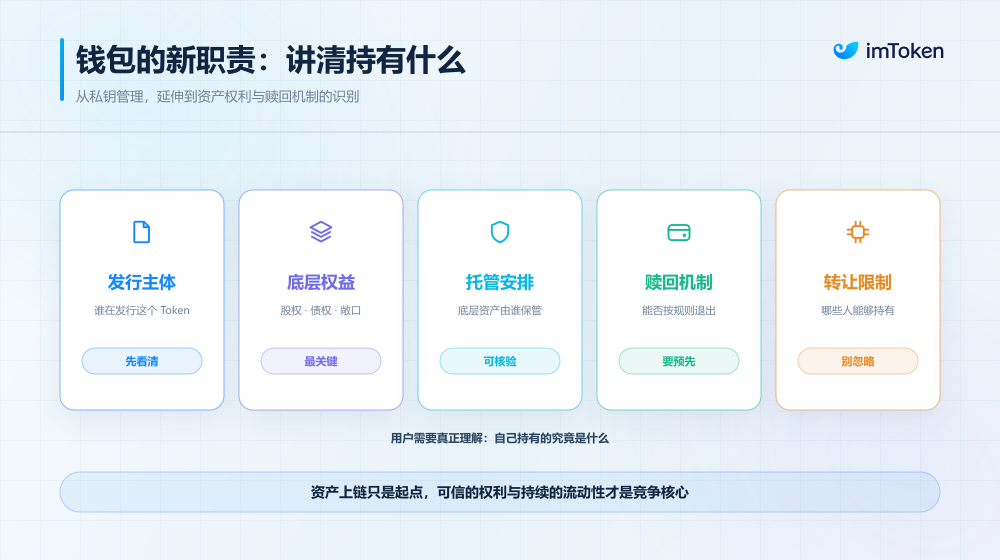
For wallets, this also means that their future responsibilities may no longer be limited to managing private keys and displaying on-chain assets.
When users begin to access tokenized stocks, funds, and other real-world assets through wallets, wallets need to help users identify asset issuers, underlying rights, custody arrangements, redemption mechanisms, and transfer restrictions, and enable users to truly understand what they actually hold.
In this sense, RWA is not just bringing more tradable assets to Crypto, but also pushing the entire industry to rethink the relationships among wallets, payments, trading, and asset management.