

Here is the translation of the content into English, preserving the HTML structure and the custom split separator: December 2026 US Economic Data Calendar: When Are NFP, CPI, FOMC, and PCE Released?

December 2026's core US macroeconomic data release window is highly concentrated in the first four weeks, with the November nonfarm payrolls report scheduled for December 4 at 08:30 ET (21:30 Singapore time the same day), the year's final Federal Open Market Committee interest rate decision set for December 9 at 14:00 ET (03:00 Singapore time on December 10, spanning to the next day), the November Consumer Price Index following closely on December 10 at 08:30 ET (21:30 Singapore time the same day), and the November Personal Consumption Expenditures Price Index alongside the third estimate of Q3 2026 GDP both due on December 23 at 08:30 ET (21:30 Singapore time the same day). Traders should note in particular that the December rate decision lands a full 18.5 hours before the November CPI release, meaning the Fed's policymakers will cast their year-end votes and update the Summary of Economic Projections without having seen the official November year-over-year consumer inflation reading.
Since US daylight saving time ended on the first Sunday of November 2026, the entire month of December operates on Eastern Standard Time (UTC-5) across the continental US, maintaining a fixed 13-hour difference from Singapore time (UTC+8). Against the backdrop of the 3.75%–4.00% federal funds rate target range, the resilience of October's 165,000 nonfarm payroll gain, and the sticky 3.3% year-over-year core PCE inflation in October, the nine official indicators landing densely in December will directly determine the liquidity pricing of US Treasury yields, the dollar index, and crypto assets as the year turns.
Key Takeaways
According to the official schedules published as of November 26, 2026 by the US Bureau of Labor Statistics, the Federal Open Market Committee, the US Bureau of Economic Analysis, and the US Census Bureau, December macro trading will unfold around three key time nodes: the first week opens with the December 1 and December 3 manufacturing and services Purchasing Managers' Index readings and culminates in the November nonfarm payrolls report on December 4; the second week marks the policy climax, with the FOMC meeting on December 8–9 and the release of the quarterly dot plot, followed by the November CPI on December 10; the third and fourth weeks wrap up with the December 15 Producer Price Index, December 16 retail sales and flash PMI, and the December 23 PCE inflation and Q3 GDP final estimate.
On the data baseline and statistical methodology front, the Fed on October 28 voted 10–2 to hold the federal funds rate target range at 3.75%–4.00%, following a 25-basis-point hike on September 16, while two committee members advocated for a further 25-basis-point hike at the October meeting. The latest baseline shows October nonfarm payrolls rose by 165,000, significantly above the prior 12-month average monthly gain of 48,000, with the unemployment rate holding at 4.1%; October headline and core PCE price indices rose 3.8% and 3.3% year-over-year respectively; October total retail sales reached $748.22 billion, up 0.2% month-over-month; and owing to the fall 2025 government funding lapse that caused missing October 2025 survey data, the October CPI failed to publish a 12-month year-over-year change, with the November report due December 10 set to restore the official year-over-year inflation reading.
Complete December 2026 US Macro Data Calendar
Once December begins, all morning data releases from US federal statistical agencies go live promptly at 08:30 Eastern Standard Time, corresponding to 21:30 Singapore time the same day—one hour before the regular US stock market open; industry association survey indicators are mostly released between 09:45 and 10:00 ET, corresponding to 22:45–23:00 Singapore time the same day; only the Fed's rate decision and quarterly Summary of Economic Projections are released at 14:00 ET, corresponding to 03:00 Singapore time the next day, making it a cross-day risk event in the early hours of the Asian trading session.
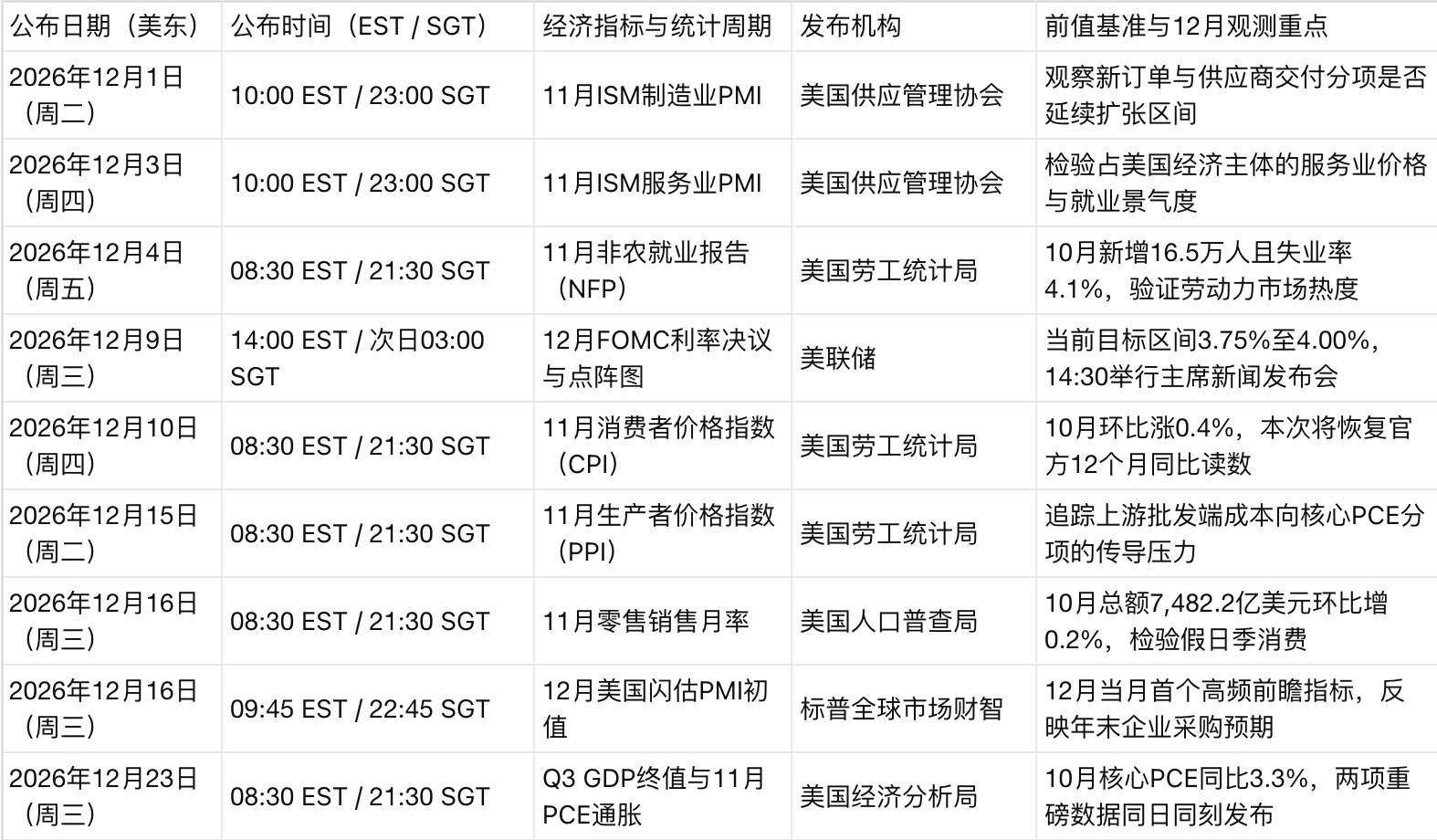
Beyond the nine monthly and quarterly core indicators above, traders should also track the weekly initial jobless claims released every Thursday at 08:30 ET (21:30 Singapore time the same day) by the US Department of Labor, as well as the regional manufacturing surveys and inflation expectations readings published by the New York Fed ahead of the FOMC blackout period, as auxiliary references for high-frequency liquidity fine-tuning.
First-Half Focus: Nonfarm Payrolls, FOMC, and the 18.5-Hour Gap Before CPI
The trading narrative in the first two weeks of December is dominated by employment data and the monetary policy decision. The industry surveys lead off, with the Institute for Supply Management releasing the November manufacturing and services PMIs on December 1 and December 3 respectively, followed by the November nonfarm payrolls report from the Bureau of Labor Statistics on December 4 at 08:30 ET. Looking back at the October report, US nonfarm payrolls rose by 165,000 in the month, 3.44 times the prior 12-month average monthly gain of 48,000, the number of persons employed part-time for economic reasons rose by 339,000 to 4.8 million, and the unemployment rate held steady at 4.1%. Since December 4 is the last official employment scorecard before the December FOMC meeting, month-over-month wage growth and unemployment rate fluctuations will directly affect the implied probability pricing of the December 9 rate path by CME rate tools.
Immediately after, on December 8–9, the Fed will hold its eighth and final regular monetary policy meeting of 2026. According to the official agenda, the policy statement and quarterly Summary of Economic Projections will be released on December 9 at 14:00 ET (03:00 Singapore time on December 10, spanning to the next day), with the Fed Chair's press conference beginning at 14:30 (03:30 Singapore time, next day). This timing creates a rare policy information window: the moment the FOMC announces its rate decision comes exactly 18.5 hours before the November CPI release (December 10 at 08:30 ET). Meanwhile, owing to the fall 2025 funding lapse that left the October 2025 CPI survey sample vacant, the Bureau of Labor Statistics published only month-over-month changes in its October report on November 10, 2026 (headline +0.4% m/m, core +0.3% m/m) without a full 12-month year-over-year reading; and because the November 2025 survey sample is intact, the November report on December 10 will restore the official 12-month year-over-year inflation rate, providing the market with the year-over-year calibration reference missing for a month, one day after the FOMC decision.
Second-Half Focus: Retail Sales, Flash PMI, and the December 23 Double Data Release
After the FOMC meeting, market attention in the third week of December shifts to the resilience of end-consumer demand and validation of fourth-quarter economic momentum. The November PPI due December 15 at 08:30 ET will be the first to reveal marginal changes in wholesale prices for energy, food, and core services; because the healthcare, airfare, and financial services components of the PPI feed directly into PCE price index calculations, this data often triggers early revisions in the bond market's expectations for the December 23 inflation reading.
December 16 brings a double data relay: first at 08:30 ET (21:30 Singapore time), the US Census Bureau releases November retail sales data, testing the true strength of Black Friday and Thanksgiving promotional season consumption—October total retail sales were $748.22 billion, up 0.2% month-over-month and 6.8% year-over-year, with core retail sales excluding autos up 0.6% month-over-month; 75 minutes later at 09:45 ET (22:45 Singapore time), S&P Global Market Intelligence will release the December US flash PMI preliminary reading, providing the first high-frequency snapshot of December corporate orders and input costs. For related business-cycle divergence logic, see the November US flash PMI analysis and the Fed Beige Book economic observations.
The last major macro day before the Christmas holiday falls on Wednesday, December 23 at 08:30 ET (21:30 Singapore time the same day), when the Bureau of Economic Analysis will simultaneously release the third estimate of Q3 2026 GDP (including corporate profits revisions) and the November personal income and outlays report. In the October report released November 25, nominal personal consumption expenditures rose $63.8 billion month-over-month ($11.8 billion in goods, $52.1 billion in services), but real PCE adjusted for inflation edged down $5.8 billion month-over-month (a decline of less than 0.1%), the personal saving rate fell to 4.1%, and the Fed's most-watched gauge—the PCE price index—rose 3.8% year-over-year, with core PCE excluding food and energy up 3.3% year-over-year. For a further breakdown of the inflation structure, see the October PCE inflation preview.
Methodology Analysis: Why CPI vs. PCE and the Two Employment Surveys Often Diverge
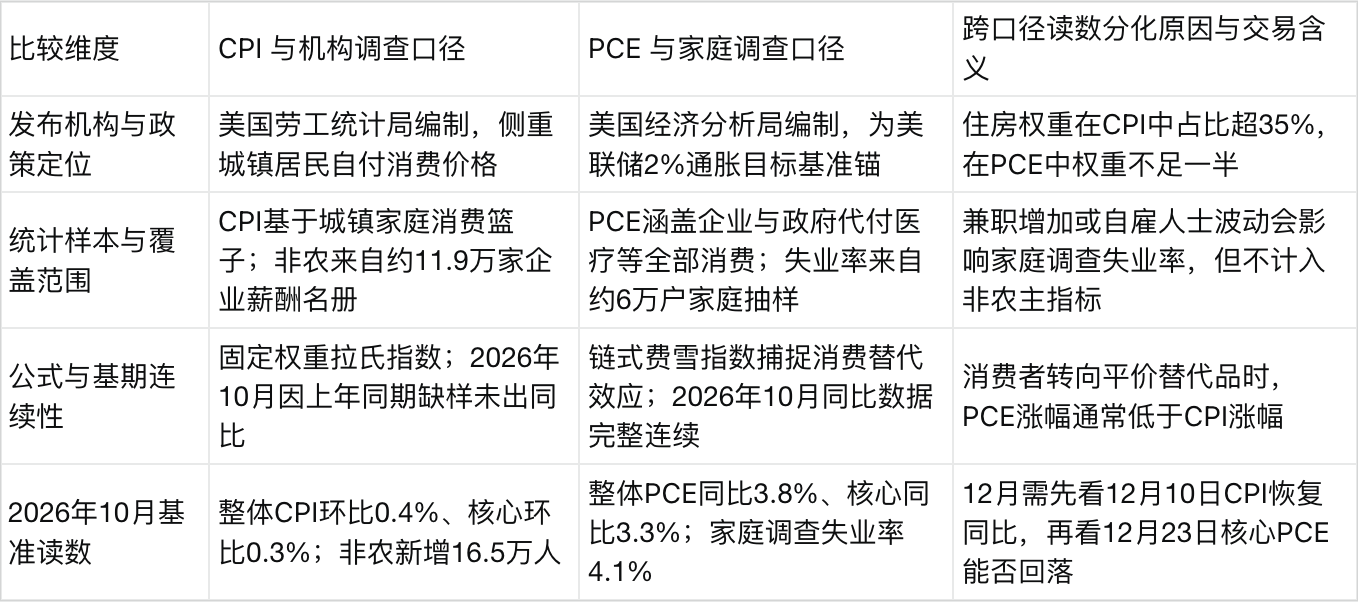
When interpreting December's dense data slate, macro traders are most prone to misjudging policy direction by conflating statistical methodologies. Take inflation gauges: both CPI and PCE recorded 0.3% core month-over-month gains in October 2026, yet the two differ significantly in weighting, coverage, and base-period continuity, leading to starkly different year-over-year readings and policy weights. Likewise, the nonfarm payrolls report released on the first Friday of each month is actually composed of two independent sample surveys, and directional divergence in a single month's readings is normal.
At the cross-asset pricing level, the US Treasury yield curve and the Intercontinental Exchange dollar index often react to the above data in stages, while the Chicago Board Options Exchange volatility index and crypto spot and perpetual contracts see implied volatility lift around data releases. When observing how macro events transmit to dollar liquidity and crypto markets, traders can track multi-asset linkages via comprehensive trading platforms such as MEXC, and combine that with the impact of a stronger dollar on assets to understand the interaction between exchange rates and risk assets. To monitor major tokens and cross-market volatility in real time during December's key data windows, go directly to view live MEXC prices for dynamic quotes.
Exclusive Commentary from the MEXC Editorial Team
The most striking structural feature of the December 2026 macro calendar is not any single data surprise, but the misalignment between the policy decision timing and the release of key inflation data. When the Fed announces its rate decision and updated Summary of Economic Projections at 14:00 ET on December 9, the November CPI will not be officially released until 18.5 hours later at 08:30 on December 10, and the Fed's most-watched November PCE price index will not emerge until two weeks later on December 23. Against the backdrop of the October decision at the 3.75%–4.00% range already drawing two dissenting votes favoring a 25-basis-point hike, this information lag means the December 9 dot plot median and the Chair's press conference language will rest more heavily on the December 4 nonfarm payrolls data and the existing October inflation baseline.
A second trading trap to watch is the amplification effect of holiday liquidity decay on the December 23 double data release. Wednesday, December 23 is only one full trading day before the Christmas market closure; European and US institutional market makers are generally in year-end position-reduction and book-locking mode, and market depth is notably thinner than at the start of the month. Yet on that very day at 08:30 ET, the Bureau of Economic Analysis will simultaneously release two heavyweight reports—the third estimate of Q3 GDP and the November PCE inflation report. Should the core PCE year-over-year reading deviate from October's 3.3% baseline, the thin year-end order book could amplify instantaneous slippage in short-term rates and risk assets.
Taking the full December rhythm together, trading focus in the first two weeks centers on the December 4 nonfarm payrolls and the December 9–10 FOMC-plus-inflation double punch; the third week picks up fundamental validation from December 16 retail sales and flash PMI; and the fourth week warrants caution over tail volatility from the December 23 double data combined with year-end liquidity contraction. On the regulatory compliance front, as the US Securities and Exchange Commission continues to advance rule alignment between spot crypto assets and traditional financial infrastructure, the marginal pricing weight of US macro rate expectations on digital asset capital flows has further strengthened.
Frequently Asked Questions
When exactly is the December 2026 US nonfarm payrolls (NFP) report released?
The November US nonfarm payrolls report published in December 2026 is scheduled for Friday, December 4 at 08:30 Eastern Standard Time, which converts to 21:30 Singapore time on December 4. The previous October nonfarm payrolls report from the Bureau of Labor Statistics showed a gain of 165,000 and an unemployment rate of 4.1%.
On what date is the December 2026 FOMC meeting held, and at what time is the rate decision released?
The December 2026 Federal Open Market Committee meeting is scheduled for December 8–9, with the rate decision statement and quarterly Summary of Economic Projections (including the dot plot) to be released on Wednesday, December 9 at 14:00 Eastern Standard Time, corresponding to 03:00 Singapore time on December 10 (spanning to the next day), and the Fed Chair's press conference beginning at 14:30 (03:30 Singapore time). The current federal funds rate target range is 3.75%–4.00%.
On what dates are the December 2026 US CPI and PCE inflation data released?
The November Consumer Price Index (CPI) will be released on Thursday, December 10 at 08:30 Eastern Standard Time (21:30 Singapore time the same day) by the Bureau of Labor Statistics, while the November Personal Consumption Expenditures (PCE) price index will be released on Wednesday, December 23 at 08:30 Eastern Standard Time (21:30 Singapore time the same day) by the Bureau of Economic Analysis. Because missing October 2025 survey data left the October 2026 CPI without a year-over-year figure, the November CPI report on December 10 will restore the 12-month year-over-year inflation reading.
Why is Eastern Time 13 hours behind Singapore time in December 2026?
US daylight saving time ended on the first Sunday of November 2026, and the entire month of December operates on Eastern Standard Time (EST, i.e., UTC-5) across the eastern US, while Singapore uses UTC+8 year-round, putting the two a fixed 13 hours