


Zero-Budget Coin Purchases, Locked-Up Holdings, Altcoin Sell-Offs: Is the US Bitcoin Reserve Bill Just a "Bad Check"?

Author: Ma He, Foresight News
On November 24 (US Eastern Time), the U.S. House Financial Services Committee formally submitted to the full House the complete substitute amendment text and committee report (Report No. 119-894) of the "American Reserve Modernization Act of 2026" (H.R. 8957), and the bill was accordingly placed on the Union Calendar No. 789.
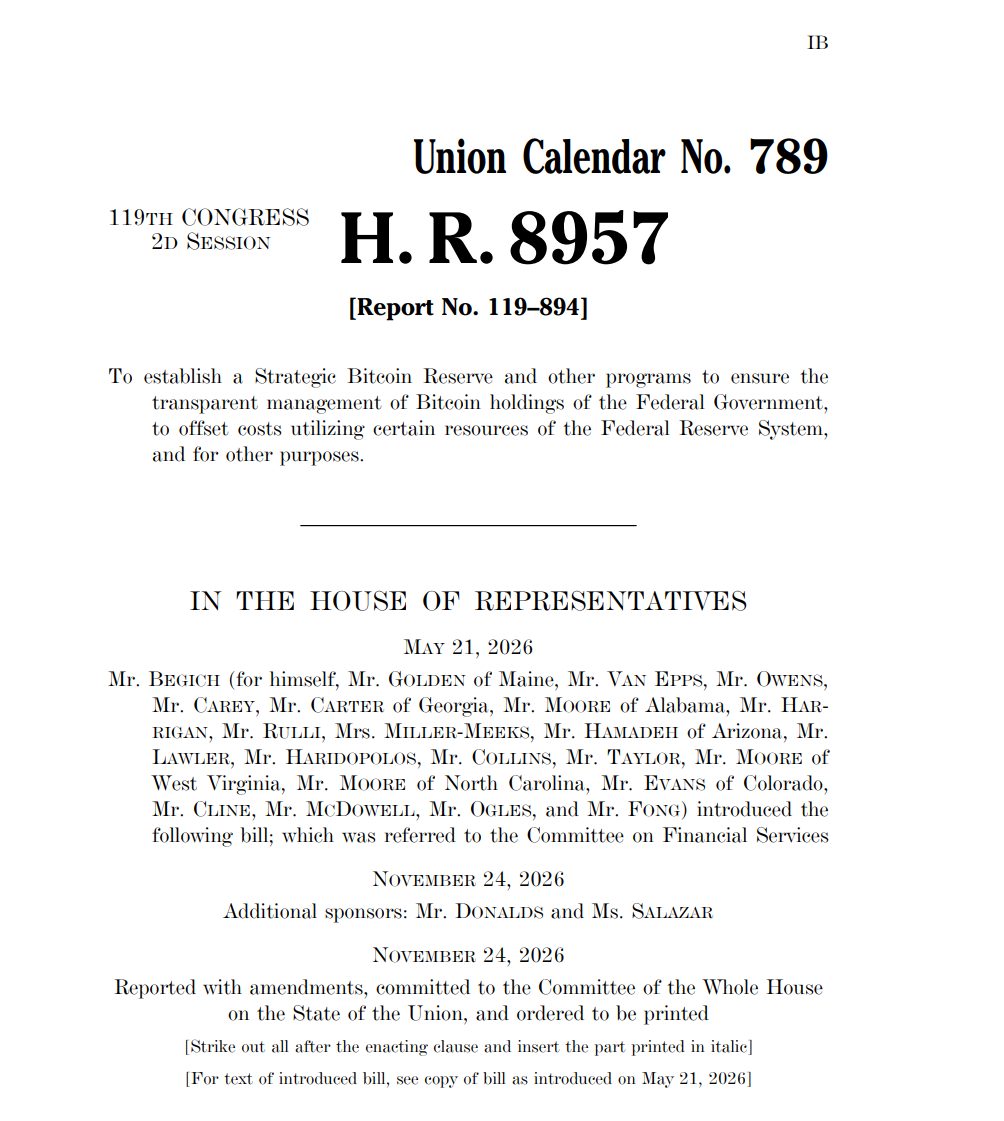
In stark contrast to the market's earlier bet on "sovereign real-money buying to pump the market," the committee deleted the entire body of the original bill and rewrote its provisions in the amendment, directly cutting the core wording in the original long title about "using specific resources of the Federal Reserve System to offset costs."
This means that this strategic Bitcoin reserve bill, which had been widely anticipated, has been drastically pared down to a stock asset management plan featuring "zero new budget, centralized custody of federally forfeited Bitcoin, and a principled 20-year lock-up."
Fed's Purse Strings Cut; Sovereign Buying Retreats to "Removing Sell Pressure"
H.R. 8957 was originally introduced on May 21 of this year by Alaska Republican Congressman Nicholas J. Begich, with 21 original cosponsors (including Maine Democratic Congressman Jared Golden). On November 24, two additional cosponsors, Byron Donalds and Maria Elvira Salazar, were added, bringing the total number of cosponsors to 23.

Nicholas J. Begich, the bill's sponsor and a U.S. Republican congressman
Despite its bipartisan cosponsor veneer, the bill still narrowly passed the Financial Services Committee on September 16 by a party-line vote of 28 to 21.
What really determines the market's pricing logic is the "funding red line" drawn by fiscal hawks in the amendment:
- "Fed buying Bitcoin" is completely out: The original bill's long title explicitly included "using specific resources of the Federal Reserve System to offset costs," but the amendment directly redrafted the title at the end and cut that wording outright, closing off the shortcut most anticipated by the market—buying Bitcoin without fiscal appropriations.
- Debt issuance, tax increases, or collateralized Bitcoin purchases strictly prohibited: Section 9 only requires the Treasury Secretary and Commerce Secretary, within 180 days after the bill's enactment, to jointly assess "budget-neutral" accumulation pathways (i.e., neither nominally nor substantively increasing federal debt, requiring no new appropriations, and imposing no net cost on taxpayers or federal agencies), and to submit reports on schedule to the Senate Banking and Finance Committees and the House Financial Services and Ways and Means Committees; Section 9(d) further stipulates in black and white that the Act in no way authorizes borrowing, financing, using U.S. digital assets or other assets as collateral, raising taxes, or deficit spending to purchase Bitcoin.
- Law enforcement funds and victim restitution take priority: The bill strictly limits "eligible Bitcoin" included in the reserve to Bitcoin owned by the federal government and not otherwise designated for other uses by law; Sections 3(5) and 7(d) explicitly preserve the priority effect of Title 31, Section 9705 of the U.S. Code (Treasury Forfeiture Fund), Title 28, Section 524(c) (Department of Justice Assets Forfeiture Fund), and drug forfeiture laws—that is, law enforcement revenue-sharing and crime victim restitution all come first, and only the remainder enters the reserve.
So how much existing BTC does the U.S. government actually hold?
Because the White House has not yet published an official audited ledger (which is precisely the direct reason Sections 6 and 7 of the bill mandate an inventory of accounts and the establishment of proof of reserves), the market mainly relies on third-party tracking.
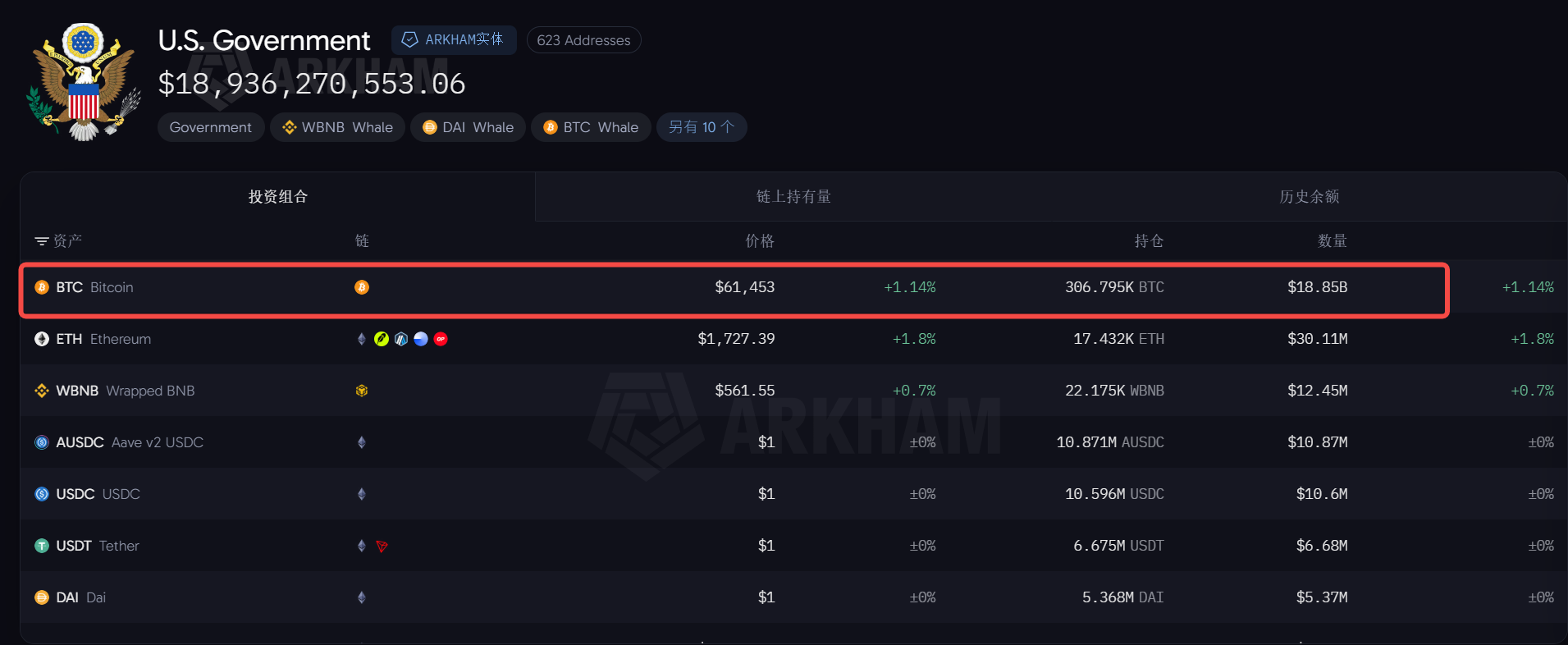
As of November 2026, Arkham on-chain data shows that U.S. government addresses hold a total of 306,795 BTC (approximately $18.85 billion).
If assets still in civil forfeiture proceedings are included (such as the Prince Group case involving approximately 127,300 BTC), CoinGecko's broad-basis holdings figure is as high as 329,693 BTC, accounting for about 1.57% of Bitcoin's total supply.
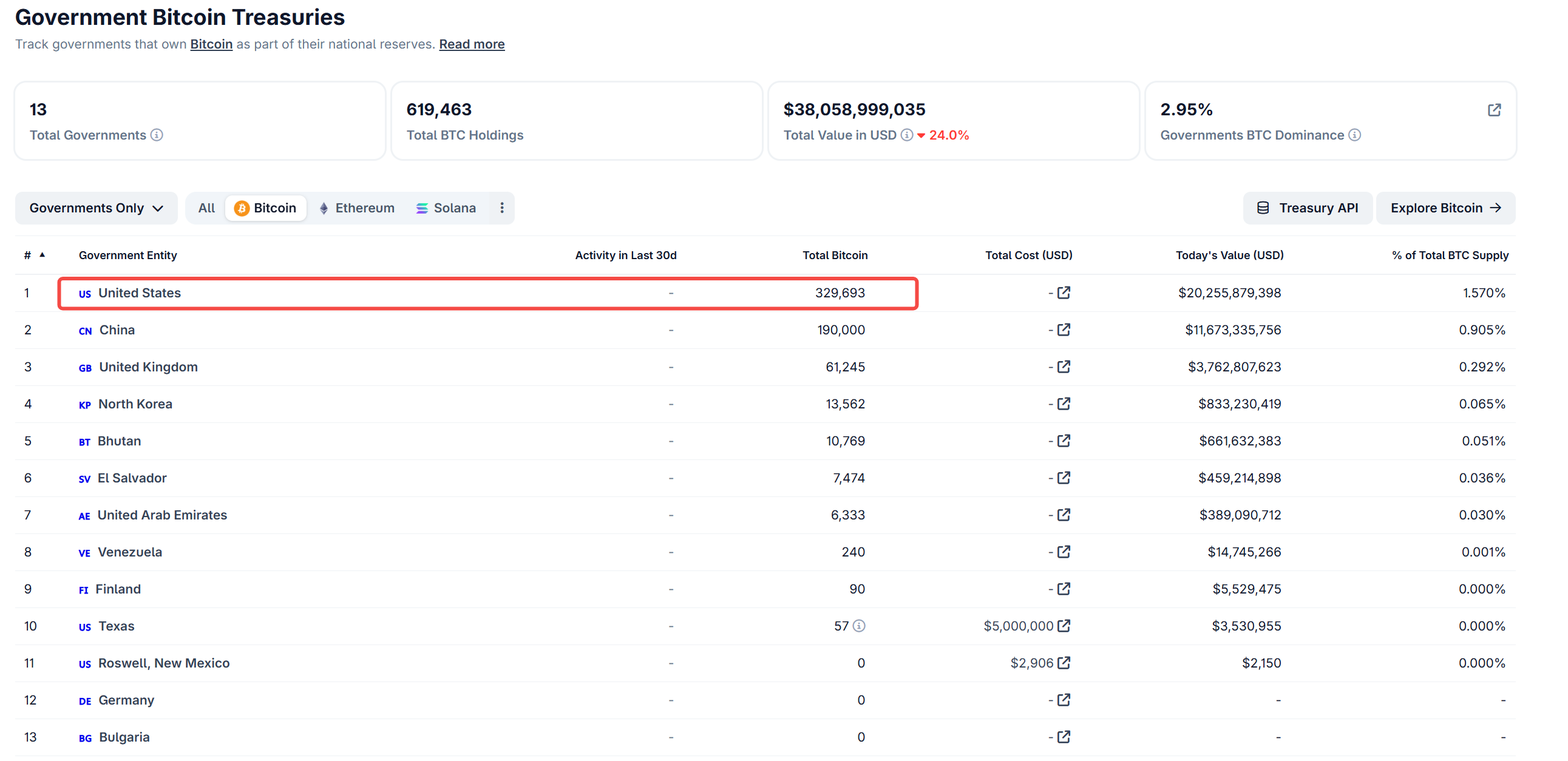
However, these holdings mainly stem from law enforcement seizures in cases such as Silk Road and the Bitfinex hack. After deducting assets tied up in pending judicial proceedings and victim restitution shares, the "net locked amount" that can ultimately be allocated to the strategic reserve will still be significantly lower than the above gross book value.
Put plainly, Washington is willing, in the legislative findings under Section 2 of the bill, to mention Bitcoin in the same breath as traditional gold reserves—giving crypto voters a resounding political designation—but it is absolutely unwilling to spend a single taxpayer dollar to pump the crypto market.
For the secondary market, the real significance of this bill is not "trillion-dollar incremental sovereign buying," but rather removing the U.S. government's existing forfeited Bitcoin from the circulating supply over the medium to long term (in principle, at least 20 years).
A "Dual-Track System" for Crypto Assets
Under Sections 4 and 7, the Treasury Secretary must, within 180 days after the bill's enactment, establish separately under the Treasury Department a "Strategic Bitcoin Reserve" and a "Digital Asset Stockpile."
Each federal agency must report all digital asset accounts within 60 days (and update annually thereafter), and during the transition period before the two reserves are established, disposal authority is in principle frozen (except for national security, statutory requirements, court orders, and victim restitution), with asset transfer to be completed within 30 days after the two reserves are established, whereupon ownership vests in the Treasury Department.
But comparing the dual-reserve provisions, the bill amounts to an officially endorsed "dual-track system" for crypto assets—Bitcoin is enthroned, while altcoins are reduced to fuel.
Bitcoin Receives "Treasury-Level" Treatment
Section 5 provides that all Bitcoin deposited into the Strategic Bitcoin Reserve must be held for at least 20 years from the bill's enactment, during which it may not be sold, exchanged, auctioned, or encumbered with rights such as staking; in the two years before the 20-year period expires, the Treasury Secretary must submit recommendations to Congress on continued holding or gradual release, and after the period expires, proposed sales every two years may not exceed 10% of total reserve holdings (with comprehensive consideration of factors such as the federal fiscal deficit, market impact, and asset diversification).
At the same time, Section 6 mandates that the Treasury Department establish a public Proof of Reserve system for crypto, disclosing total holdings, transaction details, and private key control status annually, verified by independent third-party crypto auditors, and subject to periodic oversight by the Comptroller General of the United States (i.e., the head of the U.S. Government Accountability Office, GAO).
Non-Bitcoin Assets Have No Lock-Up Period and Can Be "Liquidated to Provide Funding"
Other crypto assets classified into the "Digital Asset Stockpile" enjoy neither the 20-year lock-up protection nor fall within the scope of mandatory proof-of-reserve audits; the Treasury Secretary may sell them at an opportune time so long as public rulemaking procedures are followed.
Under Section 4(d)(3)(B), proceeds from asset disposal are first used to cover the operating costs of the two reserves, with the balance remitted to the Treasury to reduce federal debt; Section 9(b)(2)(A) even directly lists "selling or exchanging non-Bitcoin assets in the stockpile" as a key assessment option for budget-neutral Bitcoin accumulation.
It is worth noting that the so-called "20-year ironclad sales ban" is not without loopholes.
First, Sections 4(d)(3)(A) and 4(f)(2) preserve the authority for "the Treasury Secretary to sell Bitcoin upon determining it is in the U.S. interest and issuing public sale rules (disclosing the sale timetable algorithm and maximum sell-off amount)," which creates statutory tension with the 20-year sales ban in Section 5. In addition, Section 5(d) requires the Treasury Department, within one year of the bill's enactment, to submit to Congress a research report on "conditions for early unlocking and selling Bitcoin and exception clauses for national security and financial stability," effectively reserving a legal escape hatch for future fiscal crises.
Second, Section 4(e) separately addresses forked coins and airdrops: such assets are locked for only one year, after which the Treasury Department retains the dominant-chain asset under the "highest publicly traded market capitalization" standard and has the right to directly auction or sell off non-material forked assets (unless the Commerce Department and industry experts determine they have unique strategic utility).
If Bitcoin faces another chain split in the future, the U.S. Treasury Department, holding massive positions, will directly wield "off-chain adjudication power."
Beyond asset lock-ups, the latter part of the bill writes in the crypto community's most concerned "anti-confiscation" immunity clause.
Section 10 of the bill directly addresses the crypto community's historical concerns about Executive Order 6102 of 1933 (which mandated the confiscation of privately held gold), explicitly prohibiting the federal government from using this Act to confiscate or infringe upon the property rights of any individual or institution lawfully holding crypto assets, and solemnly affirming in the form of "congressional opinion" that: individuals' right to self-custody private keys is the cornerstone of financial sovereignty, privacy, and individual freedom in the digital age.
Risk of Being Stalled by Year-End
In House floor procedures, placement on the calendar does not mean a vote is necessarily scheduled; the bill must still pass four hurdles: rule-setting by the House Rules Committee, a full House vote, passage by the Senate in an identical text, and presidential signature.
It is worth noting that the 119th Congress will expire on January 3, 2027, and bills that have not completed the process will automatically be cleared at that time.
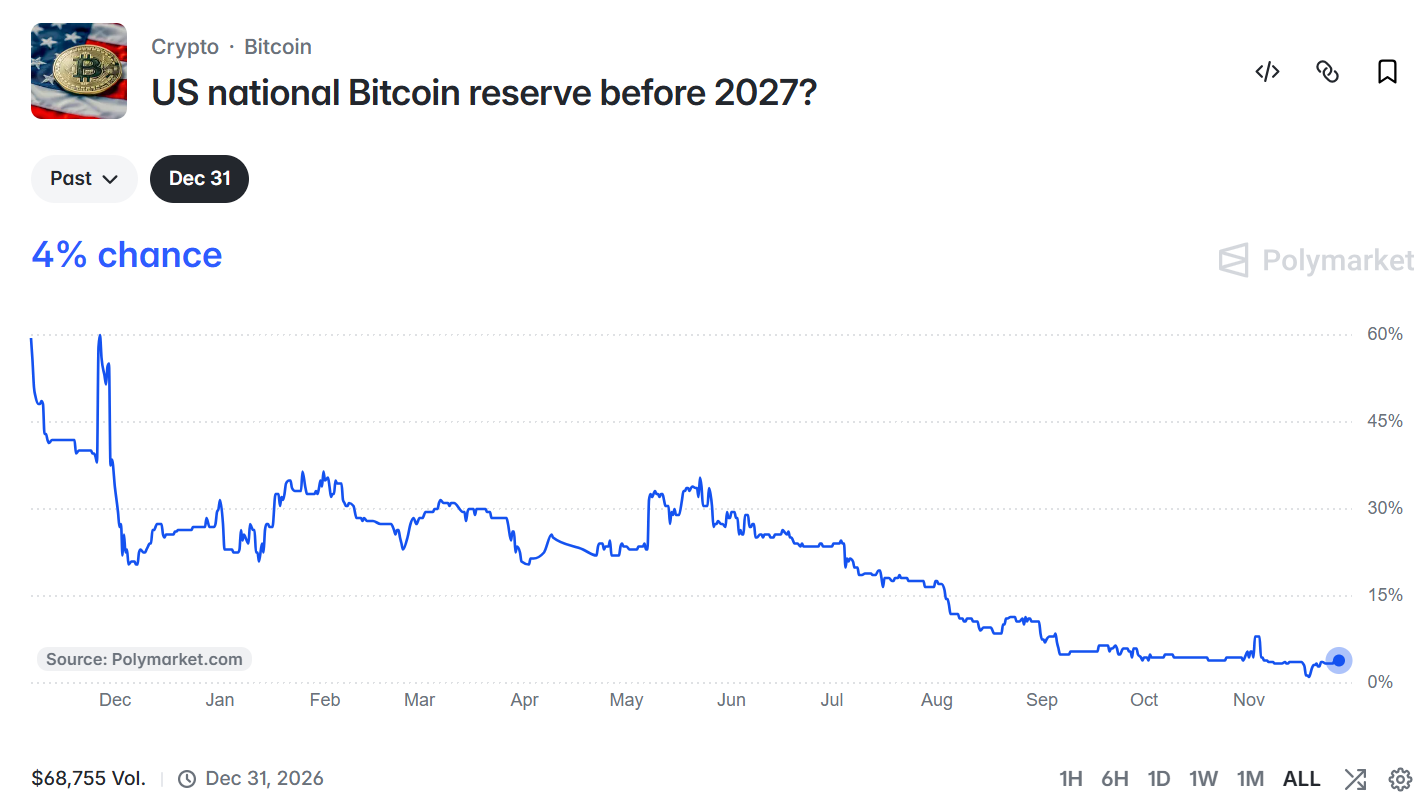
Prediction markets have already voted with real money in advance. As of November 27, in the Polymarket contract on "the U.S. establishing a national Bitcoin reserve before 2027," the probability of "Yes" has fallen to about 4%, a sharp pullback from 34% when the bill was introduced in May this year (note: the settlement conditions of this contract are not entirely equivalent to the legislative outcome of H.R. 8957). Although the contract's total trading volume is only about $68,800 and liquidity is thin, it still reflects the market's extreme pessimism about year-end legislation.
A more realistic political headwind is that, with Democrats sweeping back control of both the Senate and House in the November 3 midterm elections and set to formally take over the 120th Congress on January 3, 2027, all 21 opposing votes previously cast against the bill in committee came from Democrats.
This means that if the bill fails to pull off a miracle, restarting legislation next year will not only find it difficult to revive the Bitcoin-buying funding pool, but resistance to advancing it will also rise further.