

Why Did BTCS Sell 27,300 ETH? An Analysis of Aave Debt Risks

Overview
On November 23, 2026, Ethereum treasury and blockchain infrastructure company BTCS (NASDAQ: BTCS) disclosed that on November 20 it sold approximately 27,300 ETH for roughly $43.8 million and used the proceeds to repay borrowings from decentralized lending protocol Aave. Following the transaction, the company's remaining ETH holdings stand at approximately 24,245 ETH, its Aave debt has fallen to about $10.5 million, and its loan-to-value (LTV) ratio has dropped to approximately 32%.
According to the Form 8-K filed by BTCS with the U.S. Securities and Exchange Commission, the transaction was a voluntary sale of assets to repay debt rather than a forced liquidation of its collateral by Aave. The company aims to reduce leverage, lower the risk of collateral liquidation triggered by further price declines, and preserve its ability to meet other debt obligations.
However, reducing leverage does not mean BTCS has eliminated all financial risk. The company still has approximately $17.9 million in senior secured convertible notes maturing in 2027, and its DeFi business Imperium has temporarily exited liquidity pools. For a public company employing an ETH-collateralized borrowing strategy, this event illustrates the complex relationship among crypto asset prices, debt management, operating revenue, and shareholder equity.
Key Takeaways
According to BTCS's official deleveraging announcement published on November 23, the average selling price of the ETH in this transaction was approximately $1,604. Working backward at the transaction level from the number of ETH sold and the remaining holdings, the pre-sale ETH position was approximately 51,545 ETH, implying a reduction of about 53.0%. Over the same period, Aave debt fell from an estimated $54.3 million before the transaction to $10.5 million, a decline of approximately 80.7%. Based on the November 22 reference ETH price of $1,722, the company's remaining ETH holdings are worth approximately $41.75 million.
BTCS's third-quarter revenue was approximately $4.093 million, of which Imperium contributed about $3.506 million, or roughly 85.7%. The company's temporary withdrawal from liquidity pools means this major revenue source will be affected by the status of capital deployment. In addition, based on the historical ETH liquidation threshold of approximately 80% disclosed by the company on August 25, combined with the latest 32% LTV for a conditional calculation, its Aave health factor is approximately 2.50. This figure is a hypothetical model result rather than an actual account health factor verified on-chain in real time.
Why Did BTCS Sell 27,300 ETH to Repay Aave Debt?
On November 20, 2026, global equity and cryptocurrency markets experienced a significant correction.
According to BTCS's announcement, the Nasdaq Composite fell 5.3% and the S&P 500 dropped 3.7% that day, while ETH retreated about 12% from its intraday high, bottoming near $1,561.
For ETH holders without borrowings, a price decline mainly means a reduction in the value of their holdings. But for companies that borrow stablecoins using ETH as collateral, a price decline also directly changes the ratio between debt and collateral.
When collateral value falls while the stablecoin debt principal does not decrease in tandem, the loan-to-value ratio rises and the health factor may decline.
BTCS chose to proactively sell ETH during this process and use the proceeds to repay Aave debt.
According to a November 24 CoinDesk market report, BTCS shares fell about 6.3% to $0.61 after the company disclosed the transaction.
This market reaction indicates that reducing debt risk does not necessarily immediately improve shareholder expectations for future profitability and asset growth.
What Was the Average Selling Price of BTCS's ETH?
Based on the transaction amount and quantity disclosed by the company, the average unit proceeds of this sale can be calculated:
Average ETH selling price = 43,800,000 ÷ 27,300 ≈ $1,604.40.
This result is also consistent with the approximate average selling price given in The Block's transaction analysis.
Because both the number of ETH sold and the proceeds disclosed by the company are approximate figures, $1,604.40 is merely an average price derived from the disclosed amounts, not the precise average execution price published by the company.
In addition, the company did not fully disclose the specific accounting cost basis of the ETH sold in this announcement.
Therefore, although management acknowledges that the sale imposed a real economic cost on the company and its shareholders, the realized accounting loss of this transaction cannot be accurately calculated solely from the $43.8 million in sale proceeds.
What Happened to BTCS's Holdings and Debt Before and After the Sale?
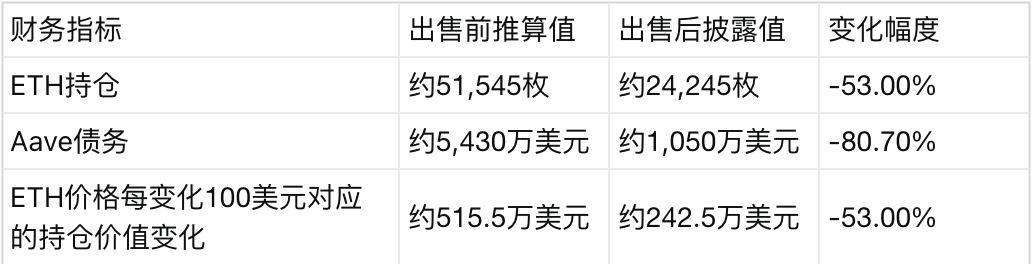 Data source: BTCS announcement and Form 8-K published on November 23, 2026. Pre-sale holdings and debt are derived at the transaction level from the sale, repayment quantities, and remaining balances, assuming no other simultaneous changes in assets and debt.
It is worth noting that, according to the borrowing disclosure filing submitted by BTCS on November 19, the company's Aave debt was approximately $54 million that day.
This figure differs by about $300,000 from the $54.3 million derived from this transaction.
Because the two disclosures use different points in time and rounded amounts, the difference cannot be directly attributed to new borrowing or interest expense.
This article therefore calculates the debt reduction percentage using the repayment amount and remaining balance from the same transaction, rather than directly stitching together debt data from different dates.
Has Aave Liquidated BTCS? How Is the Health Factor Calculated?
BTCS voluntarily selling ETH to repay debt and Aave executing a forced liquidation are distinct economic actions.
The former is decided by the borrower regarding asset sales and debt repayment arrangements, while the latter is executed by eligible third parties after a collateralized borrowing position meets the liquidation conditions specified by the protocol.
According to Aave's health factor documentation, the health factor (HF) of a borrowing position measures the extent to which collateral assets cover the debt.
Its basic formula is:
Health Factor = Total collateral value × Weighted average liquidation threshold ÷ Total borrowed value.
When the health factor falls below 1, the relevant position may enter a liquidatable state.
In the actual liquidation process, liquidators repay some or all eligible debt on behalf of the borrower and receive the corresponding collateral assets and liquidation bonuses in accordance with protocol rules.
What BTCS disclosed this time was a voluntary sale of ETH and repayment of borrowings; it did not disclose that Aave had executed a forced liquidation of these 27,300 ETH.
What Is the Difference Between LTV and the Liquidation Threshold?
The loan-to-value (LTV) ratio measures the relationship between the current value of debt and the value of collateral.
LTV = Debt value ÷ Collateral value.
The liquidation threshold (LT) is an important parameter the protocol uses to determine whether a collateralized borrowing position may enter liquidation.
In a simplified model with a single collateral type and a fixed liquidation threshold:
Health Factor = Liquidation threshold ÷ Current LTV.
For example, assuming an ETH-collateralized borrowing position has an LTV of 50% and a liquidation threshold of 80%, the health factor is:
80% ÷ 50% = 1.60.
Here, 50% is the current ratio of debt value to collateral value, while 80% is a liquidation risk parameter; the two are not the same concept.
According to the historical Aave borrowing filing submitted by BTCS on August 25, the company's board had previously approved a 50% internal LTV cap on May 15 and disclosed in the relevant filing that the ETH liquidation threshold was approximately 80%.
The company's internal leverage management cap does not equal Aave's protocol liquidation threshold. Companies may voluntarily reduce debt exposure before protocol liquidation conditions are met.
What Is BTCS's Current Aave Health Factor?
According to the November 23 announcement, after completing debt repayment, BTCS's remaining Aave debt is approximately $10.5 million and its LTV is approximately 32%.
From this, the collateral value under the relevant LTV basis can be estimated:
10,500,000 ÷ 32% ≈ $32,812,500.
If it is assumed that the previously disclosed 80% liquidation threshold still applies, the model health factor is:
80% ÷ 32% = 2.50.
However, this result does not represent the real-time health factor of BTCS's actual on-chain positions.
The company's latest announcement does not fully disclose the composition of collateral assets, all wallet positions, the applicable protocol version, or item-by-item liquidation parameters, so the actual account status cannot be precisely reconstructed from public announcements alone.
At the same time, the remaining 24,245 ETH are not necessarily all used as Aave collateral.
Substituting the value of all ETH holdings directly into the health factor formula may overstate the actual collateral coverage capacity.
For methods of calculating ETH-collateralized borrowing, LTV, and health factors, please refer to the Aave Health Factor Calculator.
If ETH Continues to Fall, Could BTCS Still Be Liquidated?
This deleveraging reduced BTCS's collateralized borrowing risk, but the remaining debt remains exposed to crypto asset price movements.
To understand the risk corresponding to the 32% initial LTV, a simplified stress test model can be constructed.
Assume the relevant collateral changes proportionally with ETH prices, borrowed value remains unchanged, no collateral is added or withdrawn, no additional debt repayment occurs, and the 80% liquidation threshold continues to apply.
Under these assumptions, the LTV and health factor after ETH price changes can be calculated separately.
Adjusted LTV = Initial LTV ÷ (1 − ETH price decline).
Adjusted health factor = Initial health factor × (1 − ETH price decline).
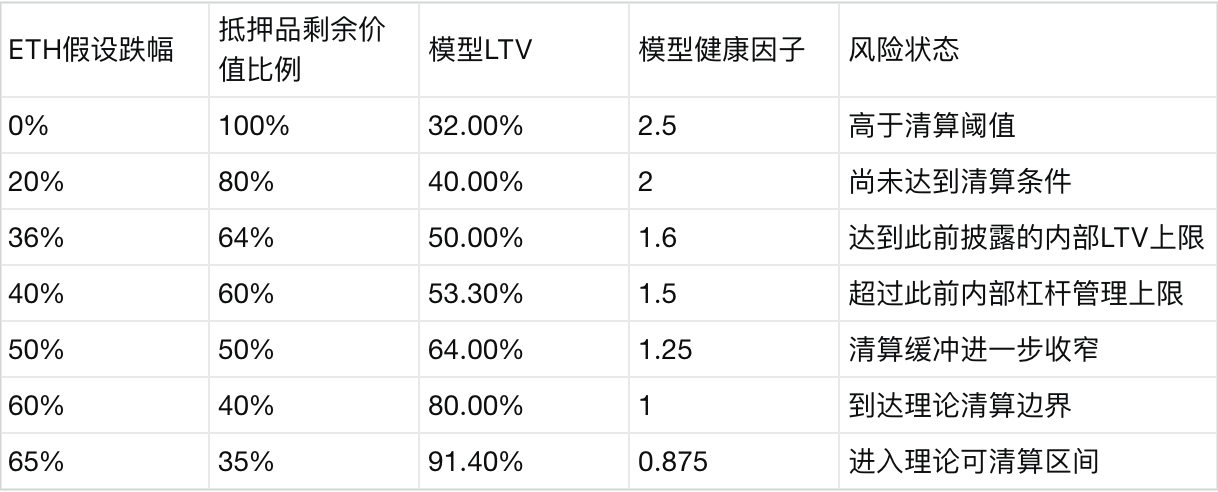 Data source: 32% LTV disclosed by BTCS on November 23, 2026, and the historical 80% liquidation threshold disclosed on August 25. All stress test results are conditional model calculations and do not represent BTCS's actual on-chain accounts or future price forecasts.
What Is the Theoretical Liquidation Price for ETH?
In the above model, the collateral price would need to fall about 60% from the starting level for the health factor to drop from 2.50 to 1.00.
The calculation relationship is:
Theoretical liquidation boundary decline = 1 − (32% ÷ 80%) = 60%.
If it is further assumed that the ETH price corresponding to the initial 32% LTV is exactly the $1,722 used by the company for asset valuation on November 22, then the theoretical liquidation boundary price is:
1,722 × (32% ÷ 80%) = $688.80.
However, the company has not explicitly demonstrated that the 32% LTV and the $1,722 valuation price use exactly the same on-chain snapshot.
Therefore, $688.80 can only be used to illustrate the calculation result in a hypothetical model and cannot be described as BTCS's actual ETH liquidation price.
Actual liquidation levels would also be affected by stablecoin debt value, accrued interest, collateral asset composition, oracle prices, and changes in protocol parameters.
Why Might a Company Sell ETH Before the Health Factor Reaches 1?
Public companies must consider both protocol liquidation risk and their own treasury management requirements.
Even if a borrowing position still has some buffer before liquidation conditions, a company may choose to repay debt early because other debt is maturing, operating cash flow is insufficient, or market volatility is intensifying.
Taking BTCS's previously disclosed 50% internal LTV cap as an example, in the above 32% initial LTV model, LTV would return to 50% as soon as collateral asset prices fall 36%.
At that point the health factor would still be 1.60, not yet at the protocol liquidation condition.
This shows that the trigger for voluntary corporate deleveraging can occur significantly earlier than the trigger for forced protocol liquidation.
A health factor above 1 does not mean a borrowing position is risk-free. Aave's official documentation notes that the volatility and price relationship between collateral assets and borrowed assets affect the appropriate level of risk buffer.
After Repaying $43.8 Million, What Financial and Operational Risks Does BTCS Still Face?
BTCS Still Has $28.4 Million in Two Disclosed Types of Debt
According to the November 23 announcement, after completing this sale and debt repayment, BTCS preliminarily estimates that the total fair value of its cash and digital assets is approximately $61 million, using the November 22 ETH price of $1,722 as a reference.
The company still has approximately $10.5 million in Aave borrowings and approximately $17.9 million in senior secured convertible note principal.
The two types of debt total:
1,050 + 1,790 = $28.4 million.
Of this, convertible notes account for approximately 63.0% of the combined principal of the two debt types.
With Aave borrowings substantially reduced, the importance of convertible notes and their maturity schedule in the company's debt structure has increased.
According to the company's announcement, these notes will mature in May and July 2027, respectively.
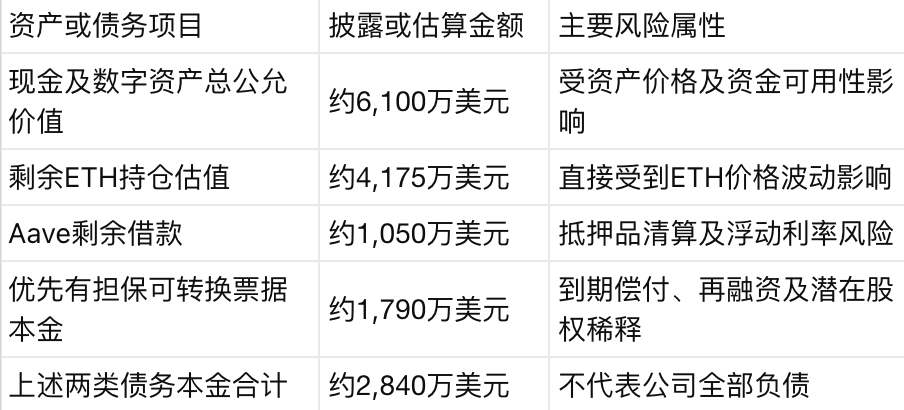
Data source: Preliminary unaudited data published by BTCS on November 23, 2026. ETH valuation is calculated independently based on 24,245 ETH and the $1,722 reference price.
The difference between the total value of cash and digital assets and the principal of the two debt types above is approximately $32.6 million.
But this difference is not the net asset value formally disclosed by BTCS.
A complete net asset value would also need to consider other assets, payables, accrued expenses, debt carrying value, potential preferred stock rights, and other accounting items.
Likewise, the $61 million cannot all be understood as cash immediately available to repay debt, because it includes ETH and other digital assets, some of which may be subject to collateral or other usage restrictions.
Imperium Contributes About 86% of Revenue but Has Temporarily Exited Liquidity Pools
BTCS is not only an ETH treasury company; it also generates revenue through DeFi activities and blockchain infrastructure operations.
According to the Q3 2026 financial report published by the company on November 12, its third-quarter total revenue was approximately $4.093 million, of which the DeFi business Imperium contributed about $3.506 million and the blockchain infrastructure business contributed about $587,000