

Workday stock falls 7% after hours—why did nearly $150 million in new AI contracts fail to lift shares?

Overview
Workday (NASDAQ: WDAY) released its FY2027 third-quarter financial results on November 24, 2026, with quarterly revenue up 11.2% year-over-year to $2.705 billion and non-GAAP diluted earnings per share of $2.82, both exceeding market expectations. New annual contract value (ACV) from the company's AI products approached $150 million, more than triple the prior-year period. However, as of 19:59 ET that day, Workday's stock fell 7.02% in after-hours trading to $166.64.
The stock decline was mainly related to slowing growth in future subscription revenue and long-term contract backlog falling short of market expectations. Although Workday raised its full-year subscription revenue guidance to $9.958 billion and its non-GAAP operating margin guidance to 31.5%, the company expects fourth-quarter subscription revenue growth of 10% year-over-year, down from 12.8% in the third quarter.
Meanwhile, Workday management disclosed that annual recurring revenue (ARR) corresponding to AI products has exceeded $750 million, up more than 130% year-over-year. This means AI commercialization is making real progress, but new contract value, annual recurring revenue, and recognized operating revenue are three different financial metrics. The rapid growth of AI products has not yet been sufficient to offset the valuation pressure from slowing growth in the overall subscription business.
Key Takeaways
According to Workday's third-quarter earnings report released on November 24, the company's subscription revenue grew 12.8% year-over-year to $2.532 billion, non-GAAP operating margin rose from 28.5% to 31.4%, and free cash flow grew approximately 25.6% year-over-year to $691 million. However, GAAP net income declined from $252 million in the prior-year period to $237 million, while diluted weighted average shares decreased by approximately 8.4%, allowing GAAP earnings per share to still rise from $0.94 to $0.96.
As of October 31, Workday's subscription revenue backlog reached $27.548 billion, up 6.1% year-over-year, of which revenue expected to be recognized over the next 12 months was $9.216 billion, up 12.3% year-over-year. Based on calculations from the raw data disclosed in the company's quarterly report, contract backlog expected to be recognized beyond 12 months was $18.332 billion, up approximately 3.2% year-over-year and down $37 million quarter-over-quarter. Meanwhile, the company expects FY2028 subscription revenue growth of approximately 11% and a non-GAAP operating margin of at least 33%. The market is reassessing whether AI commercialization can drive overall revenue reacceleration and whether margin improvement can be sustained.
Workday's Third-Quarter Results Beat Expectations—Why Did the Stock Fall 7% After Hours?
According to Stock Analysis market data, Workday rose 1.79% during the regular U.S. trading session on November 24, closing at $179.23.
After the earnings release, WDAY's stock fell significantly. As of 19:59 ET, corresponding to 08:59 Singapore time on November 25, the stock dropped to $166.64, down 7.02% from the regular trading close.
According to Investing.com's earnings preview, the market had previously expected Workday's third-quarter revenue to be approximately $2.69 billion, with adjusted earnings per share of $2.75.
The actual reported revenue of $2.705 billion was approximately 0.6% above that expectation, while adjusted earnings per share beat expectations by approximately 2.5%.
But historical results that beat market expectations do not mean that forward guidance will also meet investor expectations.
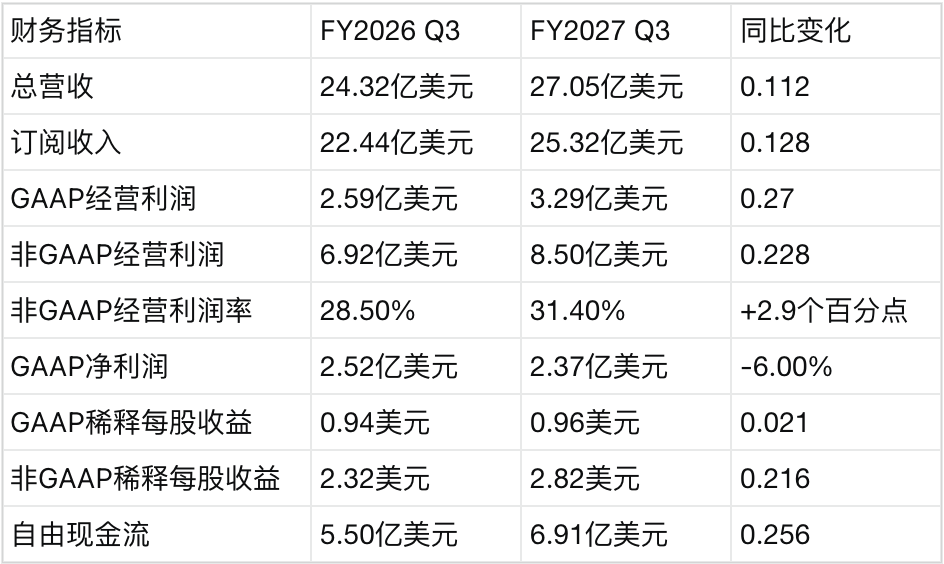
Source: Workday's quarterly earnings report and regulatory disclosures released on November 24, 2026. Some year-over-year changes are calculated based on the company's rounded data.
According to SiliconANGLE's earnings coverage, Workday's fourth-quarter subscription revenue guidance of $2.6 billion was slightly below the market's previous expectation of approximately $2.61 billion.
Although the difference is only about $10 million, the market is more focused on the trend of subscription revenue growth decelerating from 12.8% in the third quarter to an expected 10% in the fourth quarter.
For enterprise software companies whose valuations are primarily based on recurring revenue, future contract growth, customer expansion, and revenue recognition speed often have a greater impact on stock valuation than quarterly profits already achieved.
This phenomenon also explains why an overall rebound in the AI sector does not guarantee that every AI software company can continue to rise after earnings are released. For background on the recent tech stock rebound, see Analysis of the U.S. AI Tech Stock Rally.
What Exactly Does Workday's Nearly $150 Million in New AI ACV Mean?
New AI ACV Is Not the Same as AI Revenue for the Quarter
Workday CEO Aneel Bhusri said on November 24 that new ACV from the company's AI products in the third quarter approached $150 million, more than triple the prior-year period.
ACV (Annual Contract Value) is typically used to measure the annual value of a commercial contract. New ACV reflects the annual contract value corresponding to new business signed during a specific reporting period.
Suppose a company signs a three-year software subscription contract with a total value of $3 million, with the contract value evenly distributed across the three years. Its annual contract value would be:
$3 million ÷ 3 = $1 million.
However, this does not mean the software vendor can recognize the full $1 million in revenue in the quarter the contract is signed.
If the related services are delivered evenly over the next 12 months and meet the accounting conditions for time-based revenue recognition, revenue corresponding to one full quarter would be approximately $250,000. The actual amount recognized still depends on the contract start date, performance obligations, and specific billing arrangements.
Therefore, Workday's nearly $150 million in new AI ACV is a commercial contract metric, not AI operating revenue already recognized in the third quarter.
Based on the growth relationship disclosed by the company, new AI ACV in the prior-year period should have been below approximately $50 million. However, since neither the exact amount nor the exact growth multiple was disclosed for this period, the precise prior-year figure cannot be derived.
What Does AI Product ARR Exceeding $750 Million Indicate?
According to the Workday earnings call transcript from November 24, company management disclosed that as of the end of the third quarter, ARR corresponding to its AI product SKUs had exceeded $750 million, up more than 130% year-over-year and nearly 25% quarter-over-quarter.
ARR (Annual Recurring Revenue) is typically used to measure the annual revenue run rate of existing recurring business.
Compared with new ACV, ARR focuses more on recurring business relationships already established at a specific point in time, rather than new contracts signed within a single quarter.
Workday's new AI ACV and AI SKU ARR reflect new contract activity and the scale of existing recurring business, respectively. They cannot be directly added together, nor should they be treated as recognized financial statement revenue.
In addition, the company has not yet disclosed standalone quarterly AI revenue or a complete AI product income statement. Therefore, one cannot directly divide the $750 million ARR by this quarter's $2.705 billion in revenue to derive the exact share of AI business in the company's overall revenue.
More Than 2,200 Core Customers Have Purchased AI Products
Workday's third-quarter earnings report shows that more than 2,200 core customers have purchased at least one AI product, an increase of nearly 25% from the previous quarter.
Meanwhile, the earnings call disclosed that more than 525 customers have purchased Flex Credits, of which more than 250 signed new contracts in the third quarter.
Management also stated that approximately 4,800 core customers have signed what the company calls the UMSA, which is one of the prerequisite steps for adopting Workday AI products.
These figures represent customer commercial relationships at different stages.
Signing a related services agreement does not necessarily mean the customer has purchased paid AI products; purchasing Flex Credits does not mean all credits have been used; and purchasing AI products does not necessarily mean the product has been fully deployed in a production environment.
From customer signing, paid procurement, production deployment to actual usage, multiple commercial conversion stages remain.
Therefore, what will be more worth watching in the future is not only the number of customers purchasing AI products, but also the actual deployment rate, renewal rate, additional credit purchases, and related revenue recognition.
How Does Workday AI Agents Make Money? Analysis of the Sana and Flex Credits Business Model
Transitioning from Traditional Subscription Software to an Enterprise Agent Platform
Workday has long served enterprise human resources management, financial management, and related business processes.
Traditional software mainly helps employees enter information, query data, and execute pre-set workflows, while enterprise-grade AI agents attempt to further complete cross-system tasks, information analysis, and business process automation.
Workday announced its next-generation Sana products and Autopilot Agents features on October 13, 2026.
Sana handles user interaction and agent coordination, while Autopilot Agents target routine repetitive work in human resources, finance, and IT.
Compared with general-purpose AI chatbots, enterprise agents also need to comply with organizations' internal data access permissions, approval rules, and business control requirements.
For example, an HR agent can help employees inquire about leave policies or initiate related requests, but whether it can further execute approvals or modify business data must be constrained by the permission system pre-set by the enterprise.
The commercial value of this business model comes not only from AI's ability to generate content, but also from whether it can reliably complete tasks within the enterprise's existing systems.
How Does Flex Credits Create a Usage-Based Charging Mechanism?
According to Workday's official Flex Credits product description, the company provides AI agents and other platform features to customers through a usage-based billing model.
Customers can obtain a certain number of usage credits according to contractual arrangements and apply those credits to eligible AI services.
This mechanism enables Workday to establish a commercialization path related to AI feature usage beyond traditional software subscriptions.
However, according to the company's November 24 earnings call, at the current stage a considerable portion of the AI business is still commercialized through premium subscription licenses.
Therefore, Workday's current AI revenue model has not yet fully shifted to usage-based billing, but is instead composed of traditional subscriptions, premium AI product licenses, and usage credit mechanisms.
Management stated that of the nearly $150 million in new AI ACV this quarter, more than half came from the company's self-developed AI products and Flex Credits.
This provides an important basis for judging whether AI commercialization relies entirely on external acquisitions, but because the company did not further break down the respective amounts of self-developed products and Flex Credits, more than half of the new ACV cannot be attributed entirely to the usage-based billing model.
How Do AI Partnerships and Acquisitions Affect Commercialization?
Workday announced on October 13 a new partnership with Anthropic to combine Claude's reasoning capabilities with Sana agents and enterprise business data.
The company had previously expanded its partnership with Google Cloud and plans to further integrate Sana services into enterprise work platforms such as Microsoft Copilot, Teams, and Slack.
For Workday, integrating AI capabilities into software environments customers already use may lower the adoption barrier for new products.
However, product integration and partnership announcements do not mean the related features have been fully put into production, nor do they mean the company has secured a definite amount of new revenue.
Meanwhile, Accenture announced on October 13 an embedded engineering collaboration program with Workday to help enterprise customers complete AI agent deployment and business process adjustments.
Workday also completed its acquisition of agent identity management platform C1.ai on November 23.
According to the quarterly report filed with the U.S. Securities and Exchange Commission, the transaction consideration was approximately $850 million and remains subject to relevant purchase price adjustment provisions.
Because the acquisition was completed after the quarter ended on October 31, C1.ai's operating results have not yet been consolidated into this third-quarter financial result.
When analyzing Workday's AI business growth in the future, it will be necessary to further distinguish growth from self-developed products, contributions from acquired businesses, and growth in customer usage.
Other enterprise software companies are also exploring similar commercialization paths. For example, Zoom Q3 FY2027 Earnings Analysis focuses on the penetration of paid AI features in enterprise customer transactions, while Autodesk Earnings Preview discusses AI usage credit charging mechanisms in professional design software.
Why Did Workday's Long-Term Subscription Contract Backlog Grow Only 3.2%?
The Growth Structure of the $27.548 Billion Contract Backlog
Workday defines Subscription Revenue Backlog as the remaining performance obligations under subscription contracts for which revenue has not yet been recognized.
This metric differs from recognized operating revenue and mainly reflects the future revenue scale corresponding to the company's existing contracts.
Of this, subscription revenue backlog for the next 12 months is typically referred to as current remaining performance obligations (cRPO), while the portion beyond 12 months corresponds to longer-term contract revenue.
Based on Workday's third-quarter regulatory report and the second-quarter earnings report released on August 27, the growth structure of the company's contract backlog can be broken down.
 Source: Workday FY2027 second-quarter earnings report and third-quarter Form 10-Q. Backlog beyond 12 months and related percentages are calculated independently based on the company's disclosed raw data.
As of October 31, 2026, subscription revenue backlog beyond 12 months was:
27.548 − 9.216 = $18.332 billion.
The corresponding amount in the prior-year period was:
25.963 − 8.206 = $17.757 billion.
Therefore, the year-over-year growth rate