

Top 10 Non-Custodial Crypto Wallets for High Net Worth Individuals: Fall 2026 Edition

Comparisons of crypto wallets are never in short supply. But the vast majority are written for ordinary users. An affluent individual or family office holding six, seven, or even eight figures in assets has entirely different preferences. At this scale, what the holder is choosing is no longer an app, but an operating model for managing a substantial portion of their balance sheet.
This report scores ten non-custodial wallets across twelve criteria: Bron, Ledger, MetaMask, MPC Vault, Phantom, Safe, Tangem, Trezor, Trust Wallet, and Zengo, with data as of November 2026. Every factual conclusion is traced back to vendor official documentation and help centers, and cross-checked against hands-on testing—each vendor's own customer service received the same set of questions about recovery, inheritance, team permissions, and limits. The scoring methodology is fully disclosed, and readers who disagree with any of the weightings can recalculate the total scores themselves.
Results Overview
Total score (out of 100)
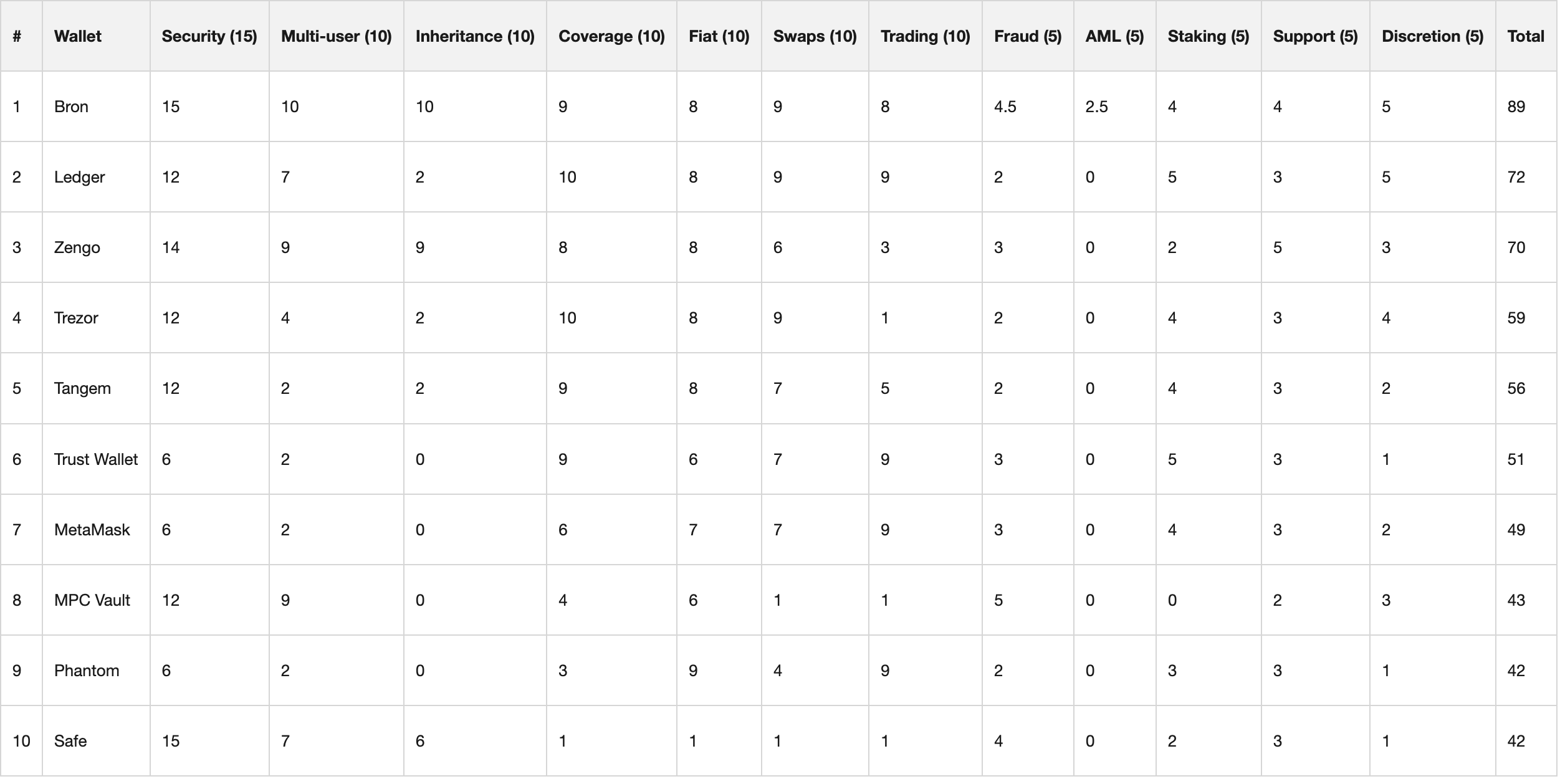
Total scores and twelve sub-scores for the ten non-custodial wallets
How Did Each of the Ten Wallets Score, and Why?
Bron (89) leads, and its sub-score shape explains the reason better than the total. It earns full marks in four categories: security, multi-user management, inheritance, and holding privacy. It is the only wallet in this group that provides on-chain confidentiality for mainstream tokens via the Zama standard, and it also offers PIN-hidden accounts, with resets taking 24 hours to take effect. Its deductions are itemized: 1 point each for asset coverage, cross-chain swaps, staking, and customer service; 0.5 points for anti-fraud tools; 2 points for fiat because there is no card; 2 points for trading—tokenized US stocks and ETFs are open to all users, but crypto, stock, and commodity perpetuals on Hyperliquid require users to actively apply for access; the biggest loss is anti-money laundering, at 2.5 points. Bron is the only wallet in this group that screens inbound and outbound transfers (via Hypernative), but this too requires an application. Holders who want these two capabilities must separately ask Bron to enable them for their account.
Zengo (70) trails Ledger by two points in third place and is the strongest consumer-grade MPC product this audience can buy: near-full marks in security, multi-user roles, and inheritance; the only vendor in this group with a published customer service response-time guarantee; a dedicated service desk for large fiat purchases; and solid holding privacy. The remaining issues: inheritance uses a timer-based process, staking categories are thin, there are no perpetuals or tokenized stocks, no card, and anti-fraud tools lack whitelisting and in-app revocation.
Ledger (72), Trezor (59), and Tangem (56) represent the best state of the hardware route and its ceiling. Ledger is second, two points above Zengo, with top-tier coverage and staking in the group, a complete trading stack in the app, near-full cross-chain swap coverage, and physical confirmation required for every transaction—but for this audience, the shortcomings are that the consumer app supports only a single user, inheritance is essentially absent, and the device itself exposes itself when crossing borders. Trezor ties Ledger on coverage and cross-chain, adds open-source firmware and a dedicated advisor for large fiat transactions, but has no native multisig, no in-app trading, and thin anti-fraud tools. Tangem's card sidesteps the visibility problem, and since October 2026 the app has added tokenized stocks and ETFs and supports two-way transfers with US banks via Tangem Pay; but it too is capped at a single user, a card that changes hands is recognized as a key that changed hands, it earns no inheritance points, has no in-app approval revocation, and for users who decline the optional mnemonic backup, the recovery model is extremely harsh.
Trust Wallet (51), MetaMask (49), and Phantom (42) are all excellent retail products—Trust's staking and yield categories are the most complete in the group, and all three score near-full marks for in-app perpetuals and tokenized stocks—but all three fail simultaneously where private wealth cares most: one device, one factor, no second user, no inheritance. Great for retail, unsuitable as a custody vehicle for affluent individuals and high-net-worth clients.
MPC Vault (43) and Safe (42) are serious infrastructure, but not easy to use. MPC Vault has a genuine policy engine, the most complete anti-fraud tools in the group, and private vaults, yet no inheritance functionality at all, private key export available only on the highest-tier plans, and no staking or trading. Safe remains the strongest signing architecture overall, with full marks on security, but more than half its points are lost to structural issues: no Bitcoin support, fiat can only be bought by card with no off-ramp, customer service has no SLA, no derivatives in the app, and the operating experience assumes you have an engineer at your side.
Scoring Methodology: How Are the Twelve Criteria Calculated?
The methodology itself is simple: each criterion is assigned a point value based on its importance to large private holdings, and each wallet is scored directly against those values. Full marks require the capability to be native and documented. Deductions are itemized—whenever points are lost, the table states exactly how many and where. A score of 0 means the capability does not exist at all. If a capability exists in the product but requires users to apply for it and is not available by default to all users, only half of that criterion's points are awarded, and the table notes specifically which ones. Because each score is itself a point value, the twelve sum to a total out of 100.
The table below lists the twelve criteria from highest to lowest point value, and the sections of the body follow the same order.
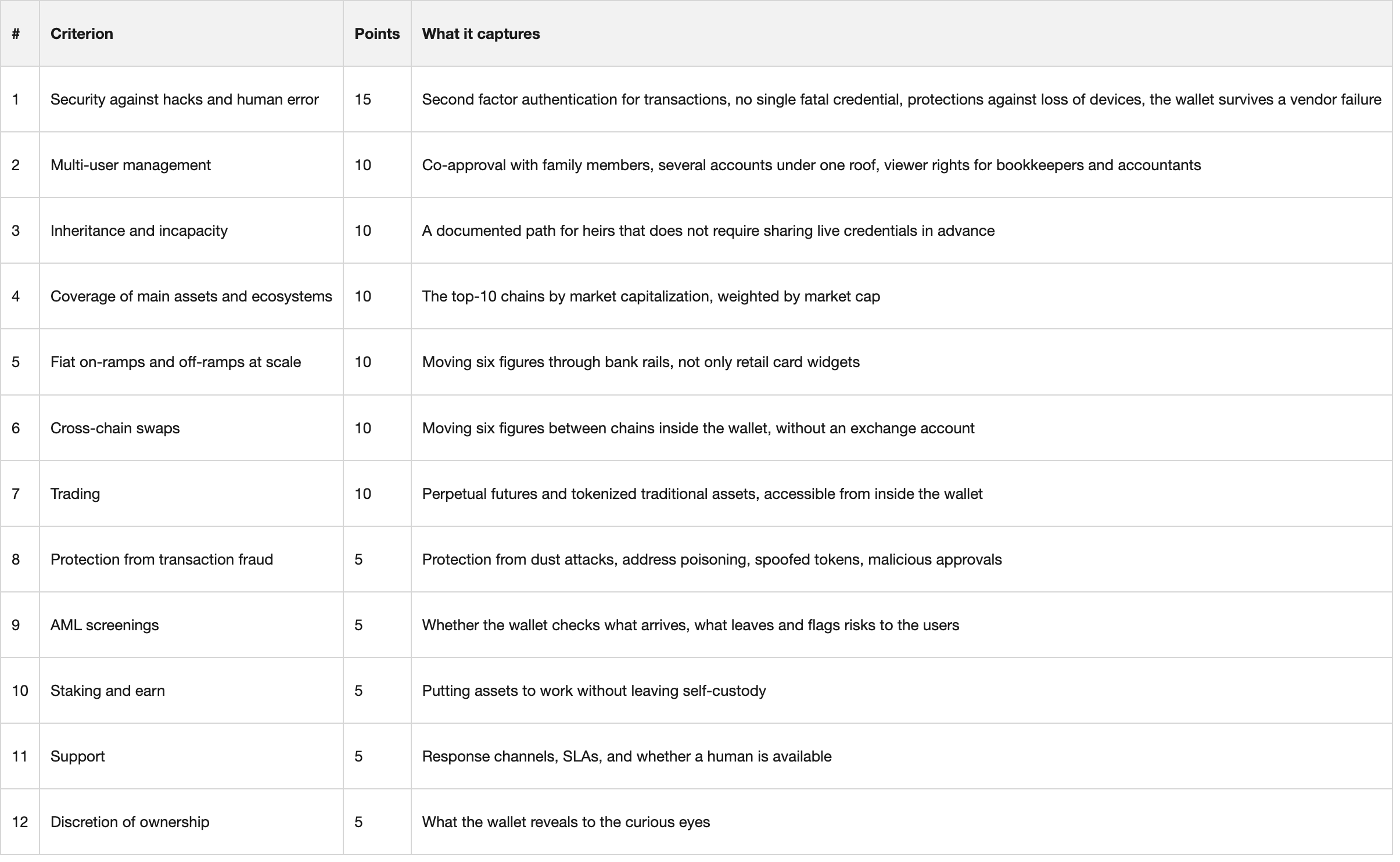
The twelve scoring criteria and their point values
1. Security Against Hackers and Human Error (15 points)
What we assessed:
(a) Whether every transaction requires a second, independent authorization—hardware confirmation, a biometric gate, or a co-signer;
(b) Whether the design has a single credential that, once lost, cannot be recovered;
(c) Whether a documented recovery path exists after the device and all credentials are lost;
(d) What happens to the holder's access if the vendor itself ceases operations.
On the first test, the camps divide cleanly. Ledger, Trezor, and Tangem's card wallets require physical confirmation for every signature—a button press, touchscreen, or NFC tap—so purely remote attacks fail; Tangem's cardless mobile wallet is not included here. Zengo Pro's Theft Guard adds 3D FaceLock biometrics to withdrawals above a user-set threshold. Multi-party designs go further: Safe's on-chain M-of-N signing, and the approval quorum thresholds in the policy engines of Bron and MPC Vault—Bron can also configure a security delay—mean that a stolen phone or a coerced signer is not enough to move the money. Software wallets with mnemonics—Trust, MetaMask, Phantom—authorize with a password or biometrics on the same device, effectively only one factor; Phantom's newer Google and Apple login wallets instead sign through its own server-side key enclave.
On the second and third tests, the ranking partially reverses. For every mnemonic product, the mnemonic is the single fatal credential: Trust customer service, when asked directly, replied "unable to recover the wallet or funds... even with identity verification or a third party," and Phantom customer service gave the same answer to a user who lost both the mnemonic and social login. MetaMask's optional Google and Apple login takes the mnemonic out of the user's hands and replaces it with a password that, according to MetaMask, cannot be recovered. The MPC generation eliminates this failure mode: Bron restores access via verification codes or FaceScan provided by two guardians, both with a 48-hour delay, or a 30-day self-service recovery; Zengo via email, biometrics, and a cloud recovery file; MPC Vault via a personal key certificate that users must back up themselves. Ledger turns recovery into a subscription—Ledger Recover, provided by Coincover, free for the first month then €9.99 per month, requiring identity verification against a government ID. Trezor does not sell a recovery service, but its Multi-share Backup can split the mnemonic into up to 16 shares, none of which is individually fatal.
The fourth test—vendor failure—requires the most due diligence, because the answers differ in nature. BIP-39 mnemonics are designed not to depend on the vendor: holdings in Trust, MetaMask, Phantom (mnemonic wallets), Ledger, Trezor, and Tangem can all be restored to any compatible wallet without vendor cooperation. Safe's contracts are on-chain and any interface can drive them, though the hosted Safe{Wallet} interface is itself a single point of failure (a compromised Safe developer machine led to the approximately $1.5 billion Bybit hack in 2025). MPC wallets must achieve the same guarantee through engineering, and vendors differ: Bron open-sources its MPC library, audited by Trail of Bits, and publishes an emergency key reconstruction path—the user's device and Qrypt, an independent third party holding the third key share, reconstruct the signing key without Bron; Zengo relies on a recovery system independently operated by a software escrow company and a trust institution, triggerable via a public GitHub repository if the company ceases operations; MPC Vault offers key share export, but only to annual Scale and Enterprise customers, and only through manual initiation by an account manager.
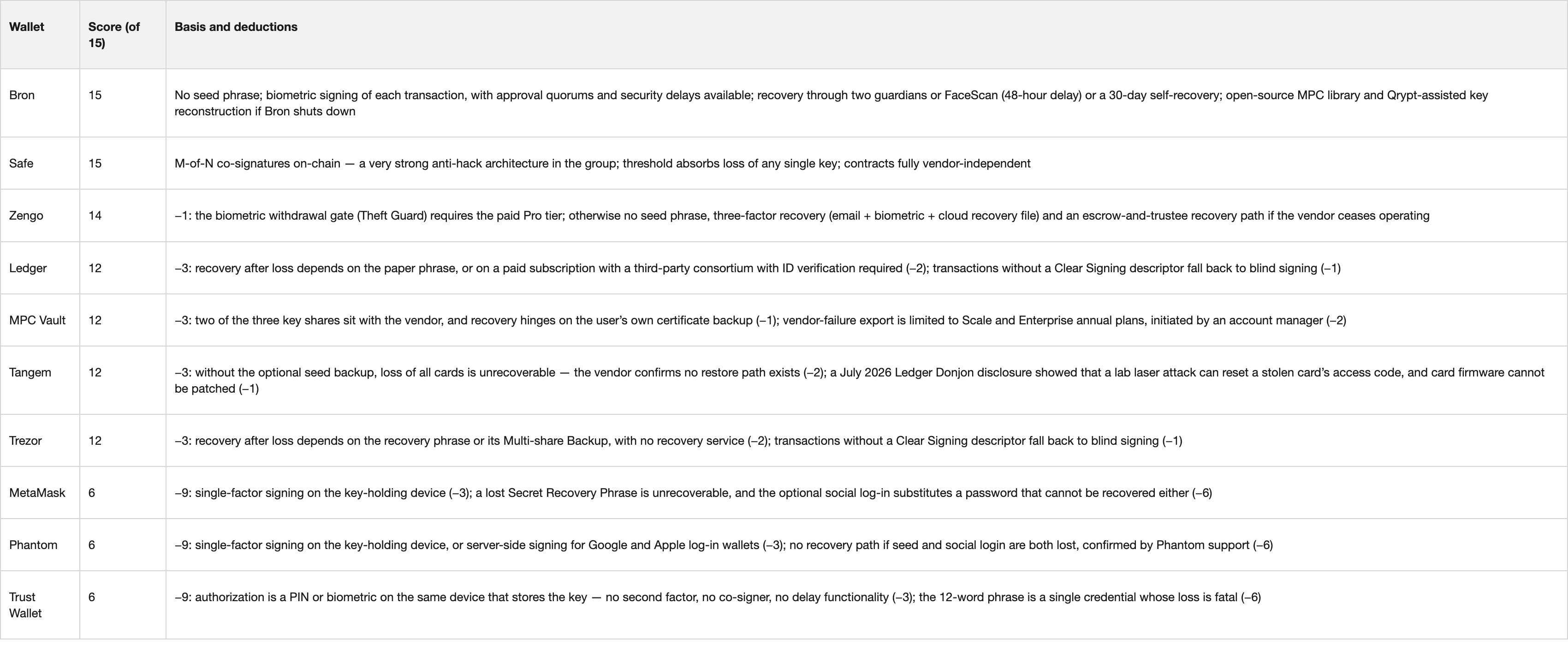
Sub-scores for the first criterion, "Security"
2. Multi-User Management (10 points)
What we assessed:
(a) Whether roles are separated—at minimum an approver who can co-sign and a viewer who can see but not touch;
(b) Whether transactions support multi-party approval with thresholds and limits;
(c) Whether multiple accounts or vaults can be managed under the same entity;
(d) Whether these capabilities exist in the product a private buyer can actually purchase, rather than a separate institutional edition.
Family offices run on separation of duties: the principal approves, the spouse or advisor co-signs, and the bookkeeper sees everything but can touch nothing. Six of the ten cannot express this relationship at all. Trust, MetaMask, Phantom, Tangem, Trezor, and Ledger's consumer app are all single-user products; asking their customer service directly yields the answer that the only way to share control is to share the key itself—precisely what affluent families must never do. Read-only modes (Trust's View-Only Wallet, Phantom's Watch Address) provide visibility rather than governance, and earn only the 2 points for visibility; MetaMask also earns 2, because its institutional connector hands roles to an external custodian.
Four products provide real answers. Bron offers Owner, Member, and Viewer roles, with approval permissions assigned by policy (a Viewer can also be an approver), and multi-party coverage across all chains including Bitcoin and Tron. Zengo Business offers Admin, Approver, Controller, and Viewer roles with configurable multisig thresholds; it is a separate enterprise app aimed at organizations, hence a 1-point deduction. MPC Vault has organization owners, admins, and members, with vault managers and members bound by transaction policies, and accountants with read-only access. Safe expresses roles on-chain through signer sets and proposers, with finer permissions relying on the third-party Zodiac Roles module—unsurpassed in granularity within the group, but EVM-only and assembled like an engineering project rather than flipped on with a switch; since October 2026, new spending limits and proposers require the paid Safe Pro plan.
Ledger deserves a separate note on consistency, because its score differs from Zengo's for a reason. Zengo's roles are a self-service enterprise app under the same brand; Ledger's consumer app has no roles, and M-of-N approval exists only in Ledger Multisig—a separate Safe-based app for teams, covering five EVM chains, with owners and proposers but no viewer role, at $10 or 5 basis points per transaction—and in Ledger Enterprise, an institutional platform that requires contacting sales. We acknowledge these paths exist, but they are not friendly to the family scenario. Trezor scores lower: Trezor Suite has no multisig and no roles, and M-of-N requires pairing the device with a third-party multisig service, mostly limited to Bitcoin.
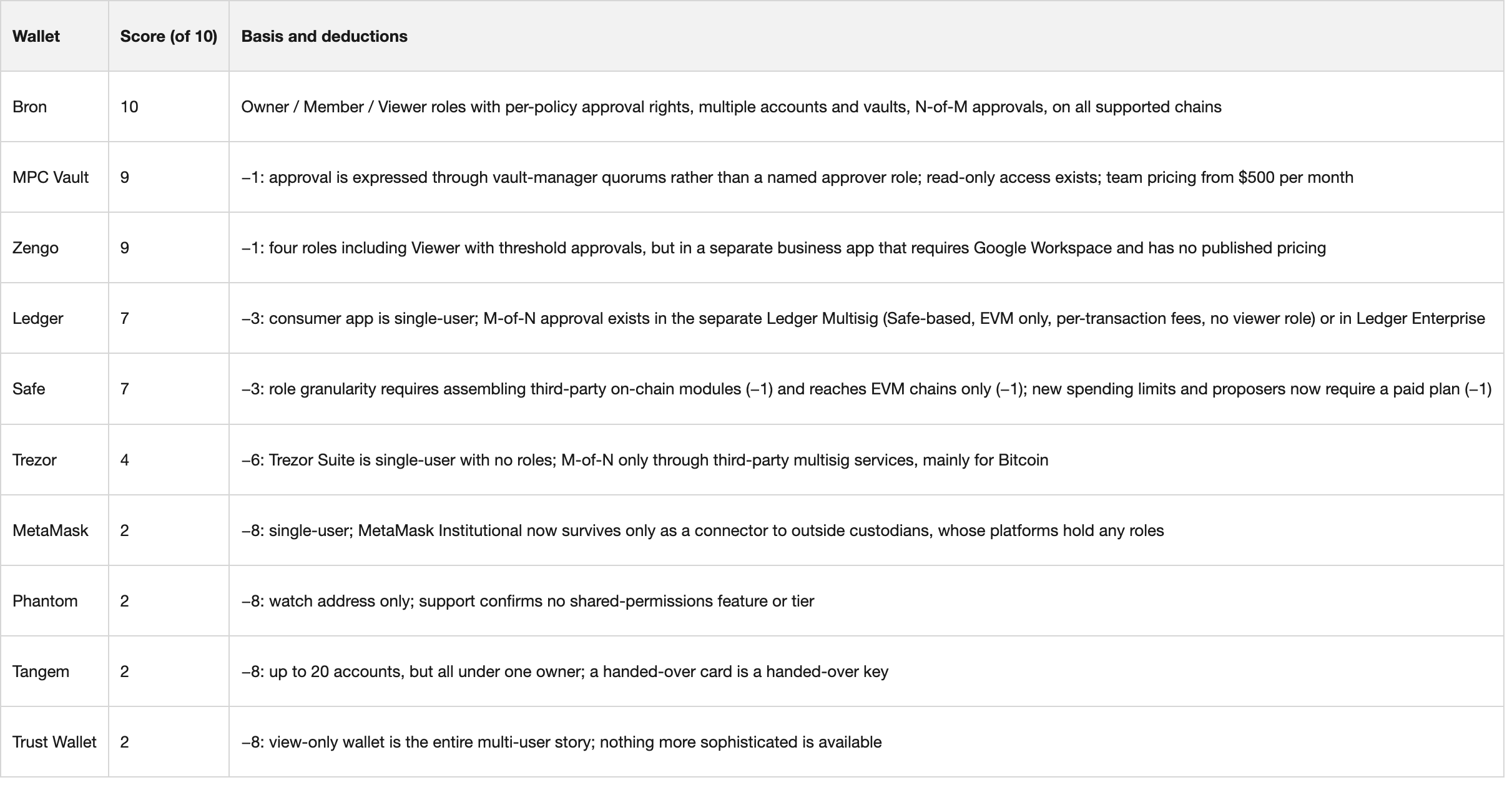
Sub-scores for the second criterion, "Multi-User Management"
3. Inheritance and Incapacity (10 points)
What we assessed:
(a) Whether there is a named, operational inheritance feature, and whether it is independent of a third-party vendor;
(b) Whether there is a mechanism to prevent premature or fraudulent execution of an heir's claim;
(c) Whether the arrangement requires handing valid credentials to heirs in advance (which turns inheritance into a permanent security hole).
This is the category where the entire industry fails most completely, and the one private wealth readers should weigh most carefully themselves. Four of the ten—Trust, Phantom, MetaMask, MPC Vault—have nothing: no feature, no beneficiary designation, no dormancy mechanism. Their customer service confirms that heirs who do not independently hold credentials inherit nothing.
Two products have named features. Bron's Digital Inheritance is process-designed: only a designated beneficiary can initiate a claim, which then enters a 12-month delay; the beneficiary can shorten it to 6 months by entering verification codes from two guardians, and the holder, any guardian, or any beneficiary can cancel at any time—a deliberate design that blocks both premature seizure and forged claims, rather than a simple dead man's switch. Zengo's Legacy Transfer is a Zengo Pro feature that, after a 3-to-24-month inactivity timer (reset each time the holder opens the wallet), releases access to a single designated recipient; setup shares the inheritance file via a Dropbox account, and the file is also stored in iCloud or Google Drive.
Two others support "no dedicated feature but workable" arrangements. Safe can be configured so that a designated recoverer replaces signers after a review delay (28 days by default, with 7, 14, or 56 days selectable), during which existing signers can veto—effective, but do-it-yourself, and EVM-only. Tangem's answer is a physical approach: give a backup card to a trusted person, lawyer, or safe deposit box, and store the access code separately—which amounts to handing over a valid key in advance, functionally no different from sharing the mnemonic, so it scores no higher than the "guidance" level. Ledger's inheritance guide, updated in October 2026, does not offer a Ledger product but instead directs users to third-party services or Ledger Multisig. Trezor likewise has no inheritance product and directs users to its multisig partners, building an inheritance solution outside the app.
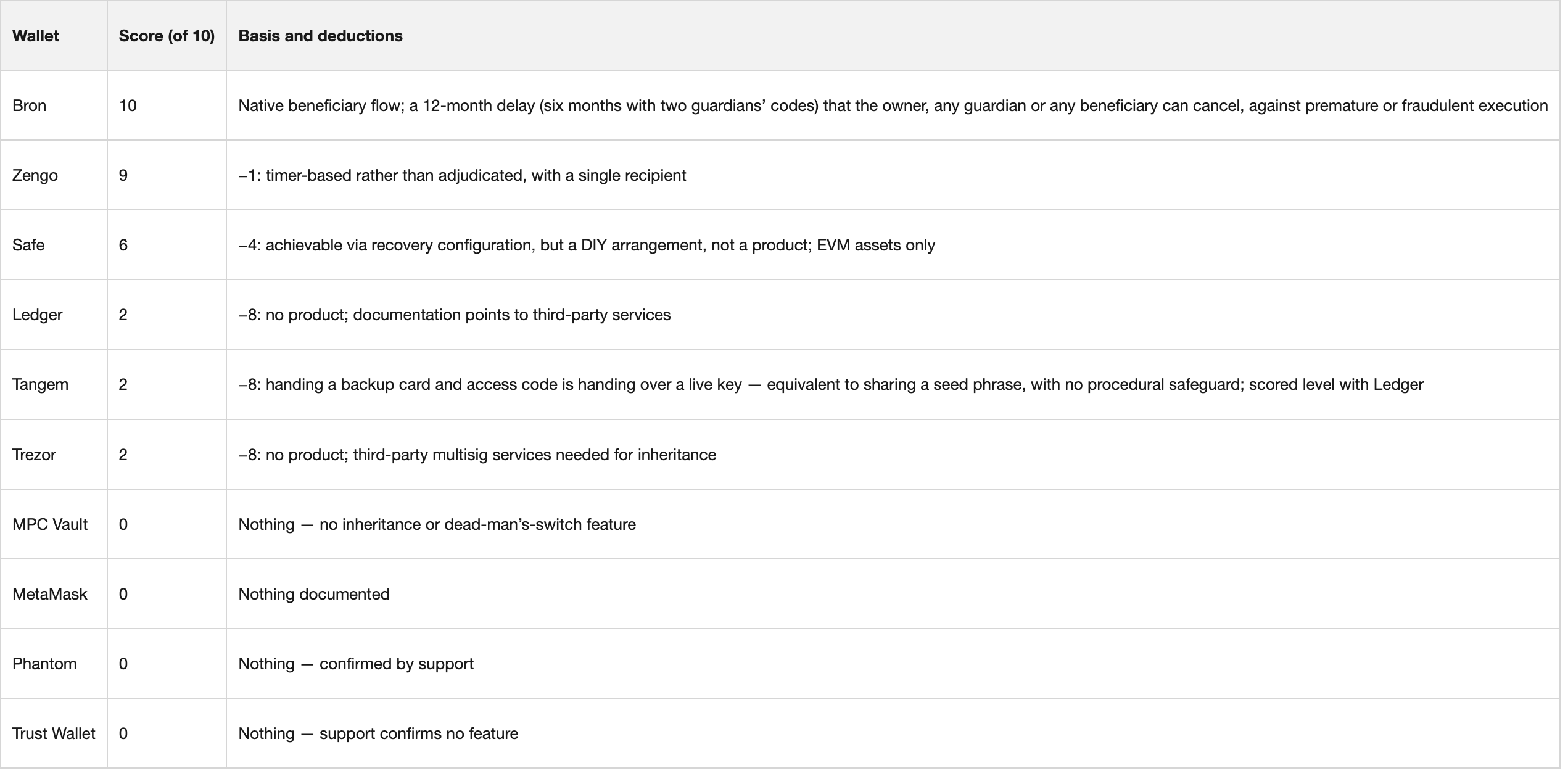
Sub-scores for the third criterion, "Inheritance and Incapacity"
4. Major Asset and Ecosystem Coverage (10 points)
What we assessed:
(a) Support for the top ten public chains by market cap, weighted by each chain's share (Bitcoin alone accounts for 72.1% of the top-ten total, and the top ten together account for about 83% of the entire market);
(b) Depth beyond the top ten, described but not scored.
After excluding stablecoins and tokens, the top ten on CoinMarketCap as of October 23, 2026 are Bitcoin, Ethereum, BNB Chain, XRP, Solana, Tron,