

Nvidia CEO Jensen Huang Returns, NVDA Surges 31% — Why Are US Tech Stocks Rallying Across the Board?

Overview
On November 23, 2026, Jensen Huang officially returned as NVIDIA's (NASDAQ: NVDA) President, Chief Executive Officer, and member of the Board of Directors, driving NVIDIA's stock up 31.48% to $165.05 in a single day, with the Nasdaq Composite rising 6.51% and the S&P 500 gaining 4.73%. This broad rally in tech stocks primarily reflected the market's repricing of uncertainty surrounding NVIDIA's management and a restoration of confidence in the sustainability of AI infrastructure investment.
According to MarketWatch market cap data, NVIDIA's market capitalization increased by approximately $952 billion in a single day, marking the largest single-day market cap gain in the company's history. However, based on historical closing prices, even after this sharp rebound, NVIDIA's stock remains about 5% below its November 11 level.
Jensen Huang's return alleviated uncertainty around the company's strategic execution and management succession, but it did not directly generate new GPU orders or change previously announced financial guidance. AI infrastructure investment returns, chip manufacturing costs, corporate financing pressures, and U.S. inflation remain key factors determining whether the tech stock rally can be sustained.
Key Takeaways
According to November 23 U.S. stock market closing data, NVIDIA rose 31.48%, the Nasdaq 100 gained 6.86%, the semiconductor index rose approximately 14%, and the S&P 500 Information Technology sector climbed about 9%. AI cloud computing company CoreWeave rose 22.3%, Micron Technology gained 19.04%, and Google parent Alphabet advanced 6.3%, indicating that the scope of market repricing has expanded from GPU design to memory chips, cloud computing, and other AI infrastructure segments.
NVIDIA's FY2027 third-quarter financial results released on November 17 showed revenue up 103% year-over-year to $115.8 billion, with data center revenue up 110% year-over-year to $107.6 billion. The company guided fourth-quarter revenue to $130 billion, plus or minus 3%, but that quarter includes an extra week. Adjusted for comparability on a 13-week versus 14-week basis, the fourth-quarter average weekly revenue guidance implies growth of only about 4.2% over the third quarter, below the unadjusted 12.3% sequential increase. Management's return improved market sentiment, but operating growth still requires validation through financial data.
Why Did Jensen Huang Return as NVIDIA CEO?
NVIDIA's Board of Directors announced on November 23 that, following a series of discussions with Jensen Huang, the Board unanimously voted to reinstate him as President, Chief Executive Officer, and Board member, effective immediately.
According to Reuters market reports, NVIDIA had previously announced on November 12 that Jensen Huang was stepping down. Chief Financial Officer Colette Kress subsequently served as interim CEO.
In its November 23 announcement, NVIDIA's Board stated that, based on communications with senior U.S. government officials, it believed Huang's reinstatement would not pose a national security risk.
However, the company also confirmed that an investigative committee composed of independent directors will continue to complete its related inquiry. The previously established National Security and Export Controls Committee will also continue to fulfill its responsibilities, and the company will hire a Chief Compliance Officer.
Therefore, Huang's return does not mean that all regulatory and governance issues previously involving the company have been resolved.
The stock price reaction is better understood from the perspective of key-person risk.
For a semiconductor company that relies heavily on its technology roadmap, supply chain coordination, and partnerships with major customers, an abrupt CEO change could heighten investor concerns about strategic continuity.
NVIDIA's Blackwell, Vera Rubin, and subsequent computing platforms span multiple product cycles and require long-term coordination across foundry, advanced packaging, high-bandwidth memory, networking equipment, and data center customers.
Management's return reduced market concerns about changes in these strategic execution areas, but it will not automatically alter signed supply contracts, product delivery cycles, or chip production capacity.
For more information on NVIDIA's business, financial performance, and product roadmap, please refer to the NVIDIA topic page.
How Much Did U.S. Tech Stocks Rise? A Broad Rebound Across the AI Supply Chain
According to closing data from the regular U.S. trading session on November 23, gains in semiconductor and AI infrastructure-related assets were broadly higher than those of major U.S. stock indices.
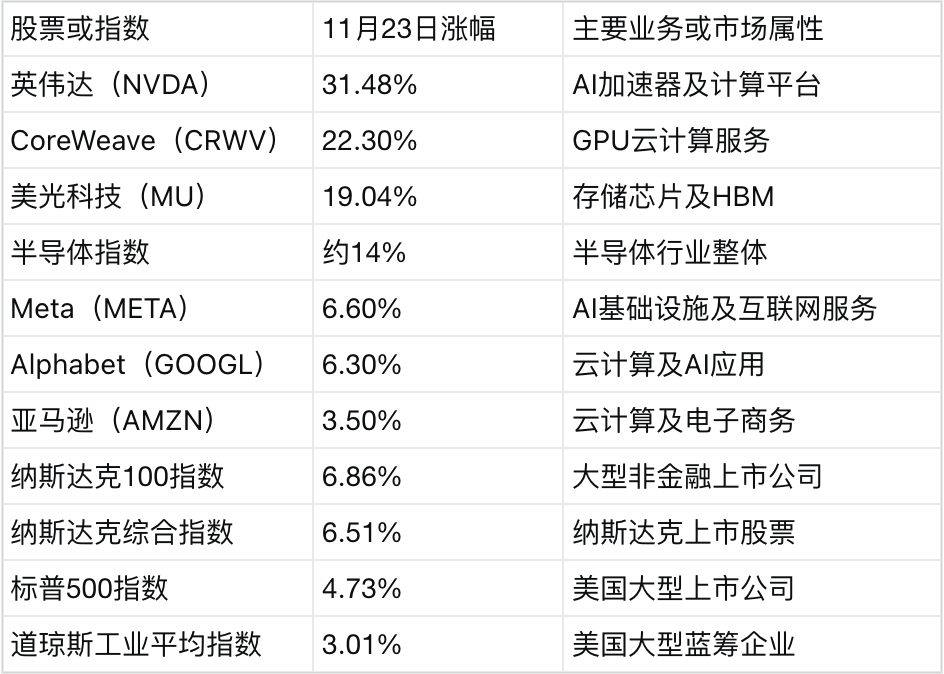
Source: Reuters, Micron Technology market coverage, and YCharts index data, as of 16:00 EST on November 23, 2026, corresponding to 05:00 Singapore time on November 24.
Why Did Semiconductor Stocks Rally First?
NVIDIA is a key participant in the AI computing infrastructure supply chain, with product demand involving advanced-node wafers, HBM, packaging substrates, and networking equipment.
According to a supply chain partnership announcement published on November 17, NVIDIA is expanding manufacturing partnerships with TSMC, Foxconn, Amkor Technology, and other supply chain companies to support production demand for current and next-generation computing platforms.
Following Jensen Huang's return, investors may lower their expectations of major changes to the aforementioned product roadmap and manufacturing partnerships.
For memory chip manufacturers such as Micron Technology, growth in AI accelerator shipments could further drive HBM demand. For foundry and advanced packaging companies, demand transmission is reflected in wafer starts, capacity utilization, and packaging business scale.
However, the November 23 stock price gains do not prove that the companies involved secured new purchase contracts that day.
Why Did AI Cloud Computing Companies Also Surge?
CoreWeave rose 22.3% on November 23, indicating that the market rally has extended to GPU compute leasing and AI cloud computing services.
NVIDIA's November 17 earnings release confirmed that the Vera Rubin NVL72 computing platform has begun shipping and is running at partners including CoreWeave, Google Cloud, Microsoft Azure, Oracle Cloud Infrastructure, and Nebius.
For these cloud computing companies, the continuity of GPU product supply is critical to data center deployment, compute leasing contracts, and future revenue recognition.
However, GPU procurement and data center construction also require substantial capital expenditure. Even with strong customer demand, financing costs, equipment depreciation, compute utilization rates, and contract pricing will still affect the actual investment returns of cloud computing companies.
AI Supply Chain Gains Do Not Mean All Tech Stock Risks Have Declined in Tandem
According to Associated Press market coverage, the rally also extended to power equipment and engineering machinery industries related to data center construction.
This indicates that AI investment has formed a cross-industry capital expenditure chain, but it also means that different companies face different risks.
Chip manufacturers primarily face technology iteration, capacity, and inventory risks; compute leasing companies need to monitor financing and equipment utilization; software companies need to demonstrate that AI features can translate into new paid revenue.
It is not possible to treat these companies as having the same profit models or risk levels based solely on a single day's stock price gains.
NVIDIA Rose 31.48% — Has It Fully Recovered Previous Losses?
Although this rally was one of NVIDIA's largest single-day rebounds in recent years, the company's stock has still not fully recovered when viewed across the full price change range.
According to Stock Analysis historical data, NVIDIA's key closing prices before and after Jensen Huang's departure are as follows.
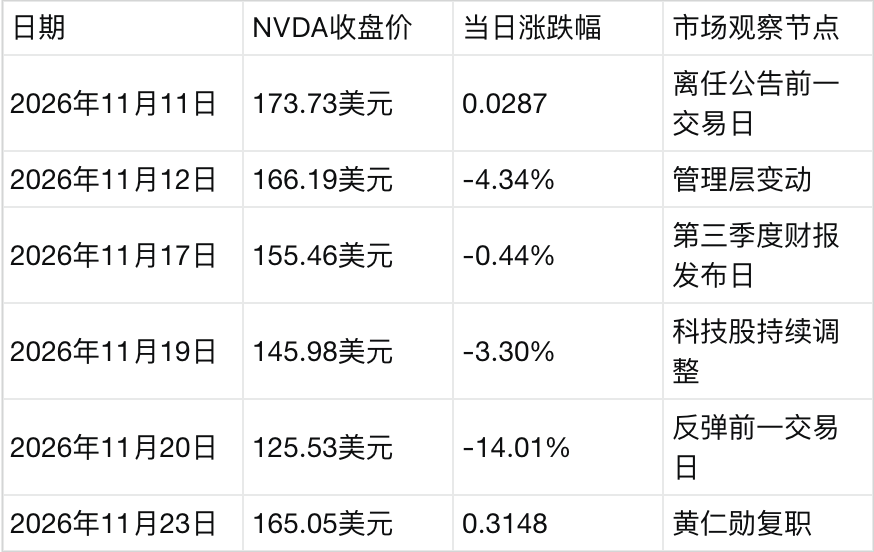
Source: Stock Analysis U.S. stock historical closing data, as of 16:00 EST on November 23, 2026.
NVIDIA fell from $173.73 on November 11 to $125.53 on November 20, a cumulative decline of approximately 27.7%.
Subsequently, the stock rebounded from $125.53 to $165.05, a single-day gain of 31.48%.
However, the decline and the rebound are calculated on different bases and cannot be directly compared by subtracting 27.7% from 31.48% to determine whether all losses have been recovered.
Based on actual closing prices:
Cumulative return = (165.05 ÷ 173.73 − 1) × 100% ≈ -5.0%
To fully recover from $125.53 to $173.73, a gain of approximately 38.4% would be required.
This rally actually recovered $39.52 of the stock price decline, against a prior cumulative decline of $48.20, corresponding to a price loss recovery ratio of approximately 82.0%.
Yahoo Finance historical data also records the $165.05 closing price and 31.48% single-day gain, providing cross-validation with the above market data.
Trading volume also indicates high market attention to this rally. According to the same Stock Analysis data source, NVIDIA's trading volume on November 23 was approximately 783 million shares, an increase of about 23.6% from 633 million shares on November 20.
However, high volume alone cannot prove that the gains came from long-term institutional buying, short covering, or other trading behavior. Public market data is not yet sufficient to accurately decompose the contribution of various market participants to the 31.48% gain.
Readers can visit the NVIDIA stock market page to further view NVDA's price changes and related market information.
Can NVIDIA's Strong Earnings Support Further Gains in AI Tech Stocks?
NVIDIA had already reported its FY2027 third-quarter results before Jensen Huang's reinstatement.
According to the official quarterly earnings release published on November 17, the company's third-quarter revenue reached $115.8 billion, up 103% year-over-year, with GAAP net income of $65.3 billion, up 105% year-over-year.
Data center revenue reached $107.6 billion, up 110% year-over-year, accounting for approximately 92.9% of the company's total revenue.
These figures indicate that AI infrastructure demand had already been reflected in the company's actual operating performance before the management change.
However, there is an easily overlooked calendar-basis difference in the next quarter's financial guidance.
The $130 Billion Revenue Guidance Includes an Extra Week
NVIDIA guided FY2027 fourth-quarter revenue to $130 billion, plus or minus 3%, corresponding to a range of $126.1 billion to $133.9 billion.
Comparing the guidance midpoint with third-quarter revenue:
Sequential quarterly revenue growth = (1,300 ÷ 1,158 − 1) × 100% ≈ 12.3%
However, according to NVIDIA's previously published quarterly reports and the latest earnings notes, FY2027 fourth quarter includes 14 weeks, while the third quarter was a standard 13 weeks.
After adjusting for the statistical period, the growth difference between the two is as follows.
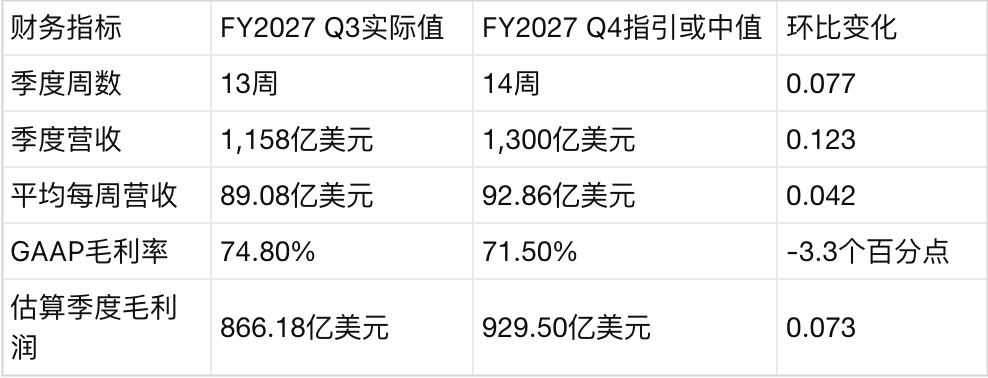
Source: NVIDIA earnings release dated November 17, 2026. Fourth-quarter revenue and gross margin use the company's guidance midpoint; average weekly revenue and gross profit are conditionally calculated results.
Comparing on an average weekly revenue basis:
(1,300 ÷ 14) ÷ (1,158 ÷ 13) − 1 ≈ 4.2%
This means that the unadjusted 12.3% sequential revenue growth expectation includes the statistical period expansion from the extra week.
Average weekly revenue growth of approximately 4.2% does not necessarily mean the company's actual demand growth rate is 4.2%, because chip deliveries, customer acceptance, and revenue recognition may be concentrated on specific dates. But this calculation can help investors avoid misreading a longer accounting period entirely as accelerated business growth.
Gross Margin Decline May Limit Profit Growth
NVIDIA's third-quarter GAAP gross margin was 74.8%, and fourth-quarter guidance is 71% to 72%.
Using the 71.5% guidance midpoint, estimated fourth-quarter gross profit would be approximately $92.950 billion, representing growth of about 7.3% over the third-quarter estimated gross profit, below the 12.3% sequential revenue growth expectation.
If further adjusted for the 13-week versus 14-week statistical period, fourth-quarter average weekly gross profit would be approximately $6.639 billion, versus approximately $6.663 billion in the third quarter, essentially flat.
This does not mean NVIDIA's profit will necessarily stop growing next quarter, but it shows that revenue expansion, accounting period changes, and gross margin decline need to be analyzed together.
Jensen Huang's return can improve investor confidence in strategic execution, but future product mix and manufacturing costs will still determine the extent to which revenue growth translates into profit.
After the Nasdaq's 6.51% Surge, What Risks Remain?
Index Weighting Amplifies Price Moves of Tech Giants
According to the Nasdaq index methodology, the Nasdaq 100 Index uses a modified market capitalization weighting mechanism.
As a result, price changes in large technology companies have a greater impact on the index.
In a simplified index calculation scenario, if a stock had a 5% index weight on the previous trading day and rose 31.48% the next day, then with other stock prices unchanged, that stock would contribute approximately 1.57 percentage points to the index gain.
This is merely a hypothetical example to explain the index weighting mechanism, not NVIDIA's actual index contribution on November 23. Accurately calculating its contribution would require the actual index weight from the previous trading day and related adjustment data.
On the other hand, according to November 23 market closing statistics, 4,088 stocks on the Nasdaq market advanced and 1,035 declined, with an advance-decline ratio of approximately 3.95.
This market breadth indicator suggests that the rally was not solely driven by mechanical index pushes from a few large technology companies, but also reflected a broader recovery in market risk appetite.
Interest Rate Pressure Has Not Disappeared With the Tech Rally
According to U.S