

MSX US Stock Daily Watch: Memory sector continues to correct, ChangXin Memory's technology progress triggers valuation reassessment

MSX US Stock Daily Observation: Memory sector sees continued correction, ChangXin Memory's technology progress triggers valuation reassessment
[MSX Research Institute · US Stock RWA Daily Observation] is a flagship daily report produced by MSX, a leading RWA trading platform. Leveraging strong macro research capabilities, we capture the core pulse of global traditional US stocks, liquidity changes, and the RWA tokenization market, helping you position ahead for quality assets.
Today's Observation
The memory sector is undergoing a new round of concentrated correction. On October 12 US Eastern Time, Micron Technology fell about 3.9%, SanDisk dropped about 6%; Western Digital and Seagate Technology also weakened in tandem. On October 13, the selloff expanded further in Asian markets, with the KOSPI falling 7.4% intraday, while Samsung Electronics and SK Hynix declined 7.7% and 8.8% respectively. The direct trigger for this round of correction is the market beginning to reassess the impact of Chinese memory manufacturer ChangXin Memory (CXMT) on the global DRAM competitive landscape.
ChangXin Memory recently announced progress on its 4F² DRAM architecture and plans to launch server DDR5 RDIMM products using this architecture by the end of 2026. Compared to the industry's current common 6F² design, the 4F² architecture can reduce the footprint of individual memory cells, integrating more storage capacity on the same wafer area, thereby improving production efficiency and unit costs.
The market is concerned that if ChangXin Memory can achieve mass production as planned and enter the server memory market, future global DRAM supply may increase, and the currently strong pricing power of Micron, Samsung, and SK Hynix could also be affected.
However, there remains a clear gap between announcing a technology roadmap, sample validation, and large-scale commercial mass production. Server memory requires not only capacity and speed but also validation of long-term stability, yield rates, power consumption, and server platform compatibility. What ChangXin Memory has disclosed is a product roadmap, which does not mean it has already achieved large-scale shipments, nor can it directly lead to the conclusion that the DRAM market is about to face oversupply.
Based on the latest industry data, the supply-demand relationship in the memory industry remains tight. TrendForce expects traditional DRAM contract prices to rise 10% to 15% quarter-over-quarter in Q4 2026, and NAND Flash contract prices to increase 15% to 20%. Among these, enterprise SSDs, driven by demand from cloud service providers and AI data centers, are expected to be the main category where price increases further accelerate. In other words, memory chip prices are still rising; it's just that the market has begun to front-run future new supply and changes in price growth rates.
Therefore, this round of correction is more like a valuation rebalancing under high expectations, rather than a memory cycle reversal already confirmed by data.
Data in a Minute
• On October 12, Micron Technology fell about 3.9%, SanDisk dropped about 6%, becoming the main laggards in the memory sector;
• Western Digital fell about 2.6% that day, and Seagate Technology also saw notable correction;
• During Asian trading on October 13, Samsung Electronics fell 7.7%, SK Hynix dropped 8.8%, and the KOSPI fell as much as 7.4%;
• ChangXin Memory plans to launch server DDR5 RDIMM products using the 4F² architecture by the end of 2026;
• The 4F² architecture can increase memory cell density, but products still need to go through mass production yield rates, server platform certification, and customer adoption;
• TrendForce expects traditional DRAM contract prices to rise 10% to 15% quarter-over-quarter in Q4 2026;
• NAND Flash contract prices are expected to rise 15% to 20% quarter-over-quarter, and enterprise SSD price increases may further accelerate;
• Micron delivered record results in its latest quarter and expects next-quarter revenue of approximately $50 billion, plus or minus $1 billion, with a gross margin of about 86%;
• Micron's HBM4 has already begun mass shipments to its first major customer, and HBM4E is planned for mass production in 2027;
• The current memory market shows clear divergence: demand for AI servers, HBM, and enterprise SSDs is strong, while consumer markets such as PCs and smartphones are beginning to be constrained by high prices and purchasing power.
MSX View
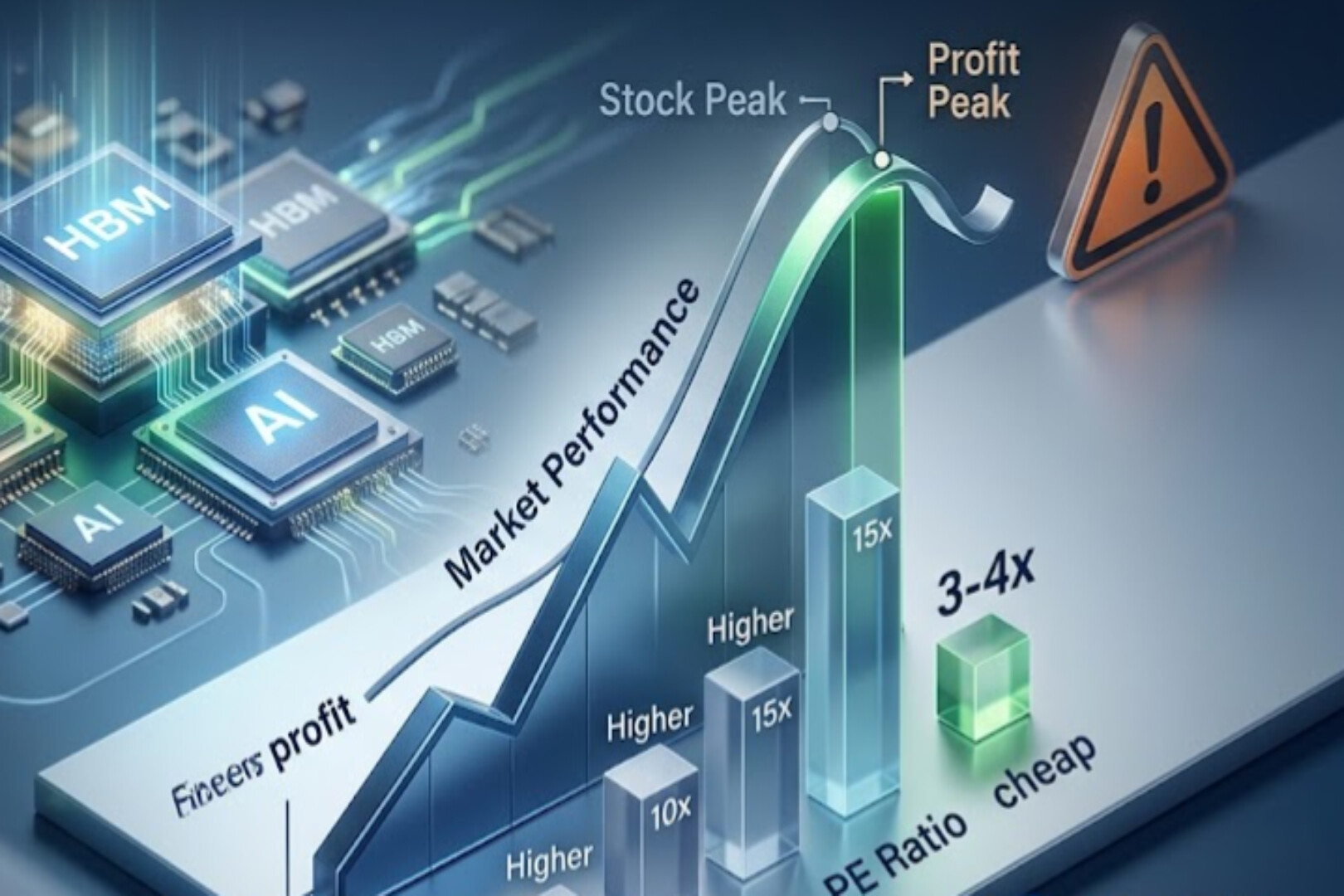
To understand this round of memory stock correction, one must first distinguish between "industry fundamentals weakening" and "the market beginning to lower expectations for the future." What can currently be confirmed is that DRAM and NAND contract prices are still rising, and demand from AI servers for HBM, server DRAM, and enterprise SSDs remains strong. Micron's gross margin guidance of approximately 86% for the next quarter also indicates that memory manufacturers still possess very strong pricing power at this stage.
But the stock market does not trade on how high current profits are, but on whether profits and prices can continue to rise going forward. When memory prices, gross margins, and market expectations are all at high levels, new competitors, potential capacity expansion, or slowing price increases will all trigger valuation adjustments. Even if corporate earnings continue to grow, as long as the growth rate falls below the market's previous optimistic expectations, stock prices can still decline.
The significance of ChangXin Memory's announcement of the 4F² architecture lies precisely here. In the short term, ChangXin Memory's technology progress will not immediately change the global supply-demand landscape. Server DDR5 products require strict certification, and whether advanced DRAM can achieve sufficiently high mass production yields still needs to be verified by subsequent data. International equipment restrictions, advanced process capabilities, and global customer adoption are also issues it must face in expanding market share.
But in the medium to long term, if ChangXin Memory successfully enters the server DRAM market, it may first change China's procurement structure, reducing Chinese server manufacturers' dependence on overseas memory suppliers. As capacity gradually expands, new supply may also put pressure on general-purpose DDR5 prices. However, this impact cannot be directly equated with a shock to the HBM market.
HBM requires advanced DRAM processes, through-silicon vias, stacked packaging, heat dissipation, and joint validation with GPU platforms. Micron, SK Hynix, and Samsung have already begun advancing toward HBM4, while ChangXin Memory's announcement this time focuses on server DDR5 RDIMM. Both product types are DRAM, but there are clear differences in technical barriers, customer structure, and profit margins.
Therefore, it is relatively reasonable for Micron to be affected by ChangXin Memory news, as it operates general-purpose DRAM, server memory, and HBM businesses simultaneously. But SanDisk primarily operates NAND Flash, while Western Digital and Seagate's core business is mechanical hard drives. ChangXin Memory's DRAM products will not directly increase NAND or hard drive supply. The synchronized decline of these companies indicates that the market is broadly reducing risk exposure to the "AI memory" trade, rather than each company's fundamentals being affected in exactly the same way.
For SanDisk, the key things to watch going forward are NAND prices, enterprise SSD shipments, and cloud service provider procurement; for Western Digital and Seagate, the focus should be on nearline HDD supply, per-drive capacity, data center orders, and new capacity. Pricing all memory companies based on ChangXin Memory's DRAM progress could overlook differences in their respective business structures.
Another risk worth noting is the consumer market's ability to absorb memory prices. AI data centers can accept higher memory costs because memory and storage directly determine GPU cluster utilization. But PC and smartphone manufacturers are more price-sensitive. As DRAM and NAND prices continue to rise, consumer electronics manufacturers may reduce procurement, lower per-device capacity, or pass costs on to consumers.
This means two trends may coexist in the memory market: AI server-related products remain in short supply, while consumer product demand is suppressed by high prices. The future memory cycle will not simply manifest as all products rising or falling simultaneously, but will more reflect divergence in product structure and customer structure.
About MSX:
MSX is a leading RWA trading platform dedicated to providing secure, efficient, and transparent access to global financial markets. As one of the world's earliest on-chain US stock trading platforms, MSX has always been at the forefront of the industry, leading market transformation through continuous innovation.
The platform deeply integrates blockchain technology with compliance frameworks, offering spot and derivatives trading for nearly 400 tokenized stocks and Pre-IPO assets, perfectly bridging the gap between traditional finance and the digital asset industry.
Centered on the core mission of "enabling free circulation of quality assets," MSX has now built a diversified digital financial services system encompassing US stock spot and perpetual contracts, crypto-to-crypto trading, Pre-IPO, and the MSX Research Institute, aiming to provide global investors with round-the-clock, high-performance access to quality assets.
Official Website: https://msx.com/
Chinese TG: https://t.me/MSXOfficial
Global TG: https://t.me/MSXGlobal
X: https://x.com/MSX_CN
Now available on global App Store / Google Play.
Risk Disclaimer: Macroeconomic and US stock market conditions are highly volatile. This content is provided solely for academic and research observation reference by the MSX Research Institute and does not constitute any investment advice.