

Storage Wiped Out ~$40 Billion Overnight, Yet the Index Hits New Highs: AI Money Is Starting to Pick Its Spots

1. First, the Facts: Who Fell, Who Rose, and What the Index Is Doing
On October 6, US Eastern Time, the S&P 500 closed up 0.58% at 7,818.93, closing above 7,800 for the first time; the Nasdaq rose 0.45% to 27,599.79, setting a record closing high for the second consecutive day; Nvidia modestly refreshed its record close, with a closing market cap of approximately $5.79 trillion and briefly surpassing $5.8 trillion intraday (the above has been verified against market data).
On the same day: Seagate fell 9.18%, Western Digital fell 6.93%, SanDisk fell 2.56%, and Micron fell 1.73%; in Seoul, SK Hynix closed down 3.69%. Based on closing prices and share counts, the combined market value of the four US-listed companies—Seagate, Western Digital, Micron, and SanDisk—evaporated by approximately $40 billion. On the rising side: Corning gained 6.03%, Marvell gained 5.81%, Lumentum gained 3.82%, Broadcom gained 3.67%, and AMD gained 2.80%.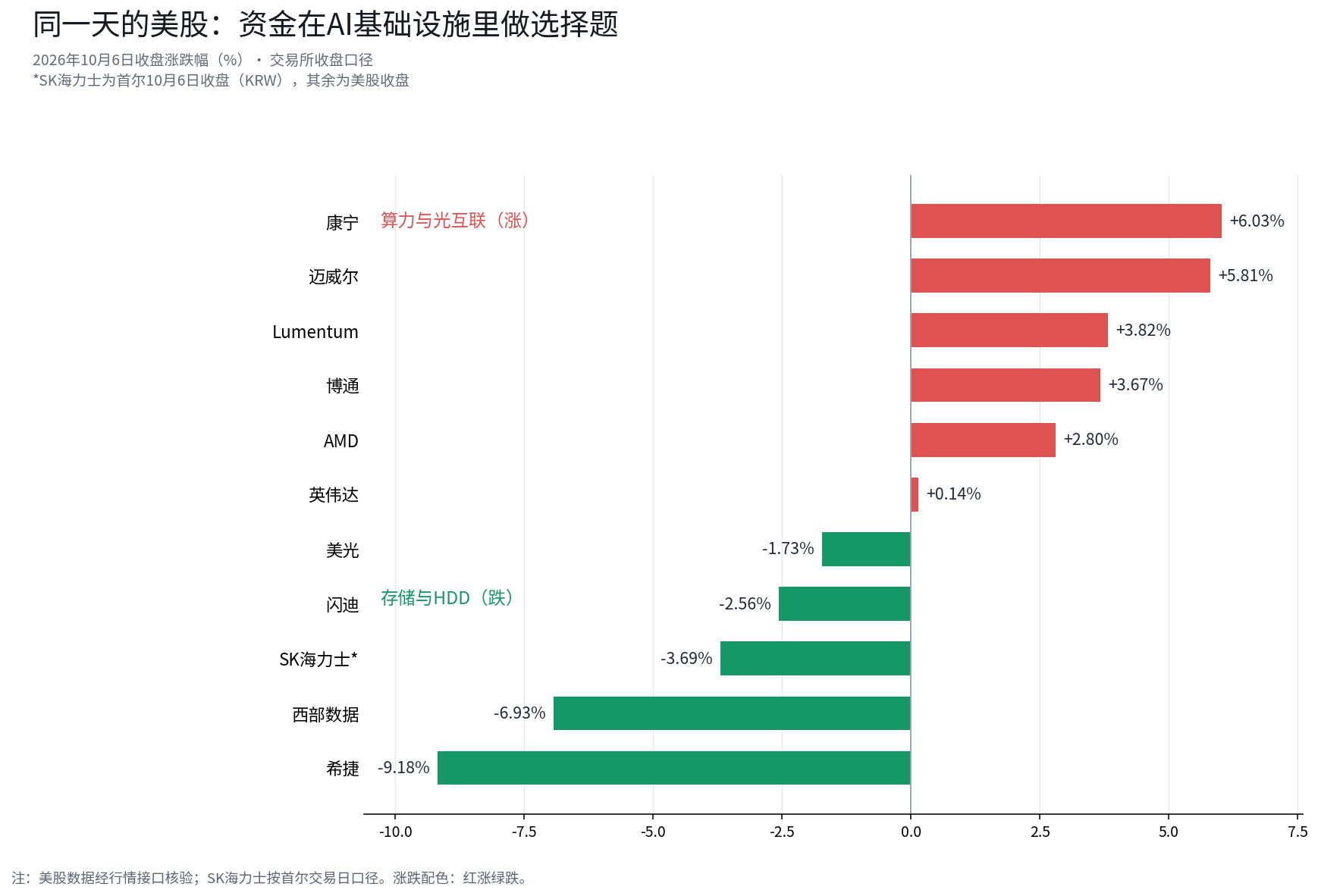
One popular claim must first be corrected: this was not a decline in the Philly Semiconductor Index. The SOXX proxy ETF closed flat on the day, having gained about 3.9% cumulatively over the previous five trading sessions, and sitting only about 1.2% below its 60-day high. The index did not fall, compute was rising, and only storage and HDDs collapsed—this structure itself is more informative than the magnitude of the decline: capital did not leave semiconductors; capital simply changed seats within semiconductors.
2. Two Catalysts Cannot Explain This Decline
The market has found two reasons for the decline in storage. First, according to a Nikkei report, Toshiba plans to invest approximately ¥60 billion to expand its Philippine plant, doubling AI data center HDD capacity before fiscal 2027—its first large-scale investment in the HDD business in five years. Second, according to Bloomberg, citing people familiar with the matter, Seagate and Toshiba are competing to acquire TDK's HDD head business, in a deal that could reach several billion dollars; TDK is the world's only independent HDD head supplier.
Both reasons are real, but neither can support a 9% single-day decline. Toshiba's capacity will not double until fiscal 2027—distant water cannot quench present thirst; and the several-billion-dollar potential outlay for the head business does not constitute a fatal variable for Seagate, a company with a market cap of $180 billion. What deserves more attention is the tiered logic below, which may affect market pricing.
3. The Stratification of AI Capex: The Market Is Repricing the "Bottleneck"
First, look at the total amount of money. According to public reports, the 2026 capital expenditure guidance from Microsoft, Google, Meta, and Amazon totals approximately $730 billion, about 77% higher than the approximately $410 billion in 2025; including Oracle, according to Bank of America estimates, the five companies will invest more than $860 billion this year and approach $1.2 trillion next year. But on the other side, annual revenue directly attributable to AI services is currently estimated at only about $25 billion—roughly 4% of capital expenditure. Goldman Sachs' calculation is even harsher: the giants need approximately $300 billion in annual AI revenue to cover their investments.
Money is increasing, and so is the pressure for returns. As capital expenditure shifts from "buying everything" to "focused breakthroughs," the question cloud providers ask shifts from "how much more do we need to buy" to "which link is choking my neck."
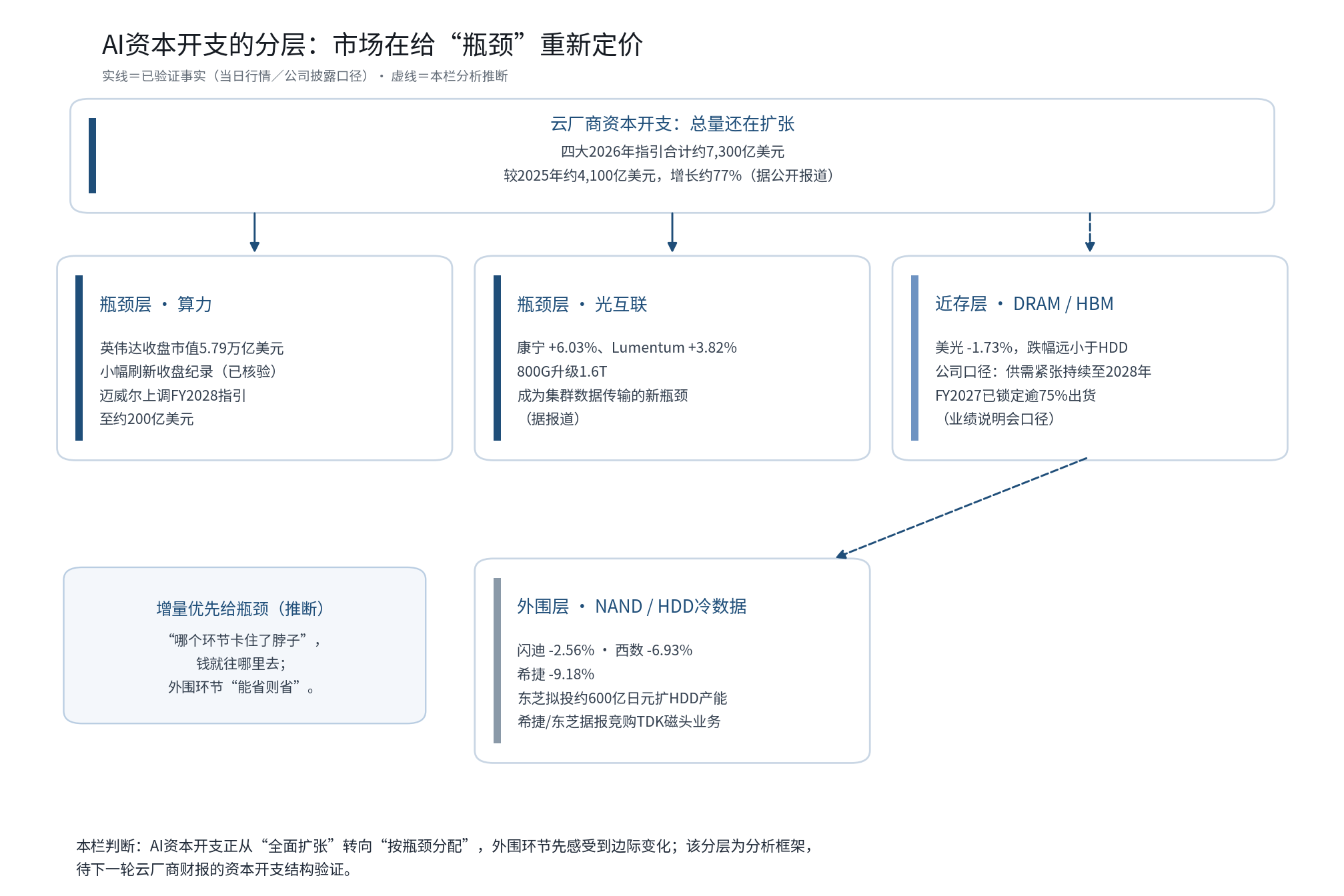
This tiered framework can simultaneously explain every gain and loss of the day:
- Bottleneck layer · Compute: Nvidia GPUs remain in short supply—according to the Financial Times, SpaceX is seeking $40 billion in financing led by Apollo Global Management, specifically to purchase Nvidia chips; Marvell raised its fiscal 2028 revenue guidance to approximately $20 billion at its investor day (Wall Street expected about $18.2 billion) and provided a fiscal 2031 revenue framework of $70 billion to $90 billion, far exceeding the consensus of approximately $46.85 billion. AMD's 2.80% gain and Broadcom's 3.67% gain belong to this layer as well.
- Bottleneck layer · Optical interconnect: upgrading from 800G to 1.6T, Corning gained 6.03% and Lumentum gained 3.82%.
- Near-memory layer · DRAM/HBM: Micron fell only 1.73%—note that Micron's own earnings call guidance is that the memory supply-demand tightness will persist through 2028, with more than 75% of fiscal 2027 shipments already locked in for allocation. At least based on the disclosures from the above companies, no obvious signs of weakening have been seen; its smaller decline compared with HDDs may be related to its closer proximity to compute demand.
- Peripheral layer · NAND/HDD cold data: the HDD duopoly fell 6%–9%. Cold data storage sits at the outermost edge of the AI training and inference chain, making it the link in cloud providers' budgets that is "first to be haggled over." Even in Marvell's own fiscal 2031 revenue framework, "switching and storage" is the smallest segment.
Our view is this: the plunge in storage is not the market saying "storage no longer matters," but rather that the marginal increment of AI capital expenditure is shifting from "buying everything" to "buying only what is most scarce." The detail that Toshiba is expanding HDDs rather than DRAM also provides an angle for observing the above framework—its new investment going into HDDs may reflect the company's judgment on long-term demand and supply-demand conditions in that field.
4. The Broader Context: The Index's "Prosperity" and Individual Stocks' "Bear Market"
The collapse in storage is not isolated; it occurred in a market with severely deteriorating breadth. According to the latest report from Morgan Stanley chief equity strategist Mike Wilson (cited by media): 51% of Russell 3000 constituents have retreated more than 20% from their June highs and entered a technical bear market, a ratio that has worsened further from over 40% two weeks ago; the median S&P 500 stock is 16% below its 52-week high, and market breadth has fallen to the lowest since the dot-com bubble burst; there is a divergence gap of about 12% between the index and breadth.
Wilson's variable for a breakout is US Treasury volatility: the 10-year Treasury yield is currently around 5.3% (verified against market data for this column), the MOVE Index is above 100 while the VIX is below 15—if bond market volatility cannot cool down, he expects the S&P 500 could probe approximately 6,800 to 7,300 over the next month to complete a "rendezvous"; otherwise, individual stock catch-up gains would fill the gap. This judgment represents only Morgan Stanley's view. Other public statistics show that semiconductors' weight in the S&P 500 has exceeded 20%, with Nvidia alone accounting for about 13% of the Nasdaq's weight—a handful of stocks propping up the index while most stocks go their own way, which explains why the storage plunge could occur on the same day as record highs.
5. What to Watch Next: Three Time Points, Two Switches
The nearest verification point is tomorrow: on the morning of October 8 Beijing time, Samsung Electronics will announce its preliminary third-quarter results. According to South Korean media, Samsung plans to release preliminary results before the market opens on October 8, with the market expecting it to potentially post its best-ever profit level (FnGuide expectation, cited by media); the official financial report and earnings call are expected in late October. This is the first data point that can be concretely verified after this round of storage selling: if Samsung delivers preliminary profit below expectations against the backdrop of rising storage prices, the market may be more inclined to interpret it as a "fundamental reassessment"; if the preliminary data is strong, the day's storage decline may be interpreted more as an emotional valuation adjustment.
Second time point: the two official earnings calls in late October. According to current media estimates, SK Hynix is tentatively scheduled for October 27 and Samsung for October 29 to release official results (neither company has officially confirmed the dates; refer to company announcements). What to watch on the calls is not just the quarterly numbers, but also management's wording on supply and demand for 2027 and beyond—if "tightness" begins to give way to "balance," the market may reassess the valuation framework for the storage sector.
Third time point: cloud providers' earnings from late October to early November. Focus on the allocation structure of capital expenditure: whether compute budgets are maintained and whether storage and cold data budgets are compressed. If the structural differentiation is confirmed, "allocation by bottleneck" shifts from this column's inference to fact; if all four categories of budgets grow in tandem, the day's selloff is more likely to prove to be a reversible repositioning.
The two switches are in the bond market. First, the extreme divergence between the MOVE Index and the VIX (MOVE above 100, VIX below 15, per Morgan Stanley's report): this is the master switch for the current fragility of the index; second, the 10-year Treasury yield, currently at an elevated level near 5.3%—every additional day it stays there makes breadth repair one notch harder.
Final Thoughts
We have three judgments. First, what truly happened that day was not a "semiconductor decline" but a surgical repositioning: the SOXX proxy ETF closed flat, compute and optical interconnect rose, and storage and HDDs collapsed—the marginal increment of AI capital expenditure is shifting from "full-scale expansion" to "allocation by bottleneck," which is our characterization of this round of storage selling. Second, the divergence within storage—HDDs down 9% while Micron fell only 1.7%—may reflect that the market is differentiating among links within the "storage" label; Toshiba directing money toward HDD capacity expansion rather than DRAM also provides an angle for observing this pricing logic. Third, against the backdrop of 51% of Russell 3000 constituents already in a bear market and the index maintaining new highs on a handful of heavyweight stocks, any "marginal change" in any link could be amplified by breadth into index-level volatility—which links may be further affected by this divergence is worth continued observation. The above judgments are based on current public information, and conclusions will change as conditions change.
Data Notes
- US equities: S&P +0.58% to 7,818.93, Nasdaq +0.45% to 27,599.79; Nvidia +0.14%, Broadcom +3.67%, AMD +2.80%, Marvell +5.81%; storage weakened: Seagate -9.18%, Western Digital -6.93%, Micron -1.73%; SK Hynix -3.69%.
- Industry: Toshiba plans to invest ¥60 billion to expand HDDs; Seagate and Toshiba compete to acquire TDK's head business; Marvell FY2028 guidance about $20 billion, FY2031 framework $70–90 billion; Micron says supply-demand tightness through 2028.
- Cloud/AI: the four major cloud providers' 2026 capital expenditure about $730 billion (+77%); SpaceX, per FT, seeks $40 billion in financing to purchase Nvidia chips.
- Market: 10Y US Treasury about 5.3%; Morgan Stanley says 51% of Russell 3000 in technical bear market, S&P may probe 6,800–7,300.
- Other: semiconductors account for more than 20% of the S&P 500, Nvidia about 13% of the Nasdaq; forward PE: Seagate 18–20x, Micron about 8x, Nvidia about 32x, AMD about 45x. Samsung pre-market results on 10/8, SK Hynix tentatively estimated 10/29. Sources: exchanges, Nikkei, Bloomberg, FT, etc.; some not independently verified.
Disclaimer:
The content of this article is for general information and market commentary purposes only, based on public materials as of the time stated herein, and relevant market data, expectations, and probabilities may change with market conditions. The views and investment strategies of third-party institutions, analysts, or other persons cited herein represent only the views of the relevant third parties at a particular time and do not represent the views or recommendations of BIT. This article does not constitute investment advice, investment research, an offer, a solicitation, or a recommendation for any securities, investment products, or trading strategies, nor should it serve as the basis for any investment decision. Financial markets involve risk, securities prices and market performance may fluctuate, and historical performance and past market trends do not represent or guarantee future results. Investors should independently assess relevant risks based on their own circumstances and seek professional advice when needed.