

BiyaPay Market Watch: Can Stablecoins and RWA Bring a New Crypto Market Rally?
The crypto industry's gaze has once again converged on Singapore. But this time, what's worth watching isn't just where Bitcoin is headed—it's what kind of connection traditional finance and on-chain markets are preparing to build.
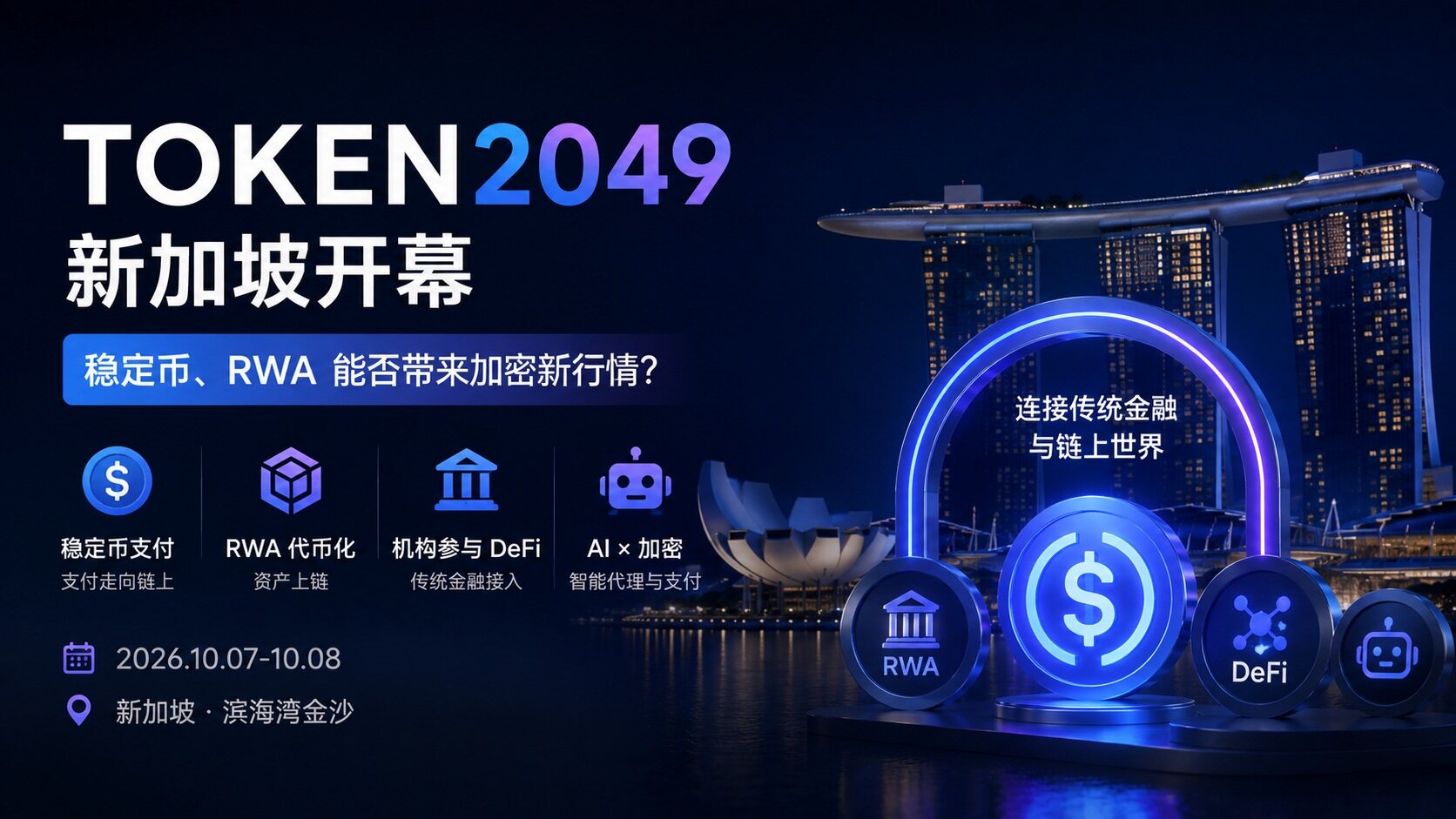
From October 7 to 8, the 2026 TOKEN2049 Singapore conference is being held at Marina Bay Sands. Judging from the public agenda, stablecoin payments, institutional participation in DeFi, asset tokenization, and the integration of AI agents with crypto networks are several threads worth close observation. The conference also covers prediction markets, privacy, and trading infrastructure, so it cannot simply be summed up as a stablecoin conference.
If we connect these topics together, a common question emerges—when crypto technology begins to serve trading, payments, and asset management, what the industry needs to prove is no longer just whether the network can run, but whether it can handle more complex financial demands.
The Conference's Focus Is How Financial Scenarios Move On-Chain
This year's agenda includes discussions on institutional participation in DeFi, institutional finance going on-chain, and next-generation stablecoin payments. These respectively correspond to how assets enter the chain, how funds are settled, and what financial activities can be conducted once they're on-chain.
These threads are not independent of each other. With only stablecoins but no usable assets and applications, funds may simply sit in wallets; with only tokenized assets but lacking settlement, custody, and liquidity, the trading experience is also difficult to improve. A truly meaningful connection requires assets, funds, and services to be present simultaneously.
Therefore, I prefer to understand this conference as an observation window. Is the crypto industry extending from a relatively independent trading market toward payments, capital markets, and automated applications?
The Key Change for Stablecoins Is Whether Use Cases Can Move Beyond Trading Accounts
Stablecoins have long served the functions of pricing, trading, and fund transfer in crypto markets. The payment discussions in this year's agenda focus on whether they can further enter everyday financial activities.
The two use cases correspond to different needs. In trading scenarios, stablecoins emphasize liquidity and exchange efficiency; once they enter corporate payments, cross-border settlement, and treasury management, account management, payment status, fees, reconciliation, and exception handling become more important. Completing an on-chain transfer is only one part of the process and doesn't necessarily mean the recipient has obtained locally usable funds.
This kind of connection can also be seen in the use cases of multi-asset platforms. For example, BiyaPay, a global one-stop asset allocation platform, uses USDT as the funding gateway between digital assets and fiat currencies, supporting exchanges between more than 30 fiat currencies and over 200 digital currencies, and consolidating US stock trading, Hong Kong stock trading, digital asset trading, cross-border remittances, and U-card payments into a single account system. USDT can first be exchanged for USD or HKD, then used for corresponding securities trading and other services. For those with cross-market needs, the convenience of this approach lies in reducing switching between multiple platforms, making the path from exchange to trading and subsequent fund usage more seamless. This is precisely the direction worth observing in stablecoin applications—not just for on-chain transfers, but also for connecting with actual funding needs.
The impact of stablecoins on the industry may first manifest as more diverse settlement tools and funding gateways. However, an increase in stablecoin supply does not necessarily mean new funds will buy BTC or ETH. They may also be used for payments, temporary fund storage, or entering other asset markets. To judge their effect on market movements, we need to continue observing where the funds actually go.

RWA Draws Attention, but the Core Isn't Giving Assets a New Name
RWA typically refers to the tokenization of real-world assets. This year's conference includes discussions on institutional finance going on-chain and asset tokenization, indicating that the connection between on-chain infrastructure and traditional asset markets is an important direction on the public agenda.
What's truly worth analyzing in this direction isn't whether an asset has issued a token, but whether trading and management processes can be improved. For example, whether asset shares can be transferred more easily, whether settlement times can be shortened, whether transaction records are easier to verify, and whether products can interoperate with other on-chain applications.
But tokenization does not automatically eliminate the problems of underlying assets. Bonds still carry credit and interest rate risk, and funds are still constrained by investment scope and redemption arrangements. On-chain records can be more transparent, but they cannot replace confirmation of the underlying asset's authenticity, custody, and holder rights.
For the crypto ecosystem, RWA may bring new asset and settlement demands, but the value doesn't necessarily flow to public chain tokens. Some revenue may remain in issuance, custody, or distribution, and some assets may also run on permissioned networks. Whether an expansion in asset scale can translate into value for a particular network or token depends on what functions it actually performs.
Why Doesn't Deeper Institutional Participation Equal Full-Scale Capital Entry?
The organizers have scheduled an institutional session on October 8, aimed at senior executives in traditional finance and digital assets. Institutional participation itself deserves attention, but attendance, discussion, pilot programs, and formal deployment are different stages.
Institutions typically care about more than just trading speed. How assets are custodied, whether trades can be audited, whether liquidity is sufficient, and who is responsible when anomalies occur all affect deployment decisions. For new technology to enter the existing financial system, it needs to adapt to these requirements, not just demonstrate a feature.
This also explains why institutional finance going on-chain may first occur in areas like partial settlement, collateral management, or asset issuance, rather than immediately translating into large-scale coin purchases. A bank or asset manager adopting a blockchain service doesn't necessarily need to continuously hold the related public chain token, let alone signal bullishness on all crypto assets.
The market easily translates "institutional attention" directly into "institutional capital entry," but between the two lie actual products, fund usage, and deployment scale. The most valuable information from this conference is whether verifiable progress has emerged in these areas.
AI and Crypto Integration: What Role Might Stablecoins Play?
AI agents are also a thread in this year's public agenda, covering on-chain transactions, the agent economy, and payments. However, that a topic receives attention doesn't mean the application has matured.
The logic is that if AI agents can call services, purchase data, or execute tasks on behalf of users, they need to handle identity, authorization, accounts, and payments. Stablecoins and programmable accounts may provide settlement methods for some automated transactions, especially in cross-platform scenarios or those requiring continuous operation.
But "AI needs payments" doesn't equal "all AI needs cryptocurrency." Traditional payment interfaces can equally serve automated applications. What crypto solutions need to prove is whether, in specific scenarios, they offer more suitable programmability, interoperability, or settlement experience.
So, for the combination of AI and crypto, what's worth watching is actual calls, real payments, and sustained usage—not judging value based on product names alone. A demo can prove a feature exists; sustained demand brings us closer to validating an application.
Can the Conference Drive Market Movements? It Depends on Which Layer the News Reaches
TOKEN2049 can first concentrate industry information, making products, partnerships, and technological progress more visible. This may affect short-term sentiment, but forming a sustained market trend requires clearer evidence of capital and usage.
If stablecoin payments expand, settlement demand may increase; if RWA forms actual issuance and trading, on-chain asset activity may increase; if DeFi attracts sustained usage, protocol revenue may improve. But these changes affect different segments respectively and won't benefit the entire market evenly.
For Bitcoin, conference discussions can influence market narrative but cannot replace spot capital flows, macro liquidity, and market positioning. For Ethereum and other smart contract networks, we need to further examine which network applications have chosen, whether transactions and fees are growing, and whether new activity can support the value of related assets.
What makes this conference worth in-depth analysis is precisely the gap between industry expansion and price returns. Stablecoins, RWA, DeFi, and AI agents provide more development directions for the crypto market, but each direction needs to answer the same question: Is the demand real, can usage be sustained, and where does the value ultimately remain?
Therefore, TOKEN2049 is not a guarantee of a new market rally—it's more like a concentrated test. It lets the market see where the crypto industry intends to go, and only the product launches, capital flows, and sustained usage after the conference will show just how far these directions have actually progressed.