


Nonfarm Payrolls Miss, October Rate Hike Bets Collapse Overnight, but the 5.34% U.S. Treasury Warning Hasn't Lifted

On October 2, the U.S. September nonfarm payrolls report delivered an unexpected "dovish blow" to the market.
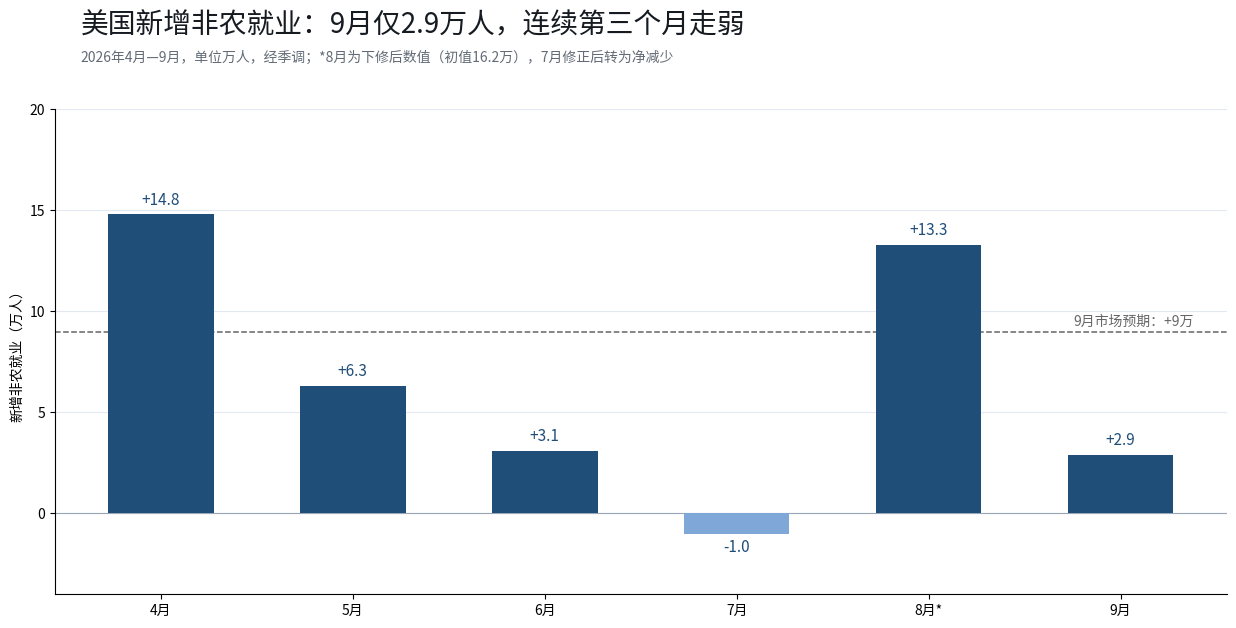
September added only 29,000 nonfarm jobs, far below the market expectation of 90,000—just one-third of the expected figure. The unemployment rate rose from 4.1% to 4.2%, while average hourly earnings fell to 3.0% year-over-year and rose just 0.1% month-over-month. More notable were the revisions to historical data: August's job gains were revised down from 162,000 to 133,000, and July's figure was revised down by another 31,000, turning into a net decline after revision—the employment picture over the past three months is even weaker than what the single-month data suggests.
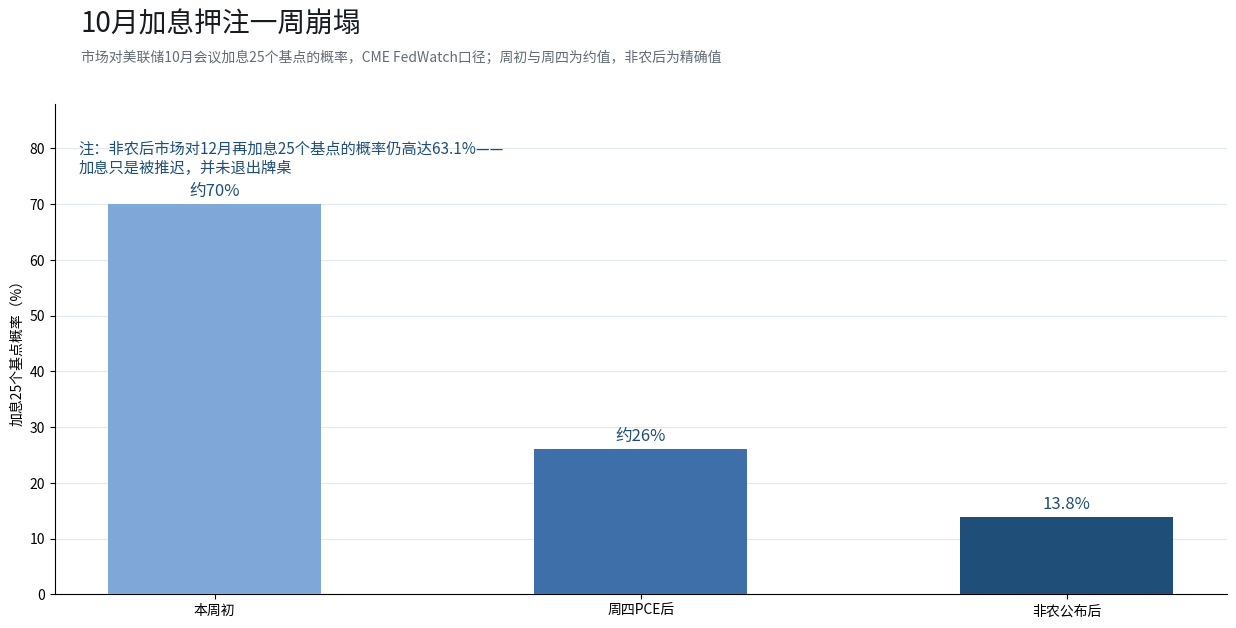
After the data was released, market bets on a Fed rate hike in October cooled abruptly: a week earlier, the probability had approached 70%, but by Friday's close it stood at 13.8%, while the probability of the Fed holding steady in October rose to 86.2%.
But the market's reaction was far more complex than simply "cooling rate-hike expectations and rising stocks."
1. Rate-Hike Bets Collapse, but Treasury Yields Refuse to Budge
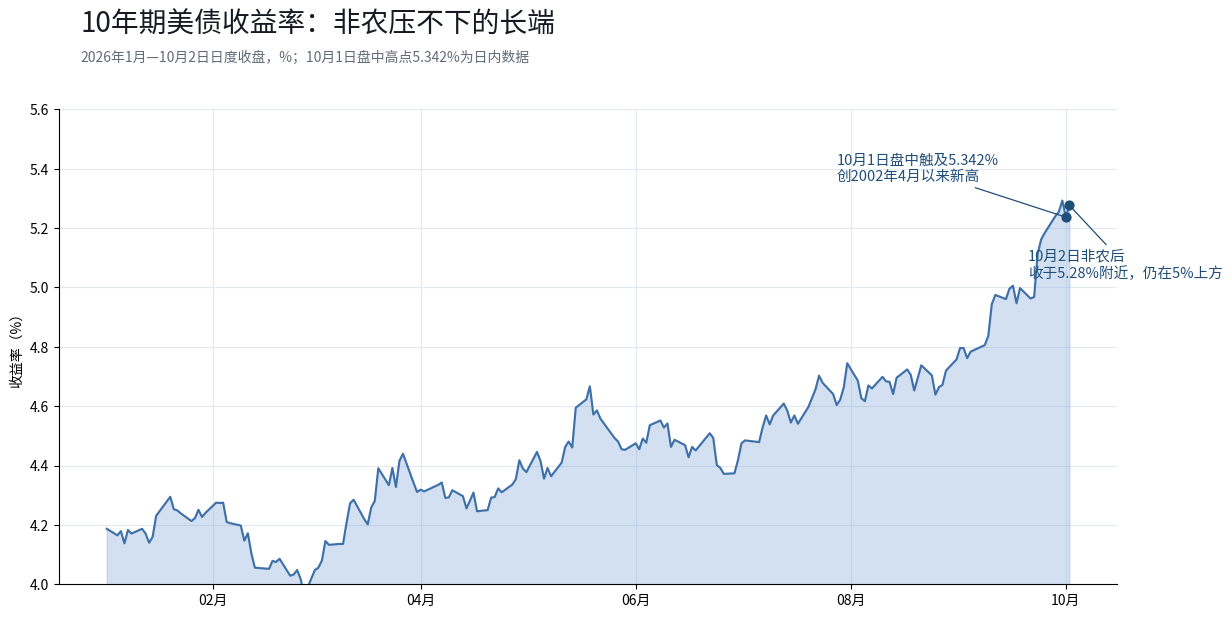
After the nonfarm data was released, the 10-year Treasury yield briefly declined during the session but rebounded by the close, finishing near 5.28%. Just the day before (October 1), the figure had touched 5.342% intraday, the highest level since April 2002—even after pulling back, it remains in the historically elevated range above 5%.
This is a warning signal worth heeding. Weakening employment data lowered rate-hike probabilities but failed to bring long-end yields down. Some institutional investment managers judge that, given the resilience of the U.S. economy, there is a credible possibility that the 10-year yield could rise toward 5.5% to 6%, and rising borrowing costs could weigh on equity returns. Persistently elevated long-end yields mean the market is no longer focused solely on "whether to hike," but also on "how long rates will stay high." Even if the Fed stops hiking, as long as long-end yields don't retreat, valuations of high-priced assets could still come under pressure.
Changes in rate-hike expectations also require precise understanding. Interest rate futures show that the probability of an October hike fell from about 26% before the data to 13.8%, but the probability of another 25 basis point hike in December remains as high as 63.1%, and the market no longer fully prices in "one more complete hike this year." Goldman Sachs has pushed back the timing of the Fed's next hike from October; New York Fed President Williams said there is no rush to act again after the September hike, but another hike later this year may be appropriate.
In other words: rate hikes haven't left the table—they've just been delayed.
2. Divergence in Tech and Semiconductors: The AI Narrative Persists, Traditional Cyclicals Fall Behind
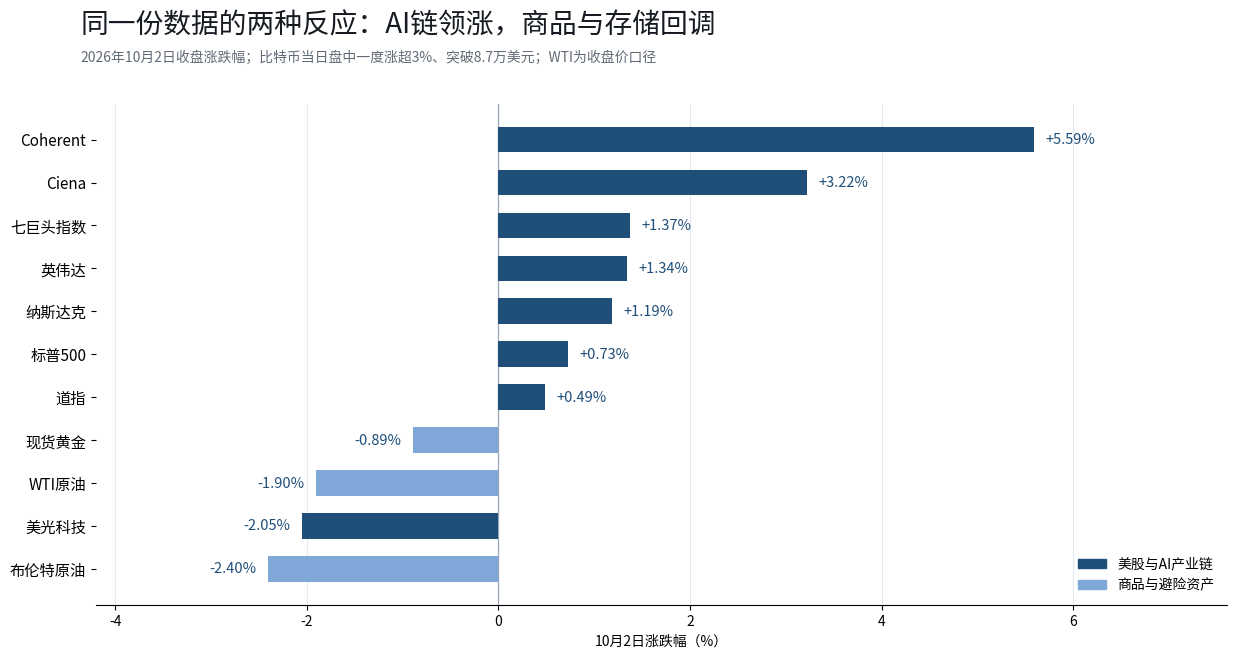
After the nonfarm data was released, U.S. stock index futures rallied in the short term, with funds further trading the main thesis of "soft economic landing and delayed rate hikes." At Friday's close, the Dow rose 0.49% to 51,176.96, the S&P 500 gained 0.73% to 7,722.72, and the Nasdaq climbed 1.19% to 27,190.86, hitting a record intraday high; the Wind U.S. Magnificent Seven Tech Index rose 1.37%, Tesla surged 4.65% on better-than-expected third-quarter deliveries, and Nvidia closed up 1.34%, touching an all-time intraday high of $237.88 and briefly reclaiming a $5.7 trillion market cap.
But the divergence within sectors is more informative than the indices themselves.
The AI supply chain continued to lead gains: the optical communications segment extended the previous day's strength, with Coherent up another 5.59% and Ciena up 3.22%—just on October 1, Coherent had surged 10.90% in a single day, and the Philadelphia Semiconductor Index rose 1.59% overall. Meanwhile, the memory segment began to fall behind: Micron Technology closed down 2.05% on Friday, contrasting with the previous day's 3.03% gain; traditional cyclicals and value sectors were also weak, with the S&P 500 equal-weight index underperforming the cap-weighted index, and most of the 11 sectors showing lackluster performance. The indices are rising, but momentum remains concentrated in a few AI-driven themes.
3. The Same Data, Divergent Answers Across Assets
The impact of the nonfarm data on various assets showed clear directional differences.
Bitcoin briefly broke above $87,000 after the data was released, gaining more than 3% intraday, and traded in a wide range of roughly $83,700 to $87,200 throughout the day, standing near $86,600 as of the morning of October 5. The $87,000 to $87,500 zone has been tested multiple times recently, and whether it can be effectively broken through remains uncertain, and may be influenced by factors such as risk appetite next week.
Gold staged a "rollercoaster" of rallying then pulling back: after the nonfarm release, spot gold briefly surged more than 1% to top $4,200, but the rally failed to sustain, closing at $4,140.09, down 0.89% on the day, while COMEX gold futures settled at $4,172.1. On the previous trading day (October 1), gold prices had also spiked to $4,218 before plunging. Since late August, gold prices have fallen by more than 10% cumulatively. The suppressing factors are clear: a firm dollar and persistently high Treasury yields outweighed the boost from the employment data; some institutional analyses suggest that precious metals will mainly trade in a range in the short term, pending greater clarity on the monetary policy path.
Oil prices fell sharply on Friday: the G7 announced the release of 100 million barrels of strategic petroleum reserves, combined with the recovery of Middle East crude exports, WTI fell more than 4% intraday before settling at $91.11 per barrel (about -1.9%), while Brent fell below $100 to close near $99.9 (about -2.4%). But the U.S. continues to deploy additional aircraft carriers and troops to the Middle East and urge allies to accelerate the release of diesel reserves, so the geopolitical premium has not fully dissipated—the part of the oil price decline is supply, and the part that won't fall is risk.
The dollar index rose above 102.2 at one point this week, hitting a new high since April 2025, before easing slightly to around 101.9 on Friday, though it still posted a weekly gain, with the dollar rising to a 17-month high against the euro. A strong dollar poses an additional headwind to any rebound in gold and emerging market assets.
4. What to Watch This Week: Three Verification Points
The first verification point: the ISM Services PMI (Monday). This is the first major data release of the week. If service sector activity cools and the prices index falls, it could further reinforce expectations that "high rates have peaked"; if services inflation proves stickier than expected, it could rekindle tightening expectations and weigh on tech stock valuations.
The second verification point: the FOMC meeting minutes (Wednesday). The Fed hiked rates by 25 basis points in September to a range of 3.75%–4.00%, and the key to the minutes lies in how strong the committee's internal consensus is on "keeping rates high for an extended period." If more officials lean toward "no further action this year," it could provide short-term support for high-valuation tech stocks; if the minutes show the committee remains wary of sticky inflation, pressure on long-end yields could persist.
The third verification point: September CPI and the direction of oil prices. Before the late-October policy meeting, September CPI is the last key piece of the puzzle; and with oil prices recently swinging sharply, OPEC+ decided on October 4 to keep its November production targets unchanged. Subsequent production policy and oil price trends could still affect energy prices and inflation expectations, and become one of the factors the market weighs in assessing the December rate path.
The nonfarm miss knocked October rate-hike bets off the table, but the warning signal from the 5.34% Treasury yield has not been resolved. Weakening employment lowered rate-hike probabilities but did not significantly push down long-end yields—this contradiction may be one of the key variables affecting tech stock valuations going forward.
Data notes: Market data is as of the October 2, 2026 U.S. stock market close (Treasuries and commodities are based on the October 2 close; Bitcoin is quoted as of the morning of October 5); nonfarm payroll data comes from the U.S. Bureau of Labor Statistics released on October 2, with historical series from FRED; rate-hike probabilities come from CME FedWatch; U.S. stock indices and individual stock gains/losses are as of the October 2 close (October 1 sector data is based on the previous trading day's close).
Disclaimer
The content of this article is for general informational and market commentary purposes only, compiled based on publicly available information as of the time stated herein, and the relevant market data, expectations, and probabilities may change with market conditions. The views and investment strategies of third-party institutions, analysts, or other persons cited in this article represent only the views of the relevant third parties at a specific time and do not represent the views or recommendations of BIT. This article does not constitute investment advice, investment research, an offer, solicitation, or recommendation of any securities, investment products, or trading strategies, and should not be used as the basis for any investment decision. Financial markets involve risk; securities prices and market performance may fluctuate, and historical performance and past market trends do not represent or guarantee future results. Investors should independently assess the relevant risks based on their own circumstances and seek professional advice when necessary.