


Vitalik's Sci-Fi Novel "Snow Moon" Chapter 23

Chapter 23
Pafogai Du, Zhego 3724, Hour 22
Gladias, Bai, and Fen sat at a table in a cafeteria deep beneath the mountain pyramid.
Green trees were planted between the tables and the walls all around the cafeteria. Two of the walls were covered in vines, while the other two were covered with enormous mirrors, making the entire cafeteria feel as though it were in some infinitely repeating, boundless space. There was only one entrance in one corner, flanked by a dense clump of bushes on each side that blocked the view of the tunnel leading to the entrance.
In another corner, and in the center of the cafeteria a few meters away from them, stood several air filters on the floor—clearly added recently, and no one had yet seriously considered how to make them blend into the environment aesthetically. Fans blowing downward and ultraviolet lamps hung from the ceiling.
The three of them were in a private area, with bushes blocking most of the rest of the cafeteria. Two speakers were simulating the sound of cicadas in a morning forest, drowning out the conversations at other tables—thus, they knew, protecting their own conversation as well.
Zei walked in, looking exhausted, and sat down with them.
"That was close. We were ambushed by a batch of Arctic drones and barely managed to defeat them. Fortunately, there was a full five-minute gap before the next batch of drones came to finish us off, so I think we had just enough time to destroy all the chips from which the Arctics could have extracted combat training data."
"How are the people of Free City feeling?"
"They're very excited."
"See, I told you earlier—cooperating with Free City first is a good way to get Kungope to gradually accept more international collaboration."
"You have to give people some quick wins they can show to their superiors or friends, and establish legitimacy with results as early as possible, before they'll believe you're capable of taking the next step."
"Yes, your advice is good. But... I suspect the next step will be harder than this. The Free City Defense Force wants to cooperate. In Viridia, we have to find a way around their institutions, which is far more difficult."
"Small projects can be accomplished by going around certain people. But to win this larger war, you need scale; and to achieve scale, you have to chew on the hard bones and genuinely win the support of some large institutions."
"Do you have any ideas?"
"Sera said she'd figure out a way to solve some problems. I gave her Verdo's contact information—he's the only senator I truly trust so far. So we'll see."
A robot came and placed food for the four of them on the table. They began eating quietly.
Fen and Gladias finished eating first, rested for a few minutes, and drank tea.
Fen took a book out of his bag and handed it to Gladias.
"Here, let's see how your Zhego language studies are coming along. Open to any page and read."
Gladias grabbed the book and flipped to a random page. He glanced at it.
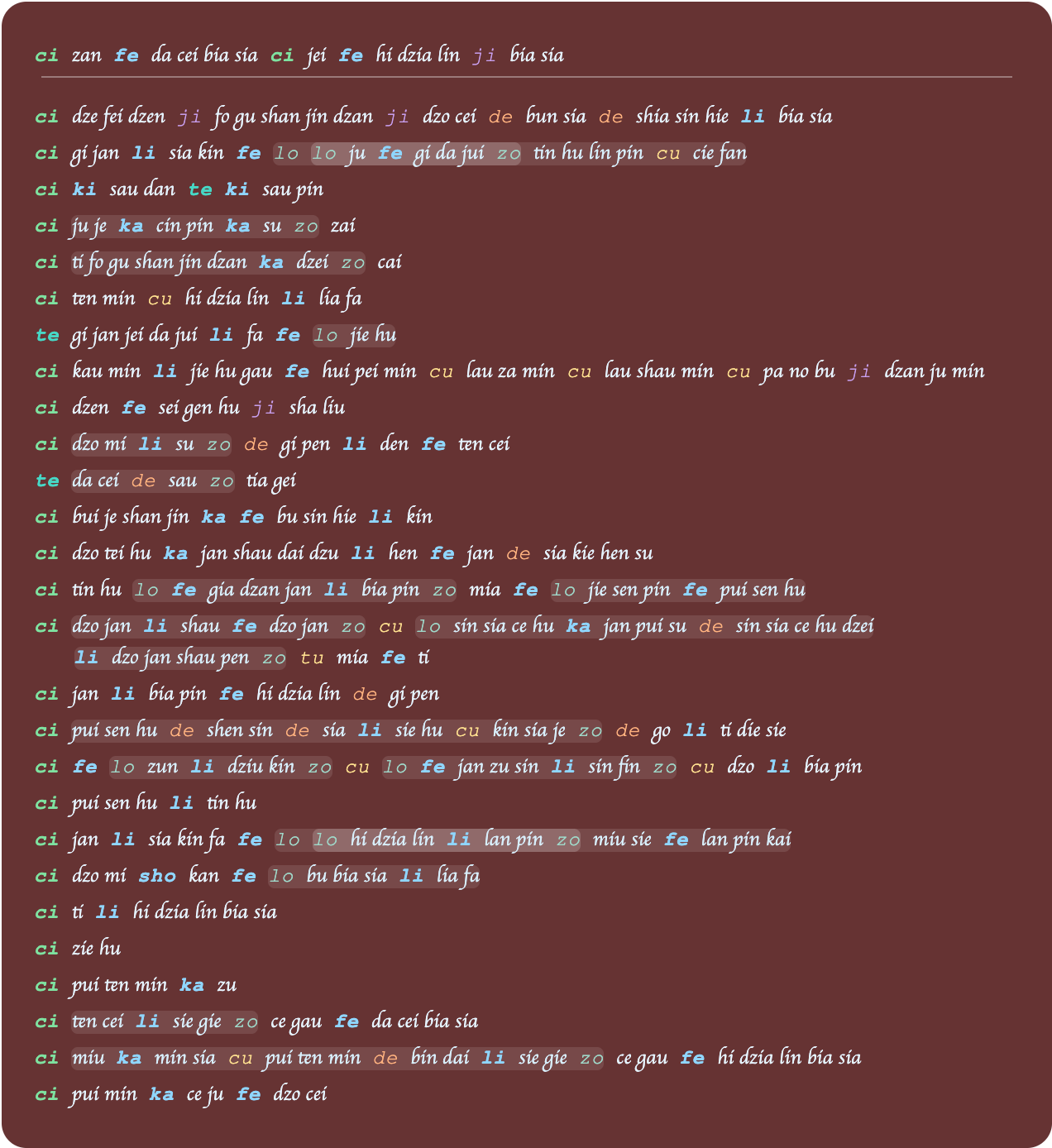
"You think I can do this?" Gladias asked in disbelief.
"Come on, give it a try."
"Alright, here goes..."
"From the 'less' of the material world, to the 'less' of the internet world."
"The 'less' here means minimalism."
"Ah, I see. Just knowing the roots, sometimes you still can't guess the meaning of the whole sentence."
"Exactly. Reducing the roots to so few inevitably causes this; once we accepted that, the whole project was able to be completed."
"Including Zhego and Viridia, forty years ago, minimalism brought about a major shift in aesthetics across the world."
"That opening part is a fixed expression meaning 'including Zhego and Viridia.' 'Beautiful thought' means aesthetics."
"Many people realized that owning a large number of physical objects brings not only the opposite of simplicity, but also feels like locking yourself in a locked room."
"'Heart of the thread' expresses a feeling of simplicity or convenience; 'locked room' here is closer to a prison."
"When the room is complex, the heart becomes complex too."
"Very good!"
"With the warm feeling brought by having few possessions—happiness?—to live is to be free."
"Excellent!"
"This change happened forty years ago, and there's a logic to it—I mean, a reason?"
"Yes."
"Electronic devices and the internet began to appear."
"This meant that the physical objects many people collected... wait, those physical objects many people collected began to become unwanted."
"Translating it as 'no longer needed' here is more accurate."
"Handheld devices made the calculators, music players, phones, and a dozen other devices people used to own no longer necessary."
"'Aggregation and grouping devices' should be 'addition and multiplication devices,' meaning calculators; 'voice conversation devices' means phones."
"It can hold an unlimited number of books."
"It's 'an infinite number of books.'"
"Many parts of our lives are migrating to the electronic world."
"It's 'many parts of our entire lives.'"
"And so, the complexity of the material world was left behind."
"That is, 'was cast behind.'"
"In recent years, we've been seeking another paradigm shift."
Gladias paused for a moment.
"Alright, I'm tired. But I'm curious. Can you tell me what the rest means?"
Zei picked up the book.
"Social media isn't always beneficial to people's mental health. People's interest in privacy is largely driven not just by fear of the Arctics, but by the fact that everyone is talking about everyone else, and the unpredictability of random events in people's private lives becoming public discourse."
"People fear many parts of the internet, especially in other countries where privacy technology isn't as powerful or as easy to understand. Location tracking, behavioral analysis, and so on. It's not just a privacy issue—people are recognizing that the internet can be as addictive as drugs."
"So now we're slowly seeing the emergence of a different kind of minimalism: internet minimalism. Disconnecting. Doing things on your own devices. Just as the growing capabilities of the digital world made physical minimalism possible, the growing capabilities of artificial intelligence and local software make internet minimalism possible—you can have your entire world on your own devices."
"Fascinating."
"Gladias, you did very well."
"Thank you. Now it's your turn: how much do you know about the Order's governance rules?"
"The Order has a set of tax assessment standards. For each standard, twenty-one Guardians are randomly selected—serving three-year terms, with seven new members added each year. This group is responsible for proposing and voting on amendments to the standards. The twenty-one are divided into three groups of seven, each mixing members in their first, second, and third years of service. Any Guardian can propose an amendment; the three groups independently discuss each proposal without knowing who comprises the other two groups. After several rounds of discussion, the twenty-one Guardians vote on each proposal, and only proposals receiving at least thirteen votes in favor are passed."
"There's a separate independent mechanism—the Sentinels. They are randomly selected and grouped to conduct audits of various enterprises. Three groups total, three people each. The task is very clear: determine which tier an enterprise falls into for each assessment standard. Smaller enterprises are audited by apprentices; apprentices are Order members in training. For an apprentice to be approved for full status, they must both pass approval by a parliamentary committee and rank in the top ten percent in predictive scoring. The scoring method is: a small random portion of the audits they complete is re-audited by Sentinels, and then how closely the apprentice's rulings match the Sentinel results is measured."
"And what about the courts?"
"The mechanism is the same as the Sentinels, except that trials are handled by five judges instead of nine Sentinels. In civil cases, either party can appeal the ruling; in criminal cases, only the defense can appeal. There are no higher or lower courts here—a new panel of judges is simply randomly selected. Common law also has a rule: if a case you bring—whether an appeal or an initial filing—is so baseless as to constitute malicious litigation, then the result isn't just losing, but potentially being ordered to pay punitive damages. This is the mechanism used to guard against what we call 'denial-of-service attacks.'"
"Speaking of which, your mention of that last point is timely. Ver, who co-parents with me, fought a long legal battle with his former employer. They used financial maneuvers to fire him and tried to evade the severance pay that had been agreed upon in advance. Ver won in the first trial, the company lost on appeal, and then they filed a second appeal. Just yesterday, the court rejected this appeal, determined it was filed in bad faith, and tripled the amount they must pay to Ver and the other employees."
"Glad to hear the system is working properly!"
"This has always been the most important question: whether the institutions actually work. For example, parliamentary hearings approving new Guardians and Sentinels—this arrangement is now almost completely ineffective, at least in my view."
Bai spoke up.
"This is all very good information, Gladias. Thank you, Zei, for grasping it so quickly. If we want to influence Viridia, understanding how these institutions operate today is just as important as the military aspect."
"Anyway, I think Deng is waiting for me and Zei in his private room. We should get going."
"Sounds good," Zei replied.
Zei and Gladias simultaneously reached to place their watches on the small green circle at the corner of the table. They both ended up pushing each other's wrists too far to establish a connection. Fen joined in and tapped the circle with his watch. After a moment, his watch rang.
The four of them rose together and strode out of the cafeteria.
Gladias lay in bed, getting ready to sleep. Suddenly, his watch rang.
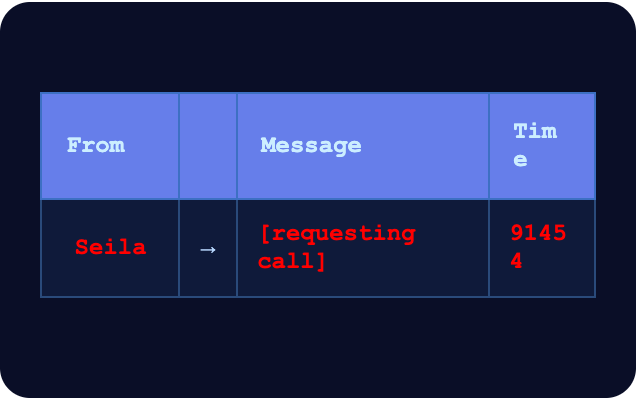
From the time of the message
Sera → [Call Request] 91454
He had only seen this red type of message twice before: once when Sera sent him a message during the attack in North Woodland, and once when she called him to talk about Delvot.
Jade was signaling to Gladias the importance of the matter and Sera's emotional state; Gladias understood that this alone conveyed more than half the message.
Gladias's heart raced as he answered the call.
"Do you know what happened to Lily?" Sera screamed.
"I... don't know. I only remember hearing she got eighty-one percent on her most recent exam. What happened?!"
"When I walked into her room, she was talking while typing on her handheld device. I could see from the mirror what she was reading and saying."
"For a few minutes, I just stared. I couldn't believe it."
"What was it?"
"She was in some chat group, and they were sharing Arctic propaganda. Cheering for Lord Ephelion's messages. Hoping the Arctics would soon come to other parts of Viridia."
"What?"
"I exploded on the spot. I confronted her—how could she betray us like this when Febrik and Hreida are trapped a thousand kilometers away because of the Arctics."
"What did she say?"
"She said the Arctics are right. Their philosophy holds that some people are inferior and some are superior, and the superior deserve to rule over the rest; that the most important thing in life is to strive to become a superior person. It was these ideas that inspired her and gave her a reason to study hard and work hard. She said our unconditional love is poison; the Arctic philosophy—where appreciation and love are earned only through success—actually pulled her out of the abyss, while everything we did didn't help at all."
"That's... terrifying."
"I screamed at her for ten minutes, then slammed the door."
"I cried for a full long hour. When I opened the door again, the window was open, and she was gone."
"Can you... track her? Through her watch?"
"I already had Moff do that. It's a waste of time—she threw her watch onto some random bus."
"God. Now I feel awful. We really never did anything to truly inspire or encourage her."
"Gladias, she's been brainwashed by the Arctics. Don't use your philosopher mindset to tell me they have a point."
"How could you be so negligent?"
"Hold on. Not seeing through Delvot—that was my responsibility. I was stupid, and so was Moff, I admit it. But this is on both of us. You're Lily's mother. You've seen her many times—before she went to Ver and Dia's house, when we visited while she was living there, and after she came back. You had just as many opportunities to improve the situation as I did; and just like me, you failed to do so. So we should solve this problem together."
"You really don't understand, do you?"
Sera hung up the phone.