


Vitalik's Sci-Fi Novel "Snow Moon" Chapter 14

Chapter 14
Sazu Du, Zego 3724 Firemonth 10
Zei's alarm went off.
He slowly stood up. He pressed a few buttons on the room service menu and ordered a glass of juice and vegetable juice.
He got dressed.
Three minutes later, the juice arrived. Zei drank it quickly, wasting no time, then opened the door and went downstairs.
When he reached the lobby, he saw someone waving at him from the lobby restaurant.
He turned to look. It was Bai.
Zei walked over and sat down next to Bai.
"jie mo kai tu jie hei ja ma?" she asked, her voice cute, unabashedly mocking the restaurant robot.
"I already had juice, no thanks," Zei replied.
"How have you been?"
"Aren't you going to ask me what I learned from the other players' strategies? You're playing in the semifinals today," Bai replied.
"So, what did you learn from the other players' strategies?"
Then he quickly added:
"You didn't do anything illegal to get your information, did you?"
"Don't worry, I'm not some kind of Arctic spy or anything like that. I just watched all the matches, and I made friends with some of the other players, and they let me join some of their practice sessions."
Zei rolled his eyes slightly, then breathed a sigh of relief.
"Basic social skills. I had to learn them growing up just to survive."
"Thank you, I appreciate it."
He paused for a moment.
"So what's your advice?"
"If there's one pattern that keeps recurring," Bai answered, "it's this: all the other players are too impatient—Gong certainly is, and actually so is everyone else. They don't just want to win, they want to win as fast as possible."
"I know the qualifying round scoring system encourages that, but... even past the eight-thousand-turn threshold, even in the practice match I saw between Gong and Deluin, this still holds true. They're not being strategic—they're being fast for the sake of being fast."
"So don't rush unless you have to, okay Zei?"
Zei nodded.
"Thanks for the advice."
The robot came, carrying Bai's vegetables, rice, and tea. Zei ordered himself a cup of tea and watched Bai eat and drink while he sipped his.
Ten minutes later, Zei's watch buzzed. The car that would take him to the semifinals had arrived.
"Welcome to the semifinals," the announcer's voice boomed.
"The day has finally come. For forty days, the players have been through the most grueling series of matches. The top four in the qualifiers are: Deluin from Red County, with a perfect six wins; Zei Remin from Pafugai Du, with five wins in six matches, averaging 5,047 turns in his victories; Gong Caibai from Zundei, with five wins in six matches, averaging 5,699 turns in his victories; and Kao Seza from Gaiyaken, with five wins in six matches, averaging 6,740 turns in his victories."
"Today, in this very special match, we will see Zei Remin face off against Gong Caibai. Immediately after, the other two players will compete in their own semifinal. Fifteen days from now, the two winners will face off in an epic best-of-three, and we will have our national champion!"
"Of course, today's rules have changed. The resources you can allocate per intervention turn are reduced by eighty percent. But beyond that, there will be five shrines—four arranged at the center of each edge of the board, and one at the center. Every thousand turns, any changes to the contents of a shrine will be applied via XOR to the areas near the shrine's four corners, and the shrine will reset to its default rock formation."
"FI LE GEI TAU FA."
Zei immediately understood the implications of the new rules. Shrines are the only objects that violate conservation of mass—and even so, under the new rules, no process reduces entropy. XOR doesn't preserve "weight," but it is reversible. So over time, the board will become increasingly full and increasingly chaotic. The reduced resource quota means intervention turns aren't for building, but for shaping the situation.
Zei set aside his usual walls, gliders, and spaceships. This time, though, he used some different designs—a symbol-carrying maneuverable spaceship he had developed months ago that could change its direction if you only intervened in a few cells.
"MU GU GEI TAU FA." Zei came up with an additional adjustment: he positioned his ships so that they would be directly opposite the shrines after two intervention turns. This would allow him to launch a glider in the right direction, turning a pair of shrines into an eternal glider factory: the glider would bounce back and forth, breaking off rock with each collision and ejecting more gliders further north, and then every thousand rotations, the rock would reset.
"PA GU..."
Zei poured all his effort into a glider storm to protect his ships heading to the center, east, and south; he decided to sacrifice the west.
"SO...BI...ZE...HA...MU...FO...SHI...LE...PA..."
Until the very last moment, Zei kept optimizing his structures.
"TAU FA"
The spaceships and gliders began to move.
A thousand turns later, the first intervention turn arrived. Zei launched several gliders, turning more rock formations into symbols and glider factories.
He realized he had a major weakness: while he could make symbols, he needed four interventions to make a symbol-carrying spaceship or a glider factory. That is to say, his three symbol-carrying ships were his entire fleet, and he had to protect them.
Just before the second intervention turn, his ship and two of Gong's ships brushed past each other in the center. Clearly, Gong wanted to do something in the center even more than he did.
Zei realized he faced a choice: he could send gliders to attack Gong's ships, he could build walls to defend against Gong's ships, or he could establish eternal glider factories.
The second intervention turn arrived. He decided on his final move: sending gliders bouncing between the central shrine and the southern shrine, the central shrine and the eastern shrine, and the southern shrine and the eastern shrine.
After the intervention turn ended, Zei noticed that Gong had done the same thing, using two symbol-carrying ships in the center. He had also adjusted the heading of both ships, sending them south as well.
Zei and Gong couldn't see the full picture, but the audience could.
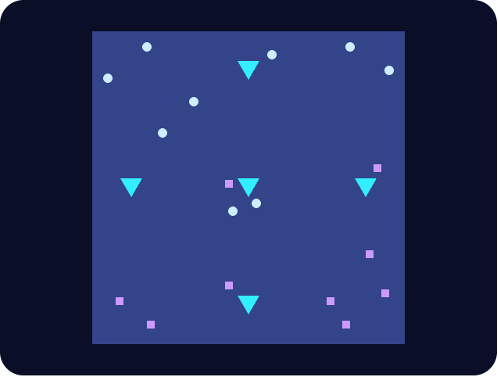
Hundreds of turns later, Zei discovered that Gong's attacks were more effective. He had not only established eternal glider factories between the central-southern shrines and the central-western shrines, but had also launched glider attacks that destroyed Zei's symbol-carrying ships.
Meanwhile, Gong's two symbol-carrying ships were moving south, and one of them was on a collision course with Zei's own ship—the collision would occur before the next intervention turn.
Zei had only one symbol-carrying ship left, the one in the east.
Zei sighed. He realized that his last symbol-carrying ship was the last mobile structure he had, and Gong knew nothing about it. His greatest advantage might be keeping it that way. On the next intervention, he maneuvered the ship to temporarily stay outside Gong's northeast base's visible range. He had the ship launch gliders to destroy the symbols undoubtedly located at Gong's northeast base. To avoid revealing its position, they wouldn't fly directly north, but would instead bounce off the northern rock shrine.
Meanwhile, in the southeast, Zei's own symbols began disappearing one by one—first from Gong's eternal glider factories, then from new gliders launched by his symbol-carrying ship as it moved from south to east.
Just before the next intervention, Zei briefly saw Gong's symbol-carrying ship appear in view near his southwest base—just before it launched gliders to destroy it.
Then the fourth intervention turn arrived. Gong had a significant material advantage, Zei knew. Zei's only advantage was concealment. And with gliders coming from the eternal glider factories, the area south of the northeast corner was one of the more comfortable places to be.
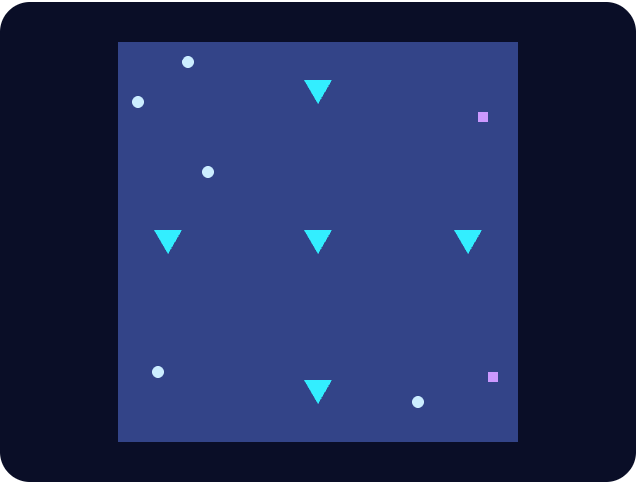
Zei decided to continue hiding. He stopped his symbol-carrying ship and began a project spanning five intervention turns to build another ship.
Meanwhile, he remembered the rock formation near the center that he had seen before his symbol-carrying spaceship was destroyed, replicated the pattern in his sandbox, and came up with a strategy to create an eternal glider factory between the central and northern shrines, wreaking havoc on Gong's northwest region.
By the fifth intervention turn, his attack had successfully dealt a heavy blow to Gong's northwest base—though Zei had no way of knowing how much damage was done. Zei continued seeking to build another symbol-carrying ship.
Not long after, Zei's last symbol in the southeast was destroyed by a glider storm. In the southeast, the last thing he saw was Gong's rune-carrying ship beginning to move north.
Zei dispatched gliders to create another eternal glider factory, this time flooding the western central space.
He didn't move his ship. He couldn't: for the next three thousand turns, before the new ship was completed, he was a helpless sitting duck.
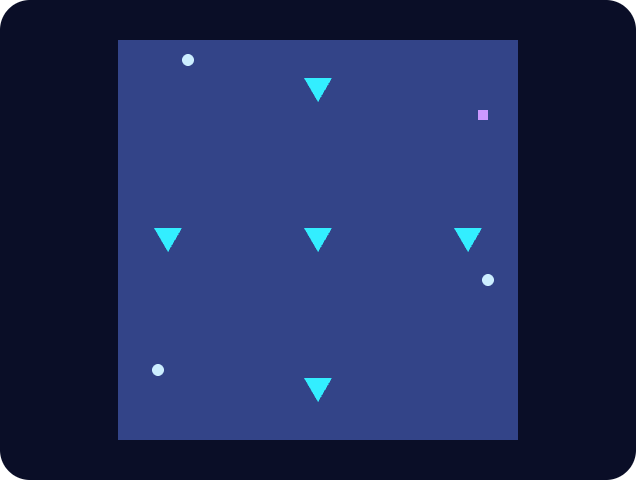
The sixth intervention turn arrived, just as Gong's rune-carrying ship came under glider attack. This gave Gong a lucky opportunity to protect it from the gliders, letting it survive a bit longer.
The ship was eventually destroyed, but only after it entered Zei's own visible range.
Zei calculated: Gong could see Zei's ship, but couldn't see the new ship Zei was building.
Zei decided to do the only thing he could: he continued building, while constructing additional walls along the west and diagonal. He wisely ignored the south: the existing glider storm, along with the wreckage of Gong's ships, was enough to provide protection on its own.
The seventh intervention turn arrived. Zei devoted all his resources to building the new ship. It was almost done. The next turn would be enough to complete it and send steering commands to both.
Then, a glider storm came at Zei's ship from all directions.
At first, the walls handled it. But then the gliders kept coming, and soon they began breaking through the walls.
The eighth intervention arrived just in time. Zei's last ship hadn't been completely destroyed yet, but it was close. He could now complete his new ship and give his existing ship one last instruction.
Zei programmed both ships to sail west. He estimated that the symbols on the old ship would be destroyed within a hundred turns, but the wreckage would still drift toward the western shore, hit the northern shrine, and release a massive glider storm southward. Meanwhile, the new ship would also sail west, but would stop north of the northern shrine, gaining some cover from the increasingly fierce glider storm.
When the ninth intervention turn arrived, Zei used nearby rock formations that had been nearly destroyed by gliders to bounce a southward-flying glider, readjusting the eternal glider factory attacking southward. He had no time to calculate what the adjustment would look like, nor any way to know its specific consequences, but he hoped it would make previously safe territory unsafe. He also launched another glider attack to the west.
The tenth intervention turn arrived. Nothing seemed to happen, except for debris. More and more debris.
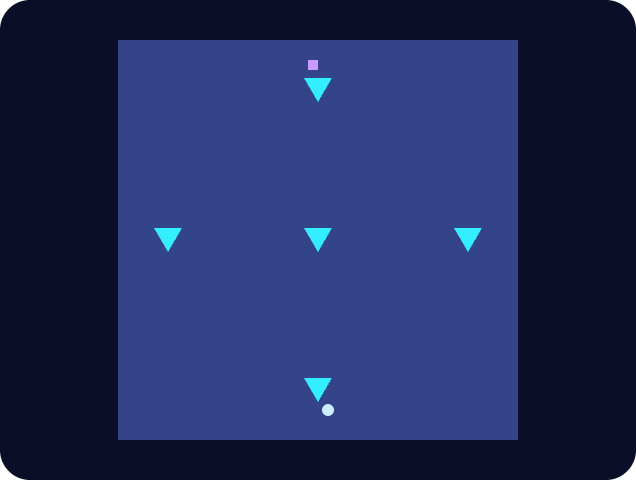
Zei reinforced the walls of matter beside his last symbol-carrying spaceship. He launched several gliders, trying to create more eternal glider factories, which he hoped would create more chaos in the south. One of the gliders was destroyed by another lost glider before it even left Zei's view.
The eleventh intervention turn arrived. Zei came up with a final trick. He figured out how to make a glider bounce south off one of his own walls so that it would hug the edge of the shrine. From simulations in his sandbox, he discovered that if it hit the corner of the central shrine, it would bounce back north. The glider would bounce back and forth between the center and the north. Each time it hit the center, it would simultaneously release another glider flying west. When that glider hit the western shrine, it would bounce off and fly southeast, hopefully causing damage to everything in the south. He did this, while mirroring the same strategy to the east.
The twelfth intervention turn arrived. By this point, the debris and lost gliders on the battlefield had become so severe that offense was no longer possible. Zei just kept building walls. Hunker down, defend, hold on.
The thirteenth intervention turn arrived. Zei built four layers of walls around the ship, and finally the walls began collapsing faster than he could build new ones.
Finally, after a few hundred more turns, the alarm sounded.
"And... Zei Remin is the winner!"
Zei breathed a sigh of relief.
Zei sat in the waiting room, watching the match between Deluin and Kao. From the very beginning, Deluin's strategy both surprised and impressed Zei. Deluin committed all his effort early on, using resources from rock formations near the north and northeast to build walls; meanwhile, he sent gliders, attempting to build eternal glider factories facing south.
Deluin didn't build any spaceships carrying mobile symbols. Instead, he simply reinforced his defenses. Kao's eternal glider factories proved to have limited use: while gliders would appear endlessly, they could only be effective for a short time. Once the glider storm hit, Deluin would find a way to deal with it.
Zei was impressed. It seemed Deluin had also discovered he needed to be more patient.
After seven thousand turns, Kao was reduced to behind the southern shrine. But Kao barely survived three thousand more turns: the number of lost gliders and debris kept increasing, while Deluin's walls provided him with far more protection than Kao had.
At ten thousand two hundred turns, Deluin was declared the winner.
Deluin stepped out of the elevator.
"That was truly impressive work, Deluin."
"Thank you! I was impressed by the strength of your walls. Now I'm excited to see how you handle your game."
"Oh—my style is much uglier than yours. But I basically won through defense too."
"Tea later?"
"Of course!"
Deluin sat in the courtyard drinking tea. As soon as Zei saw him, he ran over to say hello.
"Deluin, great to see you!"
Deluin waved too. Zei ran the rest of the way to his table and sat down.
A robot immediately slid over to their table.
"jie mo kai tu jie hei ja ma?"
A menu appeared.
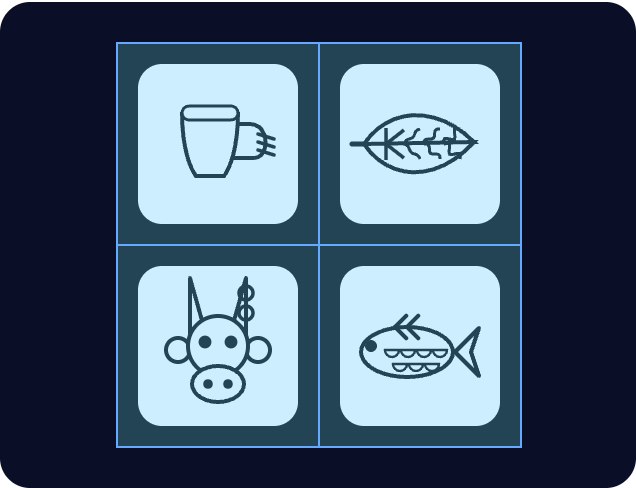
"Wow," Zei gasped.
"What is this?" Deluin asked.
"I think these are new symbols they're A/B testing for the ninth edition of Zego."
He immediately realized he was talking to a foreigner, and added:
"Have you heard of the ninth edition of Zego?"
"Oh yes, several people have mentioned it to me. Making the language visual. Bringing back pictographs for each root, but with pronunciation fully readable from the glyphs. And there's another layer—they're trying to make the grammar look more like mathematics."
"Yes, so I'm trying to parse this. The cup is water—'ja'. I see two unusual things about the cup. More straight horizontal lines than usual, and three diagonal lines on the right side. Maybe these are pronunciation markers? One for consonants, one for vowels?"
"The top right is 'kai'. The unusual things I see are... an extra vertical vein on the left, then transitioning to increasingly curved veins on the right? Although... I'm not sure I'd make the images this detailed, since they usually have different meanings depending on context."
"Wait, you know Zego?"
"Zei, isn't the whole point of Zego that it only has