


Vitalik's Science Fiction Novel "Snow Moon" Chapter 11

Chapter 11
Meldan, Viridia · 3724 Flower Time 15
Sera, Daea, and Vel stood together on a large grassy field, along with many other families nearby.
Daea spotted Gladias approaching from a distance. She waved to him. Gladias noticed and, with a smile on his face, walked toward them more quickly.
"So glad to see you here!" Daea exclaimed.
"Well, I couldn't miss my son's first real Hailis match," Gladias replied.
"So how have you been?"
"Hmm, the Order has a lot going on. You know, I can't talk about it publicly. But things are going well!"
"And you?"
Vel began to speak.
"Well, there's a lot of paperwork for the lawsuit against Fork. It's taken up a large part of my time over the past two months."
"Remind me, what happened there?"
"Ah, sorry, I've been trying not to burden you with the details. I know you already have a lot on your plate."
"Come on, Vel, your life matters to us."
"Well, remember about half a year ago, I lost my job at Leap because they went bankrupt. A month later, another employee reached out to me, and that's how I learned what actually happened. See, the official story is—"
"I remember this from the news. Leap was struggling, and as a last-ditch effort to save themselves, they made a risky bet in the financial markets, buying derivatives on real estate prices in the regions where they were about to announce the launch of their services. But it didn't work—not enough people cared, and then they got unlucky, prices fell, and the whole thing collapsed."
"Exactly. But then I learned that the only reason Leap could place such a huge bet in such a niche market without causing absurd slippage was that the hedge fund 'Fork' took the other side. And Fork's main owner had already secretly bought up a large block of Leap shares at an extremely low price."
"If local housing prices rose, Leap would profit and Fork would lose, netting zero for them overall. Conversely, if housing prices fell—which they did—Leap would lose and Fork would profit, still net zero. But here's the asymmetry: once Leap took a loss—and it did—they would declare bankruptcy, so they wouldn't have to pay year-end bonuses or a full year of severance to their employees. In other words, they walked on our backs and gave themselves a free option."
"When we found out, we filed a lawsuit—all the employees filed a class action together. It's been tough; Fork even managed to intimidate some media outlets into not covering it. But I think the judges have seen through their tricks so far. So I'm optimistic."
Hearing a loud noise, they all turned to look in the direction of the sound.
It was the instructor. A large truck had driven to the center of the field.
"The Hailis match starts in five minutes!" the instructor shouted. The instructor pressed a button, and the truck's rear door began to open slowly, the bottom hinges tilting backward. Moments later, it became a ramp.
Several personal rotorcraft slid out of the truck automatically. These flying devices were simple in construction, like a chair with rotors mounted on top and protective guards around the sides.
Some children around ten to twelve years old ran toward the truck, half wearing yellow shirts and the other half wearing purple shirts. Zven was one of those in yellow. They grabbed the helicopters and began strapping themselves in.
The instructor walked into the truck and soon came out with a much smaller box. He opened the box, and four bright red drones jumped out, flying into the sky. They were shaped like balls, only a few centimeters in diameter, with soft feather-like rotors on top.
"Welcome to today's Hailis match," the instructor said. "Today we'll play a limited game, red ball only. If you catch the red ball and bring it back to me, your team gets a point. The first team to six points wins."
By now, all ten children had strapped into their personal helicopters, and the rotor blades began to spin—enough to overcome about three-quarters of Earth's gravity. The children ran around excitedly, some jumping about two meters off the ground before gently gliding back down.
"Does everyone know what to do?" the instructor asked.
"Yeah!" many children shouted in unison.
"Then we'll start the match in five... four... three... two... one...!"
The personal helicopters flew into the air.
"You know, I'm surprised they still do this at schools," Gladias said to Sera. "If this were invented today, they'd definitely say it's too dangerous."
"It was only invented less than ten years ago."
"In Zego."
Zven spotted a red ball and began flying toward it. A moment later, two children in purple shirts also spotted the red ball and began chasing after him.
The red ball suddenly veered to the left.
Zven and the other children turned left as well. The rotor guard of Zven's helicopter collided with the rotor guard of another child's helicopter, and the two bounced apart without causing any damage.
Zven maneuvered his rotorcraft upward. He was slightly behind the child he had just collided with, while a third child flew forward and quickly came directly below him. The airflow from the rotors below sucked Zven downward, and his feet soon hit the protective mesh on top of another rotorcraft.
Zven quickly jumped off, and both he and the other child were thrown several meters before stabilizing and flying off in different directions.
"The AI on these things has gotten really good now," Gladias murmured.
The red ball suddenly changed direction again, this time upward. Zven immediately opened his rotors to maximum power and climbed upward. The child he had just collided with was still a few meters below him, and the other child didn't notice the red ball's change of direction in time, so Zven took the lead.
Zven saw the red ball getting closer, and then closer still. Now it was only a meter away from him.
The red ball suddenly shut off its rotors and began to fall. Zven thought quickly, and just as the ball fell to the height of his feet, he kicked it back, propelling his aircraft forward. He reached out and caught the red ball in his palm.
Then he aimed his helicopter toward the instructor and flew over. The rotors slowed—though they didn't stop completely. As Zven's altitude descended at the safe maximum of five meters per moment, they would accelerate back—the speed at which you land after falling from just under two meters. The instructor watched Zven land and reached out to take the red ball Zven handed him.
"Zven makes the first catch of the match, Yellow Team scores first!"
He sent the red ball flying again. It shot forward rapidly, in the opposite direction from where Zven was standing.
Zven flew back and continued searching for more red balls. "How are Hreida, Lili, and Febrik?" Gladias asked Daea. Sera heard the question and tilted her head slightly to listen for the answer.
"Hreida went to North Woodland for a math competition. We've been trying to get Lili more interested in art, but so far it hasn't really worked."
"I also talked with Zven for a while, and he showed me his homework. I was surprised. I saw the arithmetic problems they gave him, and they seemed... slightly more advanced than the problems Febrik got at his age?"
"Domus makes a beautiful catch!" the instructor shouted. "Gale with a nice catch! Purple Team scores two points."
Sera joined the conversation.
"Well, Glad, you're—" She caught herself, briefly remembering that even designating a Guardian was inappropriate—"now an Order member. Is there anything the Order can do to improve education in Viridia?"
"You know, schools aren't under the Order's jurisdiction. Public schools are managed by the Education Committee established by the Council. However, there have been proposals to support more private schools, funding them through graph grants, and establishing some evaluation standards to give them proper incentives."
"Maybe you should try to push for that at your Guardian meetings?" Sera replied, whispering into her watch instead of a neckband. She thought it best to have this conversation privately rather than having to carefully choose every word to avoid revealing Gladias's position.
Gladias thought Delvot would support it. However, he'd probably prefer private schools without evaluation standards, receiving only nudges.
"Zven with another beautiful catch! Yellow Team scores their second point."
Gladias and Sera's attention returned to the match. There were three groups in the sky, three children each, each group chasing what they must have thought were different red balls. Zven flew alone, not attempting to join any group. Instead, he seemed to just hover in the sky, his eyes constantly scanning the horizon, trying to find where a fourth red ball might be.
One of the children fell from the sky, but the rotor's AI automatically stopped his fall. He landed, stood up moments later, and flew back into the sky.
A minute later, a child landed next to the instructor and handed him a red ball.
"Gale with another beautiful catch! Purple Team scores their third point."
The red ball flew back into the sky, and Gale and two other children chasing it with him took off after it again.
Another two minutes passed. Another child landed next to the instructor.
"Dra with a beautiful catch! Yellow Team scores their third point."
A minute later, two other children landed at about the same time:
"Platt with a nice catch! Yellow Team scores their fourth point."
"Meni with a beautiful catch! Purple Team scores their fourth point."
Zven continued his solitary search for the fourth red ball, which all the other children seemed to have completely forgotten about.
"Egardo with a beautiful catch! Purple Team scores their fifth point."
"Dra with another excellent catch! Yellow Team scores their fifth point."
He began flying closer to the ground.
Gladias and Sera saw Gale shoot ahead of his two competitors, preparing to catch the red ball. It was only a meter away from him.
Gale's hand reached out. He was about to grab it.
Then, suddenly, another child crashed into him, and he veered several meters to the right. That kid tried to grab the red ball, but the red ball quickly turned and flew backward, landing right between the two. As it passed, both Gale and the other child tried to grab it with their hands, but neither caught it.
Gale was the first to spot the red ball again and quickly flew toward it. His two competitors soon followed, though they were at least ten meters behind.
Both Gale and the red ball were climbing, and Gale was gradually closing in on the red ball. Five meters. Four meters. Three meters.
Meanwhile, Zven seemed to suddenly plummet toward the ground, and the rotorcraft's AI stopped his fall just in time as usual. High above, far above the other players, Gale triumphantly raised his hand, the red ball clutched in his fist.
Many spectators cheered. Gale flew past the other two students following him and began descending at the maximum speed of five meters per moment.
Suddenly, Gladias and Sera's eyes turned to Zven. He had already gotten off his helicopter and was running toward the instructor.
While Gale was still about thirty meters in the air, Zven opened his palm and handed the instructor the fourth red ball with a broken rotor that he had found on the ground.
"Zven with a nice catch. Yellow Team scores their sixth point. Yellow Team wins the match!"
Gladias breathed a sigh of relief.
Sera felt proud of Zven.
"He took the road less traveled," she softly recited, quoting an old Viridian author, "and that has made all the difference."
Gladias opened the gate, entered the booth, and closed the gate again.
Three other Guardians were already there. Gladias thought the other three must still be on their way.
This was Gladias's third Guardian circle, and the topic was air quality. Here, his assigned number was two.
Gladias immediately took out his watch and whispered into his neckband, checking the current room's air quality.
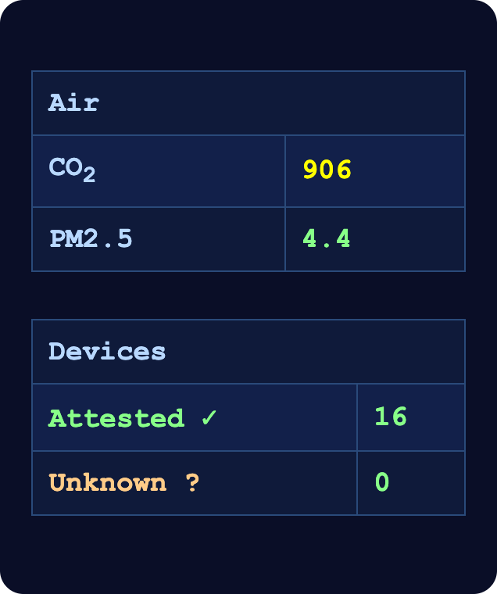
Air
CO2 2 906
PM2.5 4.4
Devices
Certified ✓ 16
Unknown? 0
"We're already at 906, and there are only four people here. How are things?" he asked. "The filters are working well, but I'm guessing they haven't figured out how to ventilate these safe compartments yet?"
"Yeah, almost everyone is genuinely behind the standard. We keep saying we really have to raise taxes across the board in this category."
The CO2 reading on Gladias's watch refreshed. It now showed 918.
"I think people will figure it out on their own," another Guardian replied. "It's just a matter of whether the technology is open and deployable enough. Over the past decade, we've halved the price of these filters every two years."
"Hmm, I think we have to push harder," Gladias replied.
"What does the current indoor air quality tax standard say?"
"It's part of the land tax. If the air quality is perfect, it's zero; if the average occupied room reading is below one thousand, there's an additional one-third per year. If there are filters or UVC, the threshold is adjusted."
"Only one-third? The difference between theoretically perfect and absolutely terrible?"
"It's levied at one-third of the land value per year. For many businesses, that's equivalent to one-sixth of their revenue."
"There are many factors involved in land tax. Public aesthetics, accessibility—both for people with disabilities and for allowing people to freely pass through your land without fencing it off. The percentage of your building that occupies the land. Active ground-floor use, though this is debated—some think it should fall under aesthetics. Emergency preparedness. Fire safety. There isn't enough room for everything."
"Come on, Viridians aren't that sick. If you look at the extensive listening report we published a month ago, resistance to indoor airborne diseases isn't even one of the top ten concerns for Viridians."
"Active ground-floor use isn't just about aesthetics, it also helps with walkability and reduces congestion—"
"Okay, but I think we should just target those things directly."
"Anyway, that's not for us to decide. Air quality is. You're missing the tail risk."
"What tail risk?" Gladias interjected.
"Super pandemics. Like, deliberately released by the Arctics."
"Is there any evidence they're engaged in anything like that?"
"They're a super opaque society. The only evidence we have that the Arctics even know Viridia exists is that we have to listen to Lord Ephelion's sermons all the time."
"So what are the possible plans on the table?"
"Raise the cap to two-thirds. Then tell the funding bodies—graph grants, quadratic funding, Council appropriations—that they should support more open—"
Another Guardian cut in:
"Quadratic funding? That round is a mess right now. Someone released a program that you download to your device, and it proves you donated to some project studying social media polarization—which isn't even that good—and then you claim a reward. You donate ten Zip coins, get twenty back, and the project gets a hundred total including the capped matching funds. A lot of people participated. Yesterday, an insider from Blue Whale exposed that this was apparently all orchestrated by them."
"Blue Whale? But why would they do that? They don't even control the projects that receive the funding."
"Wherever it goes, if it's hiring Iptak's people to dig holes and then fill them back in, they'd still do it. Their goal is to drain funding from anything that interfaces with open platforms. Starve the open ecosystem, and the closed ecosystem wins by default."
"Okay, we'll stick with graph grants. Through our channels, we'll advise the graph grant people to support more open-source technology, including air filtration, cleaning, wastewater scanning, and so on."
"Wastewater scanning too? You want to violate everyone's privacy even more? If the Arctics hack in and get all that data, then they'll know who lives where, even when they move, and when everyone is healthy or sick?"
"I thought you were the one who kept saying there's no evidence the Arctics are actually doing those crazy things?"
"Isn't there some cryptographic method to get the data we want from scans without collecting the data itself in plaintext anywhere?"
"Well, if you can find a genius who can solve a problem like that, let us know."
Gladias got off the bus and pulled the strap on the front cover of his privacy robe. His face was still covered, but the strap between his