

Vitalik's sci-fi novel "Snow Moon" Chapter 10

Chapter 10
Free City, United City-States · 3724 Windmoon 24
The taxi Yaan was riding in stopped in front of the Free City Economic Research Institute—he was a researcher here. He got out and walked into the building, lightly tapped his handheld device to pay, and passed through the turnstile.
Out of the corner of his eye, he noticed that the toll had risen by ten percent compared to before.
He walked to the dining area and saw that most of the tables were full. Only one table was empty, and a woman was already sitting at it.
"May I sit here?" Yaan asked.
"Of course."
Yaan sat down.
"I'm Yaan," he said.
"I'm Utaku. I'm from Belpaki, pursuing a doctorate at the Institute."
A robot glided up to Yaan and offered him a menu.
Yaan quickly scanned it and ordered a dish of vegetables and fish, along with a glass of water.
He noticed the prices were also higher than before.
"Wow, everything's gotten more expensive now."
"Haven't you been following the news?"
"Not since I got back from the meeting in Hapton."
"Well, Hapton should be news too. Everyone's talking about raising the defense budget."
"Arctic fears?"
"Yes, their drone activity has been increasing. Though surprisingly, a lot of politicians seem completely indifferent to it. Only Red Shire and its neighbors seem to truly take it seriously."
"Hmm, and somehow, Free City too."
"Why us? I'm glad, but half of the United City-States are closer to Red Shire than we are—they should be more worried!"
"Devonville does take it seriously—after all, twelve percent of Devonville's council seats are elected by Red Shire. But Deplexi, Ondak, and Imbel really don't take it seriously at all."
"That's strange. Remember, the constitution prohibits the government from collecting more than the basic land tax and a portion of rents from its natural resource assets. So it's not even the government taking this seriously—it's the large corporations."
The robot returned with Yaan's food and water. Yaan picked up the food from the tray and placed it on the table. Then he picked up the glass of water and immediately took a sip.
"They're now donating three percent of their revenue to defense, and even banding together to punish companies that refuse to contribute. Mounia refused to pay for defense—claiming concerns about corruption, though everyone thinks they just want a free ride—so the charging station operators united and threatened to exclude Mounia's cars from their networks if they didn't join; and they control ninety percent of the charging stations in Free City. Yesterday, Mounia gave in."
"That's... brutal. If any industry tried to do this under normal circumstances, they'd face half of Free City's anti-collusion measures, and maybe five new competitors would be funded to oppose them."
"Usually, yes. But hey, times are different now."
Meldan Viridia
"Are you going to your first Guardian meeting?" Sera asked Gladias.
"I'm attending the first two Guardian meetings back to back. The first one discusses cultural values in public events and performances—exactly the criterion that was used to judge Dreadknot."
"Oh, what's the topic of cultural values in events?"
"During the discussion, I mentioned that this assessment standard makes people become overly bland to avoid offending anyone. Unexpectedly, several others agreed. I think I'll try to push for a revision."
"Viridia is so 'interesting'!" Sera joked. "Isn't this the 'gie' you're supposed to replace? 'Fau' just means 'again.'"
"Ah, right."
"But yes. Viridia will become interesting again."
"And the second one?"
"The hardware openness assessment standard. The issue is whether to revise it to exempt military and surveillance products."
"Uh, what are the trade-offs there?"
Gladias carefully thought about how to phrase this. He considered for a moment whether to mention Delvort, but then decided not to.
"Well," he began, "some Guardians believe we should stay away from funding war—it's a negative-sum game. If both sides have better bombs and combat drones, the result is the same, just with more things blown up and more people injured."
He was pleased with himself. He had a feeling that Sera might be sensitive to anything that could harm Zhego, and would plead with him to take the position most favorable to Zhego. He braced himself, ready to answer Sera's next question.
"But the funding... isn't that more of a matter for the Atlas funding side?"
Gladias breathed a sigh of relief inwardly.
"Remember, we also make some weapons. And surveillance products. These rules affect how secretive we are about our own secrets."
"I see..."
"Well, let me know how the meeting goes!"
Gladias walked down the corridor and entered a courtyard. He found a series of booths with thick sliding doors. He walked to the rightmost one as instructed.
He slid the barrier open. It took tremendous effort for him to do so. He immediately saw that this booth was far more suitable than the cloth stall in Great Plum Harbor. When the barrier opened, he could see its internal structure: a layer of anti-transmission foil, then a soundproofing layer, and other layers he couldn't identify.
Just then, he also noticed a constant humming sound coming from all directions outside the booth. He realized that white noise could further mask anything passing through the soundproof walls. If the noise was forty decibels, and the walls were good enough to attenuate sound by fifty decibels, then it could mask sounds up to ninety decibels from inside—or maybe seventy decibels if you wanted a safety margin. That was enough to completely mask any conversation.
After fully opening the barrier, Gladias looked inside the booth. A table extended from the entrance all the way to the opposite wall, with a bench on each side.
Five other people were already seated, all wearing privacy robes.
"Welcome! You must be Number Four," one of them said loudly.
"I am indeed."
"I'm Number Twenty of this group, in my third year of tenure. We have two second-years—though Number Eleven hasn't arrived yet—two third-years, and two first-years; now plus you."
"Nice to meet you all."
Gladias sat down on the bench next to Number Twenty. Twenty opened his handheld device, and Gladias could see him scrolling through recent audits, measuring various enterprises' standings on cultural values, and the resulting decisions.
A moment later, another Guardian walked in. He closed the barrier behind him and sat down.
"So, the cultural values assessment standard..." another third-year Guardian began.
"It's 'cultural values in events and performances,'" Number One, a first-year, corrected. "We don't handle social media or other online content—that falls under another rule; nor architecture and public billboards—that belongs to the aesthetic tax category."
"We all know that. You don't need to show off here," the third-year Guardian replied, using a joking tone to try to make his point without offending Number One.
"How do we want to approach this? Maybe we should first agree on what problem we're trying to solve?"
"Let's look at some examples," replied a second-year Guardian who hadn't spoken yet.
Gladias saw an opportunity to intervene.
"How do you all feel about Dreadknot?"
"What do you mean?"
"In the last audit, their tax tier was raised to Tier Four." Gladias began reading the assessment criteria.
"The content glorifies one or more of the following: violence, lawless behavior, use of discouraged substances, gambling or risky ventures, excessive flaunting of wealth, poor conflict resolution, religious or ethnic hatred."
"Do we think Dreadknot glorifies violence, lawlessness, or hatred?"
"Their last song was about destroying cities and peeling people's flesh. Why not?"
"Do we really think those lyrics would make anyone in real life want to peel anyone's flesh? It's a song. I remember we went through this years ago with games—science eventually showed they could slightly increase aggressive behavior, but there's no evidence they actually cause violence."
"I remember that too. The evidence I read reached harsher conclusions than that."
"Do we want to dig into those studies together and go through them?"
Several other Guardians nodded. They began quietly issuing commands to their handheld devices.
Gladias took the opportunity to continue.
"But beyond that, do we really want Viridia to be a society where artists have to constantly worry about this, where all songs, games, and movies become boring and pale?"
"They don't have to constantly worry. That's the whole point of Viridia's regulatory system. We don't ban them. We just raise their taxes slightly instead of slightly lowering them. So, on top of the ten things they already have to worry about—like what their fans will enjoy, what might or might not offend their corporate sponsors, and so on—things that won't break them but still have an impact—we ask them to consider one additional question: the public interest."
Gladias decided to try a different argument.
"Actually, I like this assessment standard. The Northwood Science Center was rewarded for providing kids with a great place to learn chemistry, biology, and rocketry—I think that's good."
"But violence is part of life. Humans originated from monkeys fighting over bananas. When we still lived in forests and caves, a quarter of us died at the hands of others. The epics they made us study and memorize in school are full of violence. Every hero in every great book has done violent things. I don't think we should completely prevent Viridians from engaging with this core part of our humanity. If we always steer public media away from violence, all people's thoughts about violence will come from the dark corners of the internet, where no one is taxed—that would be worse."
"Has any research tried to measure this?" Twenty interjected.
"I don't know if you can measure this through research," Gladias replied.
Another third-year Guardian spoke up again.
"This is good. I think we've raised some important questions that involve not just science, but also our underlying goals and values."
"I think we should re-read those studies about games from back then. Meanwhile, we should also see what Viridians think about this. Can we have Emerald produce a broad listening report on what people have said about Dreadknot on Bluewhale or Silverword over the past year?"
"I don't think what people say on social media is necessarily a good guide to what's good for people," Eleven interjected.
"Alright, but let's take some time now to read through it."
Gladias nodded. Several other Guardians nodded along.
"Please wait a moment. Bluewhale always refuses to let you read messages on their platform through anything other than their interface—I have some tricks to work around that."
Almost exactly a minute later, a new window appeared on each Guardian's handheld device, showing Emerald thinking in real time and logging what people were saying about violence and Dreadknot on Bluewhale and Silverword. The Guardians began staring intently at their devices—some reading game studies, some watching Emerald think.
Gladias stood outside, drinking a glass of warm water. His first Guardian meeting had lasted seventy-five minutes and was over, and he was on a twenty-five-minute break.
His watch buzzed.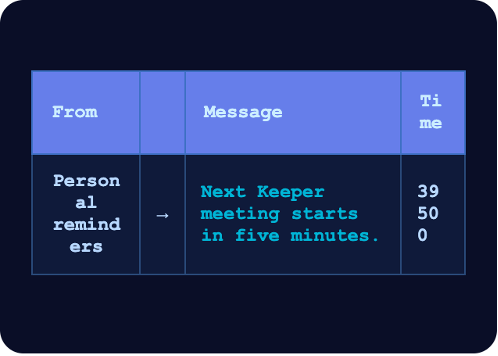 Starting from message time
Personal reminder → Next Guardian meeting will begin in five minutes. 39500
Time to go.
Gladias turned the corner and took the last few steps toward the booth.
Soon he arrived and opened the barrier.
Two other Guardians were already seated inside, one on each side. Both wore privacy robes, with hoods and masks.
"Hello, you two!"
"Hello! I'm Number Eighteen. What number are you?"
"Number Six."
"I'm Number Nine."
Eighteen thought for a moment, then stood up.
"Wait, before the others get here, would you two mind standing up again?"
Gladias and Nine both stood up, briefly stepping out of the booth with the door open, looking in from outside.
"Alright, let's take a look."
Eighteen switched his handheld device to a different mode and began waving it around the room. He also pulled out a drone and pressed several buttons on his handheld device. The drone began flying near the edges of the room, above and below the table.
Eighteen and Nine watched quietly as Eighteen conducted the scan. Two more Guardians arrived and quietly joined them.
"Hmm, no transmissions, and no thermodynamic electronic devices detected."
A minute later, the drone unexpectedly buzzed above the middle of the far end of the table.
Eighteen jumped to that position with his handheld device and began intensely observing and poking at the table. A moment later, he stood up triumphantly, holding a needle-like device with a bulb a few millimeters wide at its tip.
"What is that?" Gladias asked.
"A surveillance device. There's a small bump on the table, and this was underneath it. Inserting one of these and then repairing the table must have required some skill." Eighteen replied.
"Wow."
Nine stepped forward and took a brief look at the device.
"I doubt this was aimed at us," he said. "Usually, the goal of whoever does this is to obtain information about upcoming business decisions and trade on financial markets based on those decisions. Smaller businesses tend to be less careful. The Order's security measures against this are quite good. Our Guardian group is just one of three discussion groups, so even if you overheard all of us, you'd only get one-third of the perspectives. And we all speak through neckbands, so voices are transmitted digitally between us."
"Actually, this thing has a camera. It can read your lip movements and neck movements, so it could still gather enough information to make out some words, especially from people who aren't yet skilled with neckbands."
"How do you know?"
"That's how the drone detected it—infrared light reflecting off the camera lens. My handheld device also picked it up with a nonlinear junction detector, but if the drone hadn't told me where to look, I probably would have missed it."
The last two Guardians arrived.
Eighteen stepped out, explained the situation, and the group looked at the listening device together. Some Guardians scanned it with their handheld devices. When they finished, Eighteen snapped the device in half.
Eighteen led the group to another empty booth a few meters away and pushed open its door.
He spent another two minutes checking the new compartment for listening devices with his handheld device and drone. Once the check was complete, he waved his hand, and all seven Guardians entered and sat down on the benches.
A newly arrived Guardian cleared his throat and seemed ready to speak.
"Maybe we should get down to business?" the Guardian asked.
"Of course!" Gladias replied.
"So we should discuss the question of openness, and how to adjust it for military hardware."
"Yes, I've read the document."
"I had some conversations with Number Zero there. His argument is that we should completely exempt military hardware. I'll let him explain why."
Zero heard his number and quickly looked up.
"So normally, open hardware is good because others can build on it, and everyone benefits, right?"
"Correct."
"But think about what happens with the military. Everyone having better weapons doesn't actually produce a net benefit for the world. If everyone has twice as good swords and twice as good shields, the two cancel out."
"If everyone has twice as good swords but shields stay the same, then both sides in a war still cancel out, but more people get hurt."
"But if everyone has twice as good shields, and swords stay the same, isn't that great?"
"Hmm, maybe." Nine interjected. "But it's actually more complicated than that. If it's a war of attrition, then if everyone has more defense, the same number of people get hurt, it just takes longer? Or if increased defense reduces deterrence, so more wars happen?"
Gladias was surprised: this argument was strikingly similar to one Delvort had recently expressed to him.
"Ultimately, the game tree is too chaotic—we simply can't reliably judge the outcome. So I think we shouldn't intervene on openness or not; just raise the intervention tax on all military hardware, whether it's open source or not, to push people toward making more useful, more humane, more interesting things."
A third-year Guardian interjected:
"I don't think we really can't be certain about anything. Look at the