

Justin Sun Prize's First Batch of Candidate Winners Officially Enters Public Notification Period, Decentralized Academic Bounty Mechanism Accelerates Implementation

Recently, the operators of the Sun Yuchen Prize announced that the first batch of candidate awardees has entered a 14-day public notice period starting September 19. The problems under public notice this time are Nos. 305, 371, 381, 526, 866, and 1001 in the official problem bank. Among them, the candidates for problems Nos. 305, 371, and 381 are formal verifiers, the candidates for problems Nos. 866 and 1001 are mathematical solvers, and problem No. 526 has candidates for both roles. This progress marks the Sun Yuchen Prize's transition from establishment to substantive operation, and also means that the world's first zero-trust, decentralized academic bounty mechanism based on a "problem list" has entered regular operation.
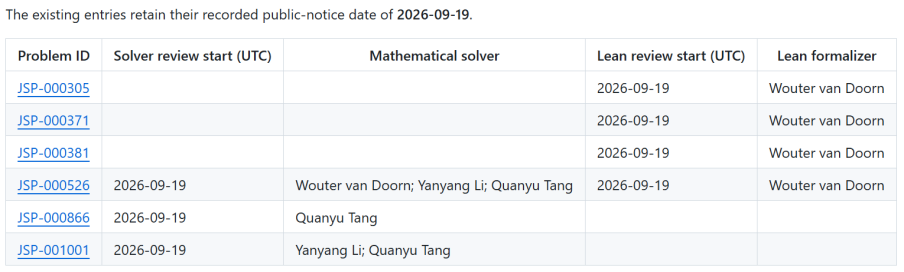
It is understood that the public notice information has been published in the Sun Yuchen Prize GitHub repository, where the public can review it at any time and, through official channels, formally challenge the correctness, attribution, priority, identity, and award eligibility of the results. After the public notice period expires and there are no unresolved objections, the relevant contributions will enter the stage of written confirmation by the award recipient and prize disbursement.
On September 16, TRON founder Sun Yuchen announced the establishment of the prize, positioning it as the world's first zero-trust, decentralized academic bounty mechanism based on a "problem list," with major breakthroughs in basic disciplines and machine formal verification as the sole criteria for awarding prizes, and a maximum prize of up to $1 million per problem. On the day of its establishment, the first batch of recognition recipients was also announced, involving solutions and formal proofs for 66 mathematical problems. Among them, the top prize of $1 million was awarded to the OpenAI research team in recognition of its solution and formal proof for the "existence and smoothness problem of the three-dimensional Navier-Stokes equations."
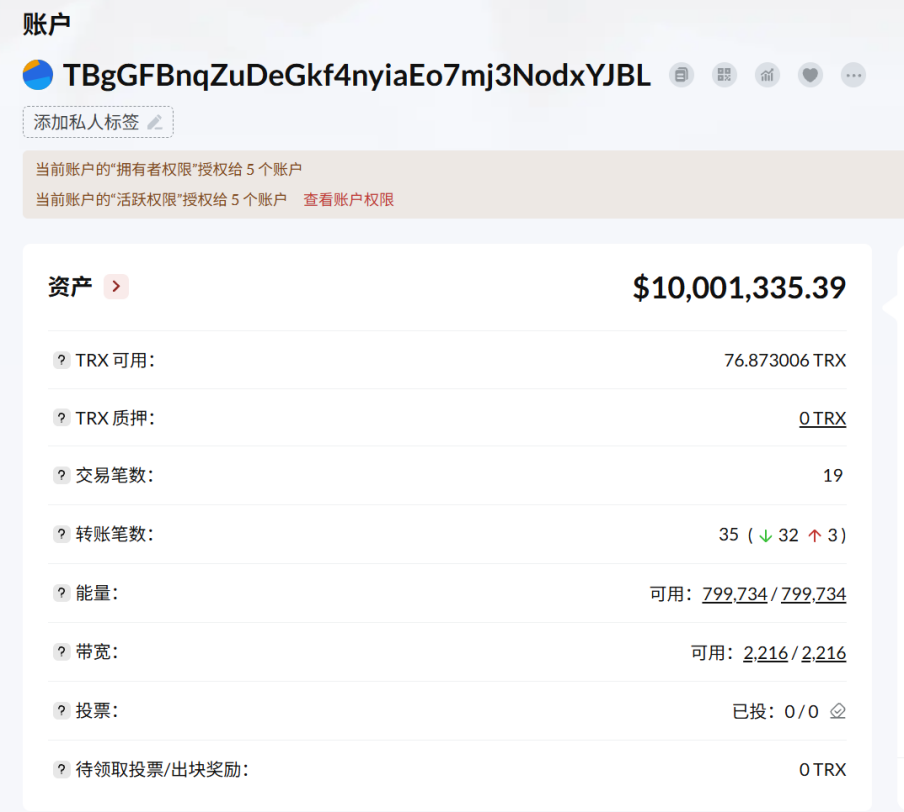
On the evening of September 22, the official social media account of the Sun Yuchen Prize published the prize pool's public on-chain address, and $10 million in prize money has currently been deposited. According to previous media reports, the disbursement records of the Sun Yuchen Prize are stored on-chain as evidence, permanently traceable and tamper-proof. Once the problem list is posted, it is permanently locked, only increasing and never decreasing, and prize money is only redeemed and never refunded. The entire process is handled on GitHub through contribution PRs (Pull Requests), claim issues, and the official email address. The operators of the Sun Yuchen Prize specifically remind the public that the official team will not ask for account passwords, wallet private keys, or mnemonic phrases, nor will it require transfers to designated addresses to activate prize money.
According to the officially announced prize claim rules, applicants need to complete qualification review and prize award in three stages. In the participation and verification stage, contributors select problems from the official problem bank, fork the repository, and submit PRs according to the contribution type. Solvers only need to provide a public mathematical proof or a link to a publication, while formal verifiers must use a fixed commit in their own repository as the source and provide a reproduction environment and build verification information.
After entering the prize application stage, contributors must use their own GitHub account to publish a prize claim issue, fill in a contact email, and complete identity verification. After passing qualification verification, the candidate list for the relevant contribution will enter a 14-day public notice period, with separate timing for the solving role and the formalization role. During the public notice period, the public may raise challenges or submit related PRs with alternative proofs.
After the public notice period expires, with no unresolved challenges and after written confirmation by the award recipient is completed, the award stage begins. During this stage, winners may supplement payment collection information and mailing information for certificates and medals through the official email address. Prizes are paid in digital currency, currently supporting USDT (TRC20) and USDC (ERC20).
The operators of the Sun Yuchen Prize stated that the prize only accepts complete mathematical solutions and complete Lean proofs for the original problems. The review order is fixed: first confirm the mathematical solution and register the solving candidate, then conduct Lean verification and formalization candidate registration. The reward is granted only to the first person to complete a problem on the list. If multiple people complete it jointly, the solver receives 70% of the total prize and the formal verifier receives 30%; if one person completes both, they can receive the full prize. The award covers mathematical progress achieved since January 1, 2026; for results already solved earlier but formally verified afterward, the formalizer can receive the award.
The operators also stated that the Sun Yuchen Prize adheres to the principles of openness, public benefit, and open source, and is open to all eligible contributors, with no restrictions based on nationality, institution, or identity, and no distinction between humans and AI. Funds are dedicated solely to prize awards and open work, not for profit. The problem list, confirmation standards, proofs, and verification materials are all open to the public through GitHub. The current problem bank already includes 1,022 mathematical problems, including the Poincare conjecture, the Riemann hypothesis, the Goldbach conjecture, and a large number of unsolved problems proposed by mathematician Erdos.
Sun Yuchen said that mathematics is the underlying language and framework of all basic science. What truly expands the boundaries of human cognition has never been only solitary inquiry, but also the transformation of insights into formalized results that can be rigorously checked by machines and reproduced by all humanity. He pointed out that the current work of transforming human mathematical proofs into machine-verifiable formal proofs still mainly relies on the spontaneous enthusiasm of the formalization community, and systematic economic incentives have long been lacking.
"People in formalization have never lacked enthusiasm; what they lack is a construction map with a price tag," and the Sun Yuchen Prize was created precisely for this. He further emphasized, "I am not a mathematician. I am a bystander. I pay. The rest is left to the proofs."