

Quantum Computing Conference Kicks Off Today: IONQ Up Nearly 12% Pre-Market, MPWR Up Over 8%, Nasdaq Hits New High; AI Power Demand Draws Attention Again

Today (September 23–25), the global quantum computing event Quantum World Congress 2026 will officially kick off in College Park, Maryland, with industry giants such as IonQ, D-Wave, Rigetti, Microsoft, and IBM all in attendance. Yet even before the curtain rises, the secondary market has already whipped up a frenzy: in after-hours trading yesterday, quantum computing stocks surged collectively, with IonQ alone jumping over 12%; in pre-market trading today, this momentum has not faded—IonQ extended its gains by nearly 12%, while analog chip and power management giant Monolithic Power Systems (MPWR) also surged over 8% in tandem.
On one side is quantum computing, still in the midst of technical breakthroughs; on the other is power chips for data center foundational power supply. These two seemingly disparate tracks actually reflect the market's repricing of the bottlenecks at both the compute and energy ends of AI's next-generation infrastructure.
1. On the Eve of the Conference: Capital Front-Running, IONQ Stages an Independent Rally
After-hours trading data from September 22 shows the quantum computing sector exhibited an extremely clear staircase-style surge: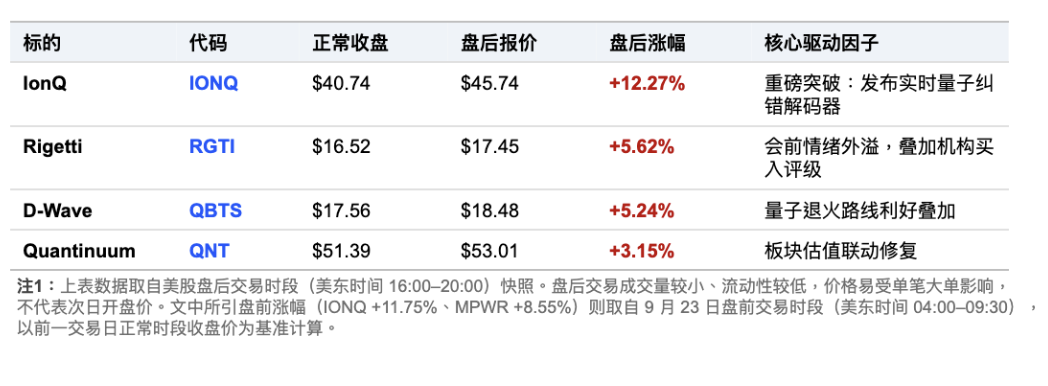
2. What Is Quantum Computing? Where Do the Industry's Pain Points Lie?
Quantum computing is not an incremental upgrade to traditional computers, but a structural transformation occurring at the foundation of computing power. The compute architecture of classical computers is built on binary classical bits—for the same n bits, the total number of states it can encode is actually the same as qubits; the difference is that it can only land on one of those states at any given moment. What makes qubits different is that they allow these states to coexist simultaneously, then amplify the probability of the correct answer through interference. To use a book analogy: a classical bit is a thick volume, and you can only open one page at a time; a qubit is all pages spread open at once, each able to interfere with the others.
The industry pain point standing between theory and usable compute power is noise. Qubits are extremely delicate—tiny disturbances in temperature or electromagnetic fields can cause the superposition state to instantly collapse, errors rapidly accumulate during computation, and the result is nothing but meaningless noise. The industry's only solution to noise is quantum error correction: encoding hundreds or thousands of physical bits into one highly reliable "logical qubit," with correction instructions issued in real time by an external classical computer. But this also triggers a fatal timing contradiction: the coherence period of a qubit is only at the microsecond level, and if the classical decoder's compute power cannot keep up, syndrome data will pile up dramatically, forcing the quantum computer to halt and wait—and every microsecond of waiting, environmental noise is generating new errors.
The industry's previous crude solution was simply to throw ever more compute power at the problem, which directly gives rise to a near-paradoxical "cost curse": for each additional logical qubit, the cost and power consumption of classical hardware grows nearly exponentially. This is precisely the deepest concern of the capital markets—before quantum computers can even be commercialized, they may be dragged down by their own massive, expensive, and power-hungry classical logistics system.
3. The Comeback of a Single CPU: What Exactly Did IonQ Get Right?
IonQ announced after hours yesterday that it has successfully developed and validated what IonQ calls the world's first end-to-end real-time quantum error correction decoder. The most striking breakthrough is that it can be driven by just an ordinary commercial CPU, achieving zero slowdown in quantum computing. Upon this news, IONQ's after-hours stock price immediately jumped over 12%.
Setting aside the hardcore technical parameters, what does this breakthrough actually mean? If fault-tolerant quantum computing is likened to a sports car racing at extreme speed, then quantum error correction is its braking and steering system. In the past, to prevent the sports car from losing control due to noise, the industry had to attach an entire cumbersome server cluster to perform real-time computation—the sports car hadn't even gone fast yet, and the logistics trailer was already crushing it to the ground. What IonQ brings is precisely the key to uprooting this "logistics nightmare."
Key data from the announcement corroborates this: the decoder employs a dual-decoder architecture, validated on circuits with up to 408 logical qubits and 88 memory blocks, processing over 31.5 million quantum operations, with additional overhead of only 0.02% under standard operating noise. It should be noted that this validation was completed on simulated circuits and is not yet a full fault-tolerant computation running end-to-end on actual physical hardware—it is a critical intermediate milestone, not the finish line.
4. AI Agents Are Pushing CPUs to the Brink—How Can Quantum Computing Break the Siege?
From Meta's Muse to recent strategic statements by various cloud vendors, the industry is sending an extremely clear signal: the battlefield of AI is shifting comprehensively from large model training to the ecosystem deployment of AI Agent intelligent agents. In the past large model arms race, compute attention was entirely on GPUs; but Agents with autonomous planning and execution capabilities need CPUs most.
According to a TrendForce report, in AI agent workflows, tool processing and logic orchestration account for 90.6% of total system latency. Faced with complex logic such as task decomposition, code execution, and multi-round state passing—which are branch-intensive and serially dependent—the GPU's parallel computing advantage is rendered useless, and the compute load is entirely placed on the CPU's shoulders. Intel and AMD's recent aggressive price increases due to data center CPU shortages are the most direct mapping of this compute structure shift in the supply chain.
It is precisely against this backdrop that quantum computing's strategic role has been given an entirely new problem-solving logic. It was never meant to replace CPUs, but rather by taking over "black hole" tasks that consume enormous CPU compute power—such as combinatorial optimization and molecular simulation—it frees up precious CPU compute power and returns it to Agent orchestration and tool execution.
This is also what makes IonQ's "single CPU + 0.02% ultra-low overhead" solution most compelling to the market: it means that when quantum computing is integrated into data centers, it will not only avoid competing for the currently extremely scarce CPU and power resources, but can also serve as a coprocessor with an extremely low barrier, enabling smooth and seamless deployment. This step substantially alleviates the core concerns of cloud vendors and enterprise customers regarding commercial deployment.
5. The Hard Constraint of Power: Behind MPWR's 8% Pre-Market Surge
Monolithic Power Systems (MPWR), which surged 8.55% in pre-market trading the same day, represents another most urgent hard constraint—power and energy management.
According to reports, MPWR recently raised its performance expectations, significantly lifting the lower bound of its 2026 enterprise data business growth from 85% to 130%. Its previous Q2 earnings report showed this segment's revenue reached $380.6 million, a year-over-year surge of 164.3%, with its revenue share climbing to 38.8%; meanwhile, the company has secured its first orders for DDR5 memory components and begun sampling high-voltage AC-to-DC products for 800V data center architectures.
The core logic driving this strong growth is that as the per-unit power consumption of AI servers skyrockets geometrically, traditional data centers have become overwhelmed and are being forced to migrate from the previous 12V/48V power supply to 800-volt DC (800V DC) high-voltage architectures. This is not an incremental patch-up, but a "blood-transfusion-level" reconstruction of the entire power link's components. When the ultimate bottleneck of AI expansion evolves from "can you buy GPUs" to "can the data center supply enough power," the pricing power of power management chips at the core of power supply naturally rises accordingly.
And this also writes the most vivid footnote for IonQ's ultra-low-power solution—in a world where power has already become an absolute hard constraint, any compute solution that "doesn't consume extra power" inherently carries extremely high commercial value.
6. The Main Logic Behind the Nasdaq's New High: Recalculating AI's Three Accounts
On September 22 (yesterday), the Nasdaq Composite Index rose 0.45% to 27,244.28 points, setting a new all-time high. Behind the index's record high, the trajectory of capital flows reveals clear sector rotation:
- September 22 opening: Memory and hard drive giants such as Micron, Seagate, and SanDisk led gains, as Agents' complex long contexts and state caching are maxing out memory bandwidth;
- September 22 after hours: IONQ drove a pulse-like surge in quantum computing, drawing a cost-reduction curve for fault-tolerant compute with single-CPU error correction;
- September 23 pre-market: MPWR continued the rally, declaring the importance of power supply and high-voltage architectures with better-than-expected guidance.
These three seemingly unrelated market moves actually point to the same core: Wall Street is comprehensively recalculating AI infrastructure's three accounts—the memory account, the power account, and the cost account. Any segment that can provide deterministic solutions for improving storage bandwidth (memory sector), reducing system power consumption and cost (IonQ's zero-overhead error correction), or solving high-voltage power supply bottlenecks (MPWR's power management) is being given higher attention by the capital markets.
Disclaimer | All market data and figures cited in this article are as of 12:00 noon (US Eastern Time) on September 23, 2026; price movements, company announcements, and market changes occurring thereafter are not included. This article is compiled and analyzed based on publicly available market information, company announcements, and third-party research reports, and involves substantial predictive content and comprehensive judgments regarding the reasons for individual stock movements. The related attributions are speculations made by the author based on public information and do not represent official statements by listed companies or any institutions. The actual commercialization pace of quantum computing technology, the sustainability of AI infrastructure capital expenditures, and the degree to which relevant companies' performance guidance is fulfilled all carry significant uncertainty: IonQ's decoder validation this time was completed on simulated circuits and is not equivalent to running end-to-end full fault-tolerant computation on actual physical hardware; Quantum World Congress runs for three days (September 23–25), and gains driven by pre-conference expectations often face realization pressure during or after the event. Additionally, the pre-market and after-hours gain data cited in this article were compiled over inconsistent time periods (as separately explained in Note 1); liquidity during these periods is far lower than normal trading hours, prices are susceptible to single large orders, and actual opening and closing performance may differ significantly—all information should be subject to officially published information and actual market movements. This article does not constitute any investment advice or offer, the individual stocks mentioned do not represent any buy or sell recommendation, and the author is not a licensed investment advisor; investors should make independent judgments based on their own financial situation and risk tolerance, and bear all risks arising therefrom. Markets carry risk; decisions require caution.